Artwork
Two Tahitian Women
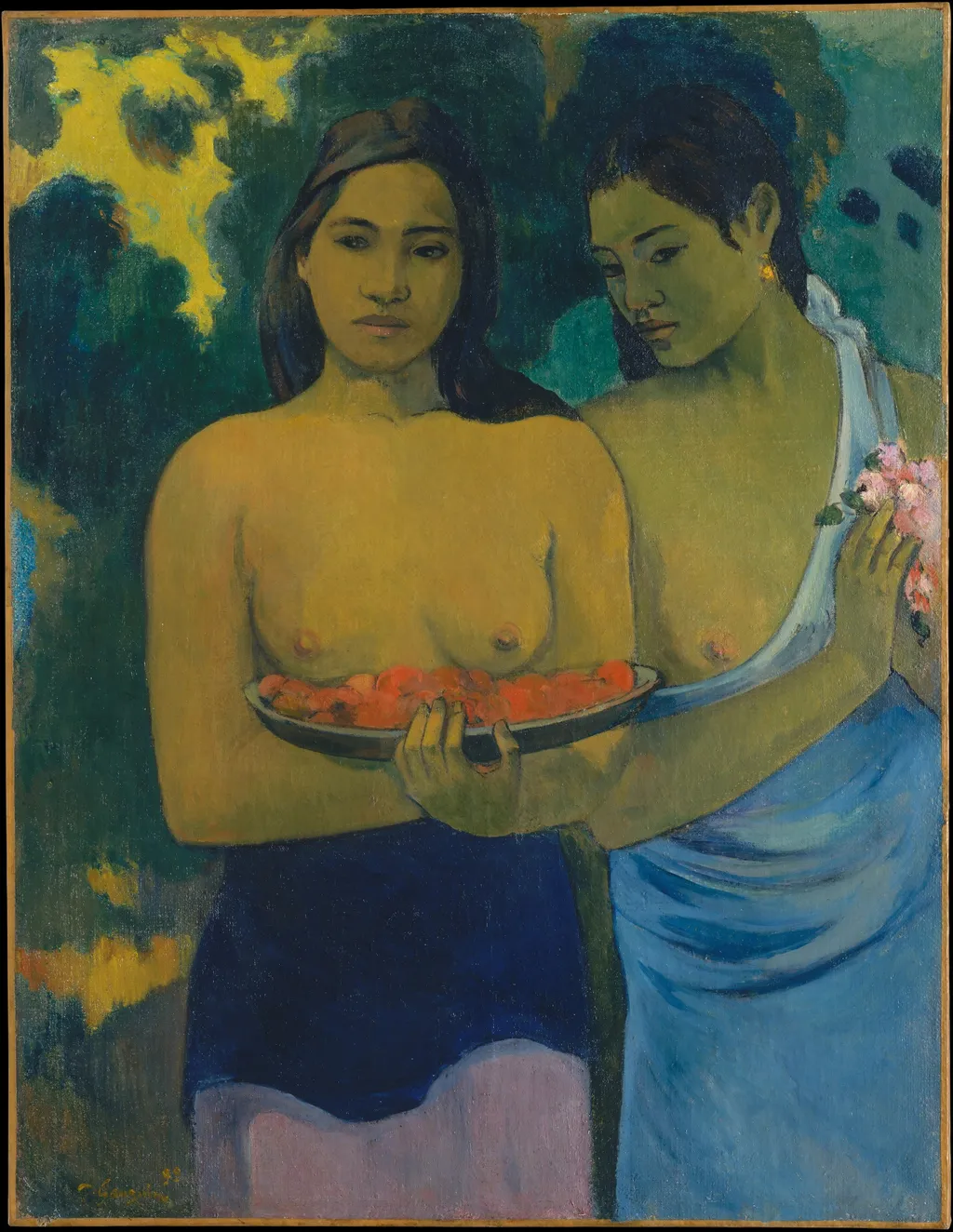
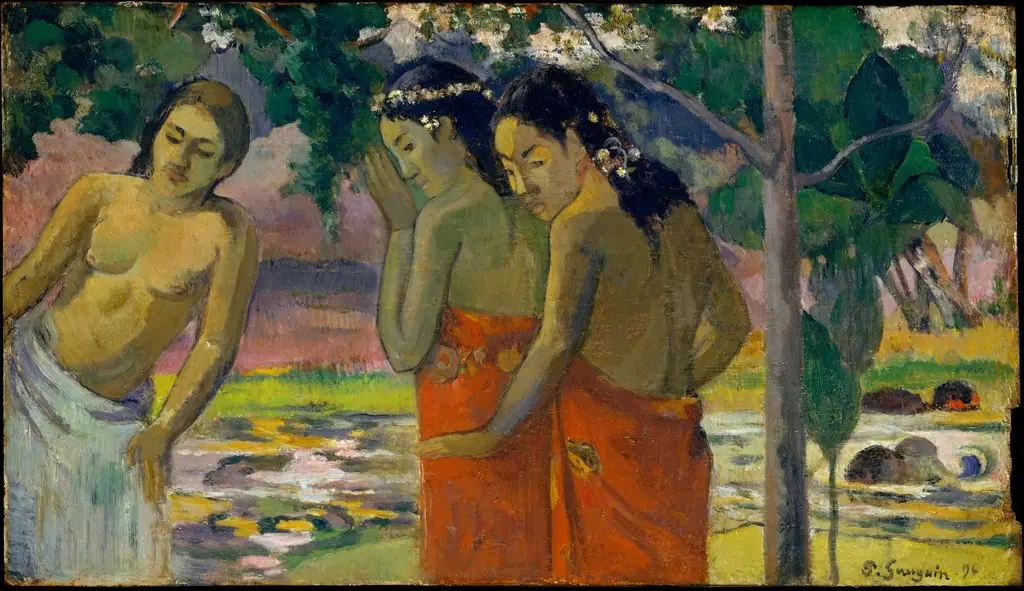
Two Tahitian Women is an oil painting by the Post-Impressionist artist Paul Gauguin. It dates from 1900 and is held in the collection of the Metropolitan Museum of Art.
About this work
Two women stand together in Tahiti, one holding mango blossoms that brighten the scene. Paul Gauguin painted it in oil around 1900, during his second, years-long stay on the island. A collector gave the work to the Met in 1949.
Subject & Meaning
The figures possess a sculptural dignity and mysterious sensuality, likely inspired by a photograph of the Borobudur temple frieze rather than live models.
Painted in 1899, this work depicts two topless Tahitian women standing confidently against an abstract background. One figure holds a tray of red flowers or unidentified fruit directly beneath her breasts, while the other clutches pink mango blossoms in a reverent, Eastern-style gesture. Although the setting suggests an innocent paradise, the subjects confront the viewer with a directness comparable to Manet's Olympia, adhering to an artistic tradition equating female breasts with fruit or flowers.
The figures possess a sculptural dignity and mysterious sensuality, likely inspired by a photograph of the Borobudur temple frieze rather than live models. These specific women also appear in Gauguin's earlier Faa Iheihe and contemporary Rupe, Rupe. The composition emphasizes vertical lines and soft curves to convey nobility, with the red fruit serving as the primary focal point for the painting's sensual charge.
Technique & Style
Executed in 1899, Two Tahitian Women is an oil painting on canvas measuring 94 by 72.4 centimeters. The composition features two standing, topless figures positioned prominently in the foreground against a completely abstract background devoid of decorative motifs, a choice that isolates and emphasizes the subjects. Gauguin constructed the forms using a cadence of vertical lines and soft curves to evoke a sculptural dignity and classical nobility.
The artist likely created the work from memory rather than direct observation, drawing inspiration from preliminary drawings and a photograph of a frieze from the Borobudur temple in Java. The figures appear in other contemporary works by Gauguin, suggesting a recurring study of these specific models. The painting's surface was protected by plexiglass during a 2011 incident, preventing any damage to the oil layer.
History & Provenance
Paul Gauguin painted Two Tahitian Women in 1899 while residing in Tahiti, employing oil on canvas (94 × 72.4 cm). The work remained in his studio until William Church Osborn acquired it; Osborn later gifted the painting to the Metropolitan Museum of Art, where it has been part of the permanent collection since 1949. Its creation coincided with Gauguin’s second Tahitian period, a time marked by financial stability after earlier hardships.
The painting, also known under several French and Italian titles, survived an attempted vandalism in 2011 thanks to protective plexiglass.
Painted in 1899, Two Tahitian Women is held in the permanent collection of the Metropolitan Museum of Art in New York City. The work was donated to the museum in 1949 by William Church Osborn. While the painting generally resides in New York, it was temporarily loaned to the National Gallery of Art in Washington, D.C., for an exhibition.
During this loan on April 1, 2011, the artwork was the target of an attack; however, protective plexiglass prevented any physical damage to the canvas. The piece is cataloged under the Wildenstein reference number 583. Its dimensions are recorded as 94 centimeters in height and 72.4 centimeters in width.
Legacy
Two Tahitian Women has retained a notable presence in art discourse since its acquisition by the Metropolitan Museum of Art in 1949. Scholars frequently liken its confrontational poses and floral symbolism to Manet’s Le déjeuner sur l’herbe and Olympia, noting a lasting tradition of equating female breasts with blossoms or fruit. The painting’s figures recur in other Gauguin works such as Faa Iheihe and Rupe, Rupe, underscoring its role in his thematic repertoire.
Its 2011 vandalism attempt at the National Gallery of Art, thwarted by plexiglass protection, attracted media attention and highlighted the work’s enduring notoriety. Contemporary commentary, including a 2011 Korea Times article describing Gauguin’s continued capacity to inspire, illustrates how the painting remains a point of reference for discussions of primitivism, eroticism, and artistic legacy.
Overview
Paul Gauguin's 1899 oil painting, "Two Tahitian Women," depicts two figures on the Pacific island of Tahiti. One woman holds mango blossoms, introducing a vibrant detail to the composition. This work reflects Gauguin's artistic engagement with Tahitian life during his time there, and it is now part of the permanent collection at the Metropolitan Museum of Art in New York City.
Context
This painting was created during Paul Gauguin's second extended period living in Tahiti, a French Polynesian island where he resided for several years. His immersion in the local culture profoundly shaped his artistic vision, inspiring numerous works that sought to portray the island's perceived exoticism and a simpler way of life, distinct from European modernity.
Own this work as a print
Artist & collection
Artist
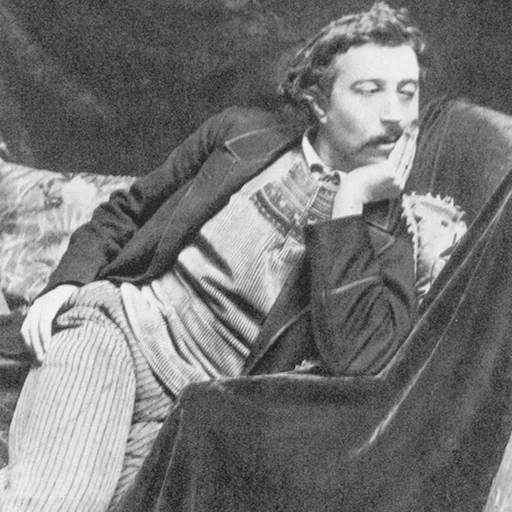
Eugène Henri Paul Gauguin (; French:; 7 June 1848 – 8 May 1903) was a French painter, sculptor, printmaker, ceramist, and writer, whose work has been primarily associated with the Post-Impressionist and Symbolist movements.