Artwork
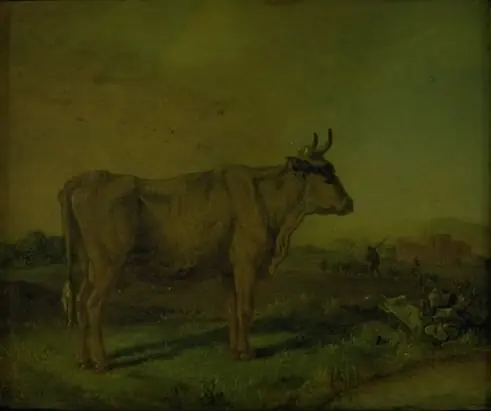
A Red Ox Standing
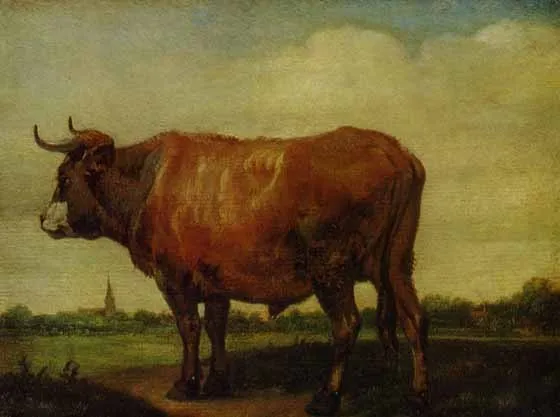
A Red Ox Standing is an oil painting by the Dutch Golden Age artist Paulus Potter. It dates from 1650 and is held in the collection of the Hermitage Museum.
About this work
Overview
The work is held in the collection of the Hermitage Museum in Saint Petersburg, where it is catalogued as a landscape painting.
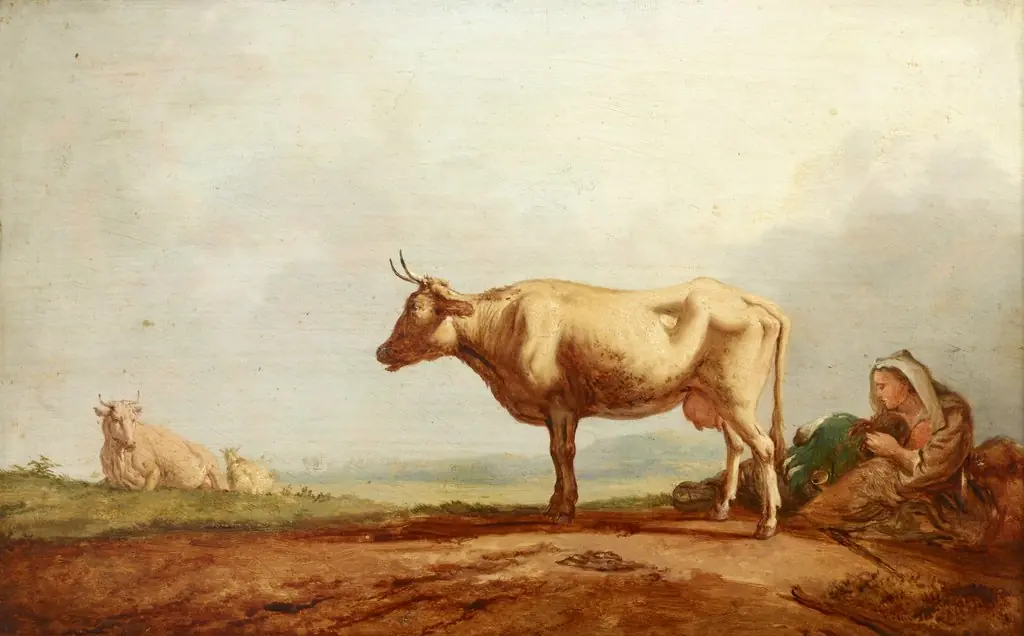
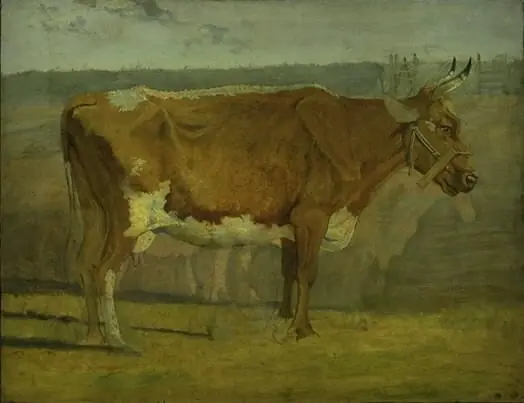
A Red Ox Standing is an oil painting on panel by the Dutch artist Paulus Potter, dated 1650. Measuring 21.8 by 28.4 cm, the small landscape depicts a single reddish-brown ox in profile against an expansive Dutch countryside. The work is held in the collection of the Hermitage Museum in Saint Petersburg, where it is catalogued as a landscape painting. Created during the final years of Potter's brief life, the painting exemplifies his reputation as one of the most accomplished animal painters of the Dutch Golden Age, a genre in which he achieved remarkable naturalism despite dying at age 28.
Subject & Meaning
The painting presents a solitary red ox standing in profile facing left, its substantial form occupying the central foreground. The animal is rendered with careful attention to anatomical accuracy: short curved horns, a distinctive white patch on its muzzle, and visible musculature beneath the coat. Its dark legs terminate in black hooves resting on a dirt path or mound. No human figures or other animals share the composition, an unusual isolation that elevates the ox to singular prominence. Behind the animal stretches a flat green landscape with low vegetation, while in the distant left background a church spire rises above the horizon line. The sky dominates the upper half of the canvas with soft pale clouds against muted blue. This composition, centering a working animal as the sole subject against atmospheric depth, carries the understated dignity characteristic of Potter's animal pieces. The church spire introduces a subtle note of human presence and perhaps spiritual resonance within an otherwise naturalistic scene, though the painting avoids explicit allegory.
Technique & Style
Potter executed the work in oil on panel, a support typical of Dutch cabinet pictures of this period. The paint surface exhibits fine craquelure throughout, consistent with its age. His brushwork appears smooth and blended, with subtle modeling of light across the ox's flank and darker shadows beneath its body to create three-dimensional volume. The overall palette consists of earthy browns, muted greens, and warm yellowish tones in the sky. The handling demonstrates the low vantage point and careful observation from life that distinguished Potter's animal painting. The smooth finish and precise rendering of textures, from the animal's coat to the atmospheric recession of the landscape, reflect the technical refinement that earned him recognition as the preeminent animal painter of his generation.
History & Provenance
The painting was created in 1650, during Potter's mature period in The Hague, where he had moved by 1649 and where he married Adriana van Balckeneynde in July 1650. The work was later owned by Heinrich von Brühl, the powerful Saxon statesman and art collector whose extensive holdings included numerous Dutch masters. Following the dissolution of von Brühl's collection, the painting entered the Hermitage Museum in Saint Petersburg, where it remains today. The Hermitage's collection of Dutch and Flemish paintings, which includes this work, has been featured in major exhibition catalogues from institutions including The Metropolitan Museum of Art.
Context
Paulus Potter was baptized on 20 November 1625 in Enkhuizen and trained with his father Pieter Symonsz Potter in Amsterdam. After joining the Guild of Saint Luke in Delft, he established himself in The Hague by 1649, where he gained access to the Dutch elite through his father-in-law, a leading building contractor. His specialization in animal painting, particularly cattle and horses in landscape settings, represented a significant development in Dutch genre painting. While he began as a history painter, Potter's naturalistic animal pieces brought him widespread acclaim during his lifetime, including patronage from Amalia of Solms-Braunfels of the stadholder's family. The Mauritshuis, which holds his most famous work The Young Bull, has celebrated him as a master of animal painting whose influence extended to the nineteenth century, when his work was admired as an early example of Romantic naturalism. Critical literature on Potter dates back to Arnold Houbraken's 1753 Groote Schouburgh and includes extensive catalogue raisonné work by Smith, Hofstede de Groot, and the 1994 Mauritshuis exhibition catalogue by Walsh, Buijsen, and Broos.
Legacy
Potter's reputation rests on approximately one hundred paintings produced before his death from tuberculosis in January 1654, just two months after his twenty-eighth birthday. His most celebrated work, The Young Bull (circa 1647) at the Mauritshuis, became an icon of Dutch art history and was later interpreted as an early expression of Romanticism. A Red Ox Standing, though smaller and less famous, participates in the same artistic achievement: the elevation of livestock to worthy artistic subjects through scrupulous observation and sympathetic presentation. The painting's presence in the Hermitage, alongside other Dutch and Flemish masterpieces, ensures its continued visibility in one of the world's major collections. Potter's influence persisted in the tradition of animal painting and in the broader appreciation of Dutch landscape naturalism, while his works have been studied in major scholarly projects including the systematic catalogues of the National Gallery of Art and the comprehensive 1994 Mauritshuis exhibition.
Artist & collection
Artist
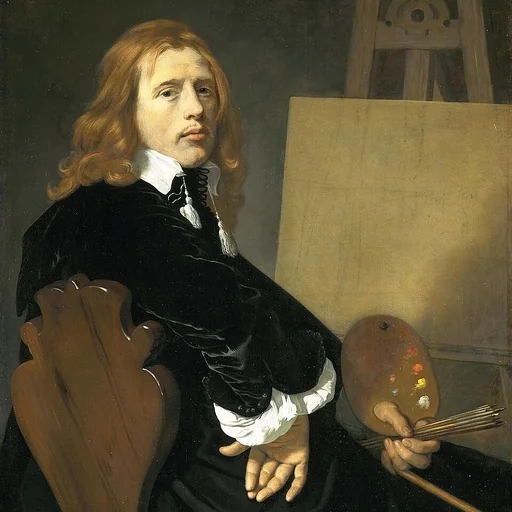
Paulus Potter (Dutch pronunciation:; 20 November 1625 (baptised) – 17 January 1654 (buried)) was a Dutch painter who specialized in landscapes featuring animals, often from a low vantage point.