Artwork
The Lover's Visit
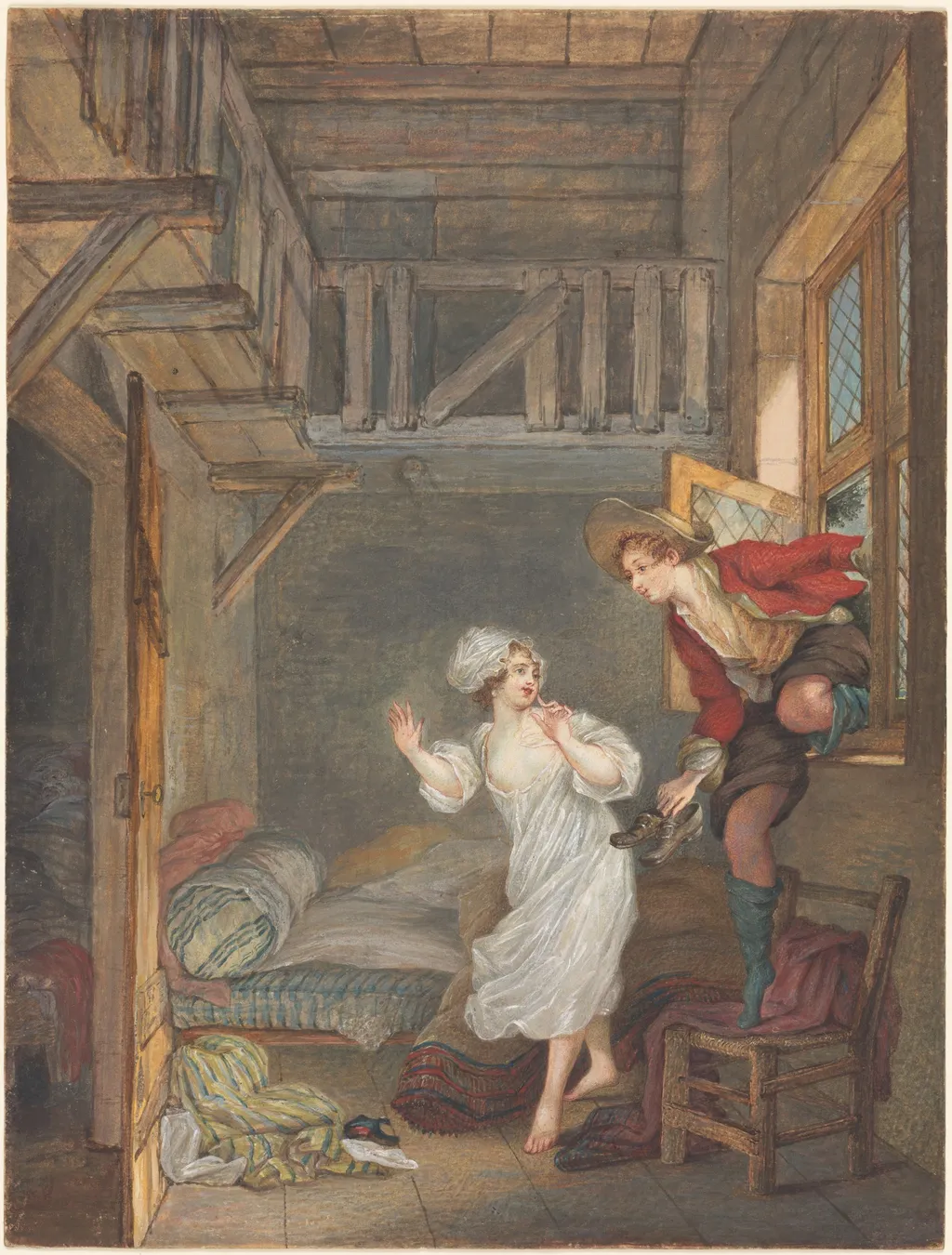
The Lover's Visit is a gouache painting by the Rococo painting artist Pierre-Antoine Baudouin. It dates from 1765 and is held in the collection of the Cleveland Museum of Art.
About this work
Subject & Meaning
The lover enters through a window, hat on his head and shoes in hand, while the woman stands in a chemise with her bare chest exposed, gesturing for silence.
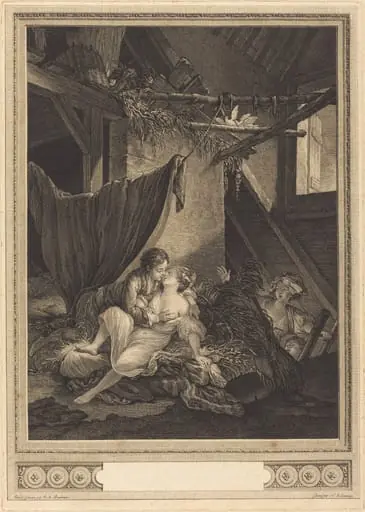
The Lover's Visit depicts a clandestine nocturnal rendezvous between a peasant lover and a young woman. The lover enters through a window, hat on his head and shoes in hand, while the woman stands in a chemise with her bare chest exposed, gesturing for silence. In the adjoining darkened chamber a third figure sleeps unaware, heightening the tension of discovery.
This scene belongs to Baudouin's Les amours champêtres series and echoes the popular song “Marchez tout doux, parlez tout bas,” whose lyrics warn of being overheard by a disapproving parent. The iconography, the furtive entry, the partially undressed figure, the sleeping witness, symbolizes the secrecy, erotic temptation, and moral peril of illicit love, presenting a genre scene that both celebrates pastoral desire and cautions against its social risks.
Technique & Style
Executed in 1765, The Lover's Visit is a gouache painting on paper measuring 31.8 by 21.6 centimeters. As part of the Rustic Loves series, the work exemplifies the libertine genre scene through its intimate scale and delicate handling of opaque watercolor. The composition depicts a young peasant woman standing in her shift with an exposed chest, silently gesturing to her lover who has entered through a window holding his hat and shoes.
A third figure sleeps in the shadowed adjacent room, emphasizing the narrative of secrecy. The artist employed soft modeling and muted tones to render the nocturnal atmosphere and the textures of the figures' simple clothing. This specific gouache served as the direct model for an engraving produced by Pierre-Philippe Choffard in 1782.
History & Provenance
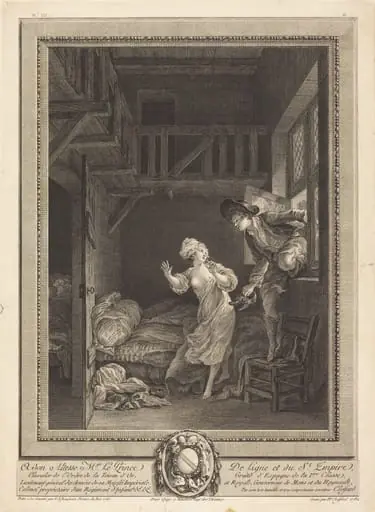
The Lover's Visit is a gouache by Pierre-Antoine Baudouin, produced around 1765 as part of the four-work series Les amours champêtres. The painting was first shown publicly at the Salon of 1767. In 1782, the engraver Pierre-Philippe Choffard produced a print after Baudouin's gouache, which subsequently circulated under the title Marchez tout doux, parlez tout bas.
The gouache entered the Cleveland Museum of Art in 1978 through a gift from the American businessman Noah L. Butkin, where it is held under accession number 1978.1027.
Context
The Lover's Visit (c. 1765) by Pierre-Antoine Baudouin belongs to a series of four gouache paintings, Les amours champêtres, exhibited at the Salon of 1767. The work's intimate, nocturnal scene of a peasant tryst aligns with the period's libertine genre tradition, emphasizing clandestine encounters and moral ambiguity. Baudouin's broader practice centered on small-scale gouache genre scenes, often depicting amorous or domestic narratives with a light, satirical touch.
The painting's later transformation into a print by Pierre-Philippe Choffard in 1782, titled Marchez tout doux, parlez tout bas, underscores its cultural resonance; the print's title references a popular song from Thémiseul de Saint-Hyacinthe's Le chef-d'œuvre d'un inconnu (1714), linking the image to contemporary literary culture.
Legacy
The work's legacy is significantly defined by its reproduction as an engraving, which expanded its reach beyond the original gouache. In 1782, engraver Pierre-Philippe Choffard created a print based on Baudouin's 1765 composition, titled "Marchez tout doux, parlez tout bas" (Walk softly, speak softly). Contemporary reports noted that the subject echoed a popular song from Le chef-d'œuvre d'un inconnu, linking the visual narrative to established literary and musical themes of the era.
This printed version secured the image's presence in major public institutions; the engraving entered the Louvre in 1935 following a donation from the estate of Edmond de Rothschild and is also held by the National Gallery of Art. While the original gouache remained in the Cleveland Museum of Art after a 1978 donation, the engraving ensured the scene's enduring circulation and recognition in the history of French genre art.
Overview
This painting, titled The Lover's Visit, is rendered in gouache. It presents a private scene within a domestic interior, capturing an intimate moment between two individuals. The composition focuses on the interaction between a woman in a light-colored dress and a man, suggesting a narrative of personal connection within a lived-in space.
Own this work as a print
Artist & collection
Artist
Pierre-Antoine Baudouin (French pronunciation:; 17 October 1723 – 15 December 1769) was a French painter. He worked in the same Rococo style of his father-in-law, François Boucher.

 Marchez tout doux, parlez tout bas
 The Surprised Lovers
 L'Escalade, ou les Adieux du Matin
 The Peasant Dance
 La Rose mal defendue
 Le savetier
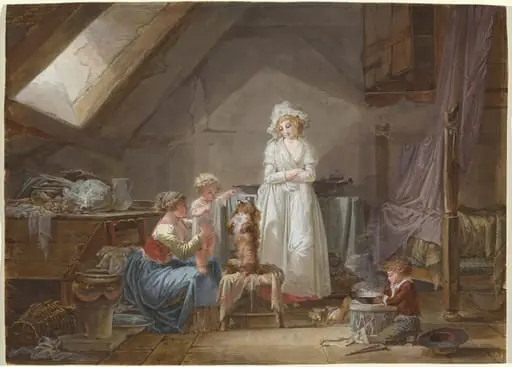 Young French Marquise in Exile in Lausanne
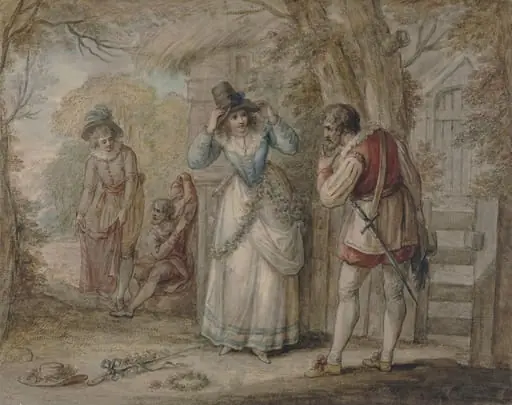 Florizel and Autolycus changing garments
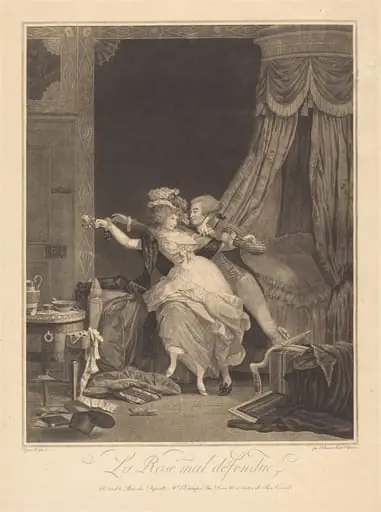 La Rose mal defendue (The Poorly Defended Rose)
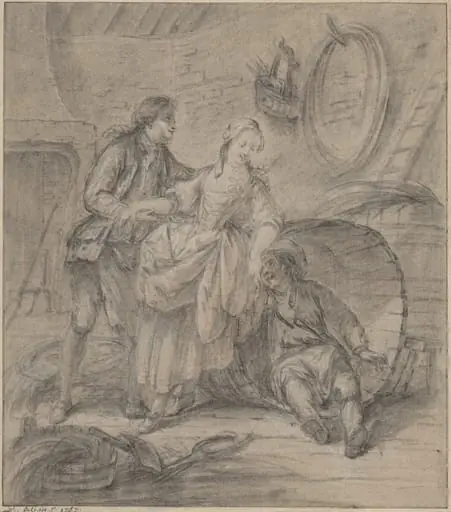 The Tale of the Cooper's Wife
 Les Soins tardifs
- The Lover's Visit