Artwork
The Vineyards at Cagnes
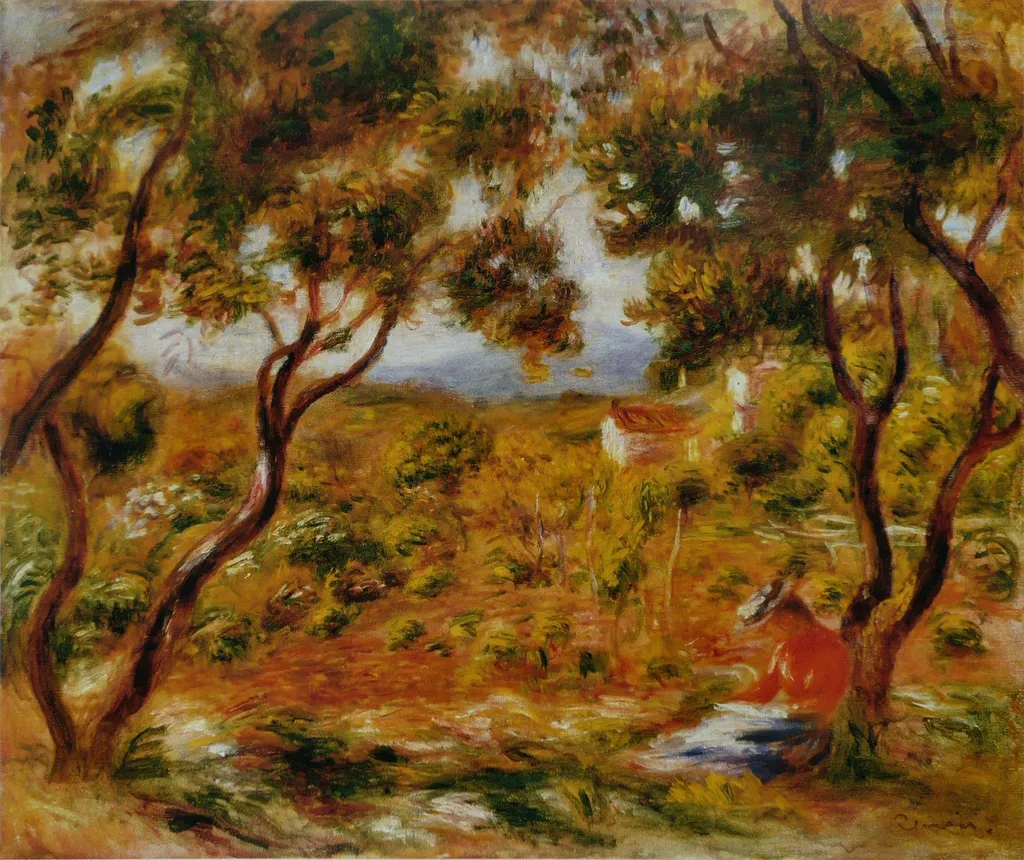
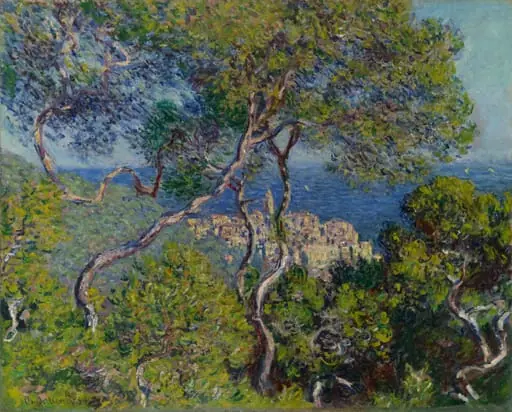
The Vineyards at Cagnes is an oil painting by the Impressionist artist Pierre-Auguste Renoir. It dates from 1908 and is held in the collection of the Brooklyn Museum.
About this work
Overview
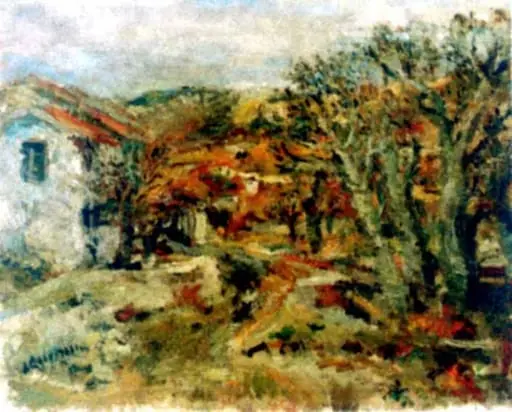
The Vineyards at Cagnes, painted by Pierre-Auguste Renoir in 1908, depicts a sun-drenched rural scene from the artist's later years in the south of France.
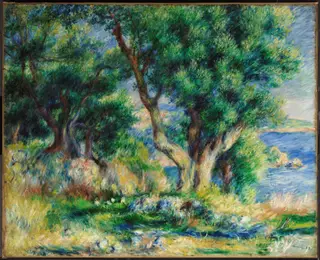
The Vineyards at Cagnes, painted by Pierre-Auguste Renoir in 1908, depicts a sun-drenched rural scene from the artist's later years in the south of France. Executed in oil on canvas, the work exemplifies Renoir's mature style, characterized by thick, textured brushstrokes and a vibrant, luminous palette. The composition centers on a dense cluster of grapevines and gnarled trees in the foreground, their twisted trunks and leafy canopies rendered in rich shades of emerald, ochre, and burnt sienna.
These organic forms create a rhythmic, almost sculptural presence that dominates the lower half of the picture plane. In the background, the landscape recedes into a hazy horizon where additional foliage and a faint architectural structure suggest the surrounding countryside of Cagnes-sur-Mer. Painted during a period when Renoir suffered from severe rheumatoid arthritis yet continued to produce prolifically, the work reflects his enduring fascination with light, nature, and the tactile quality of paint.
The Vineyards at Cagnes stands as a testament to the artist's ability to capture the warmth and vitality of the Mediterranean landscape, bridging his Impressionist roots with a more robust, decorative approach that defined his final decade.
Subject & Meaning
The work depicts the cultivated landscape surrounding the town of Cagnes-sur-Mer, focusing on the orderly rows of vines that characterize the region’s agricultural heritage. By emphasizing the gentle rise of trees and the modest building beyond, Renoir conveys a sense of peaceful labor and the harmonious relationship between human cultivation and the natural environment.
Technique & Style
Renoir employs thick, impasto brushstrokes that give the surface a tactile, almost sculptural quality. Layers of pigment are blended to create atmospheric depth, while the loose handling of foliage and foliage forms a soft, impressionistic impression of light filtering through the canopy. The overall effect balances texture with a muted, harmonious color scheme.
History & Provenance
Executed in the final decade of Renoir’s career, The Vineyards at Cagnes entered the collection of the Brooklyn Museum, where it remains on view. The painting reflects the artist’s later focus on landscape subjects after relocating to the French Riviera, marking a period of continued productivity despite his advancing age.
Own this work as a print
Artist & collection

Artist
Pierre-Auguste Renoir was a French artist who was a leading painter in the development of the Impressionist style.