Artwork
Winter Landscape with a Bird Trap
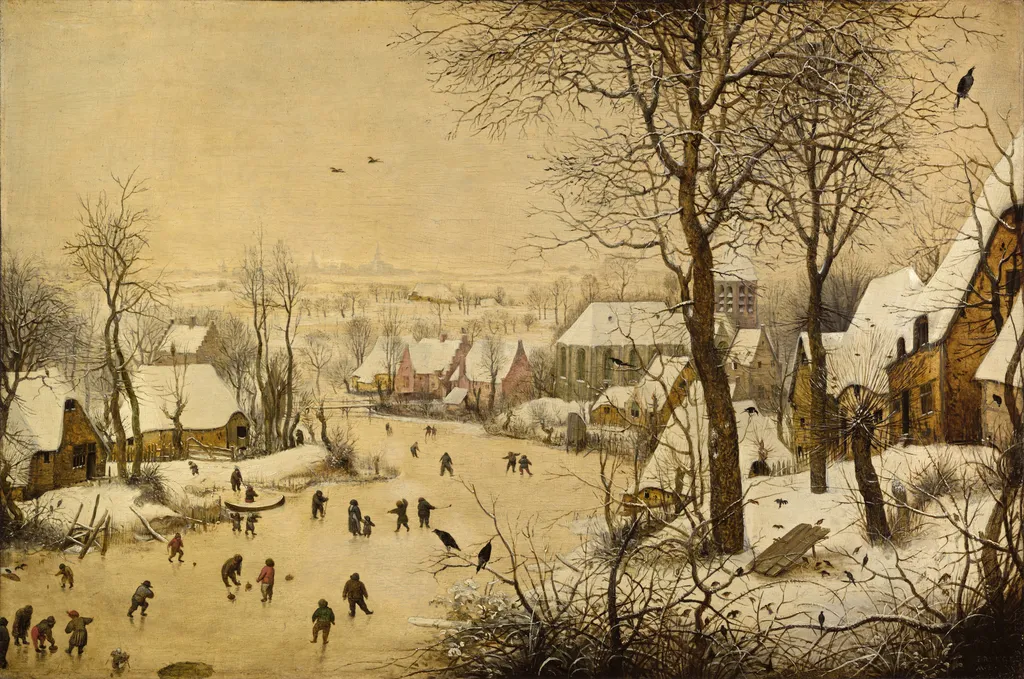
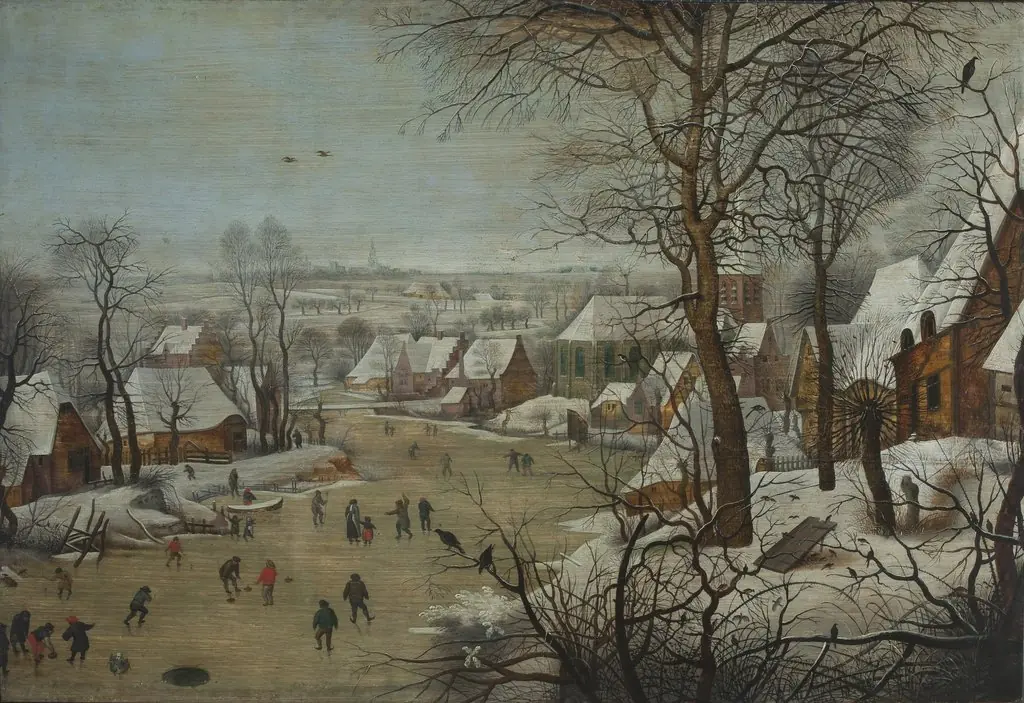
Winter Landscape with a Bird Trap is an oil painting by the Northern Renaissance artist Pieter Brueghel I. It dates from 1565 and is held in the collection of the Royal Museums of Fine Arts of Belgium.
About this work
Technique & Style
The surface shows inconsistent colour in some areas, suggesting later intervention.
The panel measures 75 × 90 cm and is executed in oil paint on oak wood. Bruegel begins with a sketch-like underdrawing that omits the bird-trap, then applies paint wet-in-wet, producing spontaneous brushwork and reddish accents that were later reworked. The surface shows inconsistent colour in some areas, suggesting later intervention.
The composition is built on a snowy background, with a village of red-tiled houses and a distant Antwerp skyline rendered in muted whites, beiges and blue-grey tones. Figures on the frozen river are rendered in dark tones with occasional red, contrasting the pale landscape, while the bird-trap and surrounding birds are added at the final stage.
History & Provenance
Winter Landscape with a Bird Trap was painted by Pieter Bruegel the Elder in 1565, as documented by the date inscription "BRVEGEL / M.D.LXV". The oil painting on oak panel measures 75 × 90 cm. Its early history is obscure; the work remained in an unnamed private collection in Brussels until it was rediscovered in 1925 and later bequeathed to the Oldmasters Museum in 1973 by Mrs. Delporte-Livrauw and Dr. Franz Delporte. The painting's creation began with a sketch-like underdrawing that omitted the bird trap, which was added in a later, wet-in-wet layer.
The composition belongs to a short series of five snowy landscapes produced in 1565, marking the emergence of the winter landscape genre.
Winter Landscape with a Bird Trap is housed in the Oldmasters Museum of the Royal Museums of Fine Arts of Belgium, where it is recorded under inventory number 8724. The work was unknown until its rediscovery in 1925 and entered the museum's collection by bequest from Dr. Franz Delporte and Mrs. Delporte-Livrauw in 1973. Its provenance prior to the 20th century remains obscure.
The painting was featured in the 2019 exhibition "Bruegel: The Master," commemorating the 450th anniversary of the artist's death, listed as work number 71 in the catalogue. No other exhibition records are documented in the sources.
Context
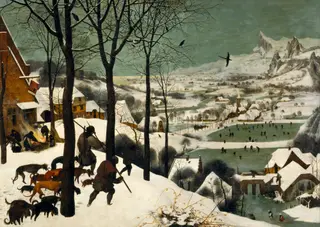
Winter Landscape with a Bird Trap occupies a foundational place in the Western tradition of winter landscape painting. Painted in 1565, it belongs to a brief sequence of five snowy landscapes by Pieter Bruegel the Elder that effectively established winter landscape as an independent genre, a tradition that flourished in the seventeenth century and shaped the careers of later specialists such as Hendrick Avercamp. The unusually severe winter of 1564/1565 is often cited as a likely catalyst for this cycle, which also includes The Hunters in the Snow of the same year.
The painting's moral dimension has long attracted scholarly attention. The juxtaposition of carefree skaters on fragile ice with birds lured toward a trap has been read as an allegory of human vulnerability to temptation, with the bird trap interpreted as a symbol of diabolical snares threatening the soul. Bruegel's restrained palette of ivory whites, ochres, and brownish blacks gives the scene a near-monochrome quality that anticipates Dutch seventeenth-century winter scenes.
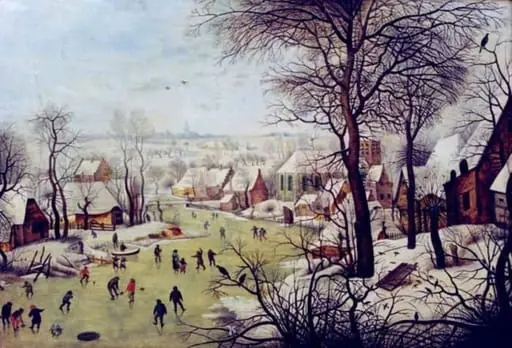
The work is also Bruegel's most frequently copied composition: art historian Klaus Ertz documented 127 early versions in his 2000 monograph on Pieter Brueghel the Younger, 45 of which he attributed to the younger son, with dated copies ranging from 1601 to 1626. Attribution of the Brussels panel itself was repeatedly questioned after its 1925 rediscovery and was only firmly re-established following a 2012 reinvestigation.
Legacy
Winter Landscape with a Bird Trap is recognized as a prototype for the winter landscape genre, establishing a tradition that flourished in the 17th century. Its composition directly influenced artists such as Hendrick Avercamp, who built his career painting similar icy scenes. The work holds the distinction of being Pieter Bruegel the Elder's most replicated painting; art historian Klaus Ertz documented 127 early copies, with 45 attributed to Pieter Brueghel the Younger.
These reproductions, often featuring subtle variations in details like the bird trap or ice games, ensured the motif's widespread popularity across Northern Europe. Although the original Brussels version faced attribution doubts after its 1925 rediscovery, its status as a seminal work of the Brueghel dynasty is now firmly established.
Overview
Pieter Bruegel the Elder painted Winter Landscape with a Bird Trap in 1565. Executed in oil on panel, the work is now housed in the Oldmasters Museum in Brussels. The composition captures a frozen river where villagers skate, while a bird trap draws birds among trees on the right. Bruegel’s signature and the date appear in the lower right corner.
Subject & Meaning
The scene juxtaposes human leisure with a subtle reminder of nature’s cycles. Skaters glide across the ice, suggesting communal activity, while the bird trap, surrounded by attracted birds, hints at the precariousness of survival during harsh winter months.
Own this work as a print
Artist & collection

Artist
Pieter Bruegel (also Brueghel or Breughel) the Elder ( BROY-gəl, US also BROO-gəl; Dutch: ; c.

Museum
Royal Museums of Fine Arts of Belgium
Continue through works from the same source collection.