Artwork
Landscape with the Fall of Icarus
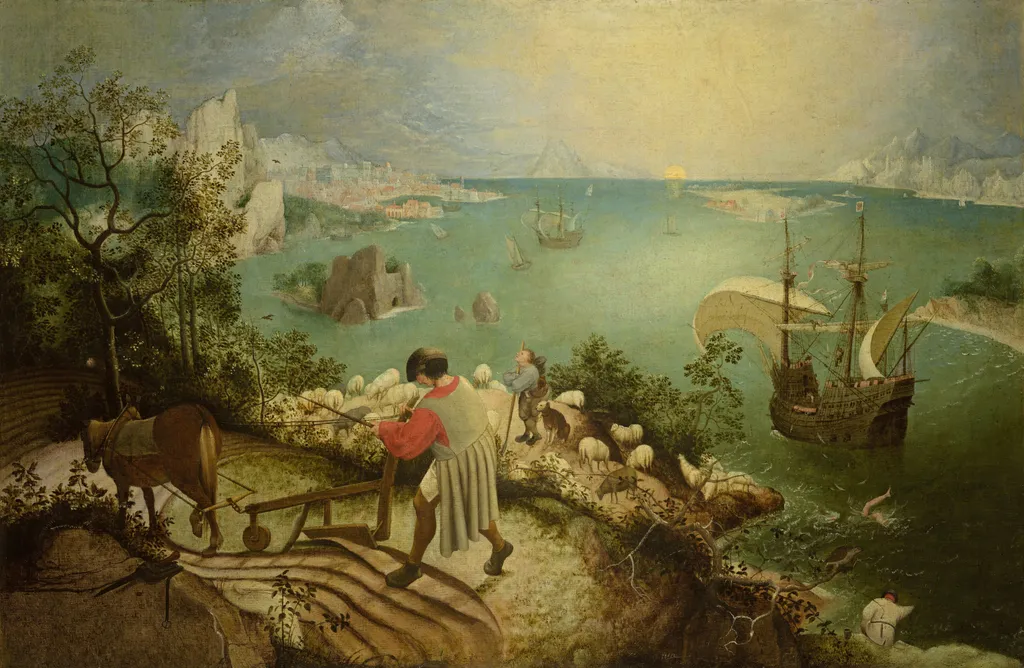
Landscape with the Fall of Icarus is an oil painting by the Northern Renaissance artist Pieter Brueghel I. It is held in the collection of the Royal Museums of Fine Arts of Belgium. The oil on canvas measures 73.
About this work
Subject & Meaning
This arrangement, often termed "Mannerist inversion," elevates lowly genre figures over the high classical subject to critique human indifference to suffering.
Derived from Ovid's Metamorphoses, the work depicts the mythological fall of Icarus, who drowned after flying too close to the sun. Uniquely for a mythological subject, the tragedy is minimized; Icarus appears merely as flailing legs splashing into the sea, while his father Daedalus is absent from the primary version. The composition prioritizes mundane agricultural labor, featuring a ploughman, shepherd, and angler who ignore the disaster.
This arrangement, often termed "Mannerist inversion," elevates lowly genre figures over the high classical subject to critique human indifference to suffering. Symbolic elements reinforce this moral: a partridge represents Perdix, who mocks the fallen Icarus, while foreground objects like a sword in a purse allude to Flemish proverbs regarding the futility of ambition. The setting is updated to the sixteenth century with contemporary ships, grounding the ancient warning in the viewer's reality.
Technique & Style
The painting is executed in oil on canvas, measuring 73.5 by 112 centimetres, and is held by the Oldmasters Museum in Brussels. It is the only known canvas painting associated with Pieter Bruegel the Elder, whose other oils were executed on panel. Technical analysis, including a 1973 paint sample re-examined by SEM-EDX and optical microscopy, revealed a stratigraphy consistent with a panel painting transferred to canvas: from bottom to top, the transfer canvas, an oily lead-white adhesive, a thick azurite overpaint, a chalk ground, oily lead white with charcoal traces, and an original azurite-based blue.
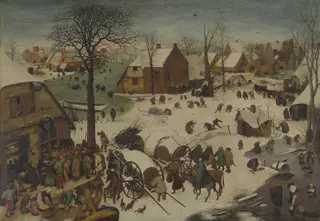
The original blue layer's composition (lead white, azurite, rare ochre and black grains, plus unusually long acicular charcoal particles) matches other authenticated Bruegel panels, including The Census of Bethlehem in the same museum.
Infrared reflectography shows an underdrawing comparable to Bruegel's authenticated works, limited to a basic placement beneath thin, semi-transparent paint on a white ground. The work has suffered considerable damage: the original canvas is torn in places with lacunae, has been reinforced twice with backing canvases, and the paint layer is heavily abraded, exposing canvas in some areas and bearing heavy overpaint elsewhere (notably the sun's reflection). A thick layer of yellowed varnish distorts the tonality, and the sea, now green, was originally bluer.
The composition is built along diagonals, with a high vantage point and shifting angles on the ploughman, shepherd and ship that heighten the sense of distance; yellow, green and brown tones dominate, punctuated by the ploughman's red shirt.
History & Provenance
The original composition is attributed to Pieter Bruegel the Elder and is believed to have been created around 1558 or in the mid-1560s, though the autograph work is now lost. Two surviving copies are known, both held in Brussels. The canvas version in the Royal Museums of Fine Arts of Belgium (Oldmasters Museum) was unknown until the museum acquired it in 1912, at which time its attribution to Bruegel was already contested.
A second version on panel, acquired in 1953 by Daniel van Buuren for his private house (now the Museum Van Buuren), is generally considered inferior; dendrochronology dates its oak panel to after 1577.
In 1963, curator Philippe Roberts-Jones and Bruegel specialist Georges Marlier proposed that the Brussels canvas had originally been painted on panel and later transferred to canvas. A 1998 radiocarbon dating of the canvas appeared to exclude Bruegel the Elder, though chemist Jacques Reisse argued in 2006 that this dating was invalid. Later technical analysis of a paint sample taken in 1973 confirmed a chalk ground beneath the original blue layer, supporting the panel-to-canvas transfer theory. The canvas has undergone two relinings and suffered tears and heavy overpainting.
The primary version of Landscape with the Fall of Icarus is held by the Royal Museums of Fine Arts of Belgium in Brussels, specifically within the Oldmasters Museum. The work entered this collection in 1912, though its attribution has been debated since its acquisition. A second version, painted on an oak panel, is held at the Museum van Buuren, also in Brussels; dendrochronological analysis dates the panel to after 1577.
While the Royal Museums' version is often cited as the most prominent, technical examinations have complicated its history, including debates over whether it was originally painted on a panel and later transferred to canvas. Both Brussels institutions display these copies, which are considered early reproductions of a lost original by Pieter Brueghel the Elder, rather than the master's own hand.
Context
Landscape with the Fall of Icarus occupies a unique position in Pieter Bruegel the Elder's oeuvre as his only known subject drawn from classical mythology, specifically Ovid's Metamorphoses. While the composition is attributed to Bruegel, the surviving canvas version in Brussels is widely considered a copy from the 1560s, possibly of a lost original dated around 1558. The work is frequently cited in art history for its subversion of genre hierarchies, employing a "Mannerist inversion" where large, mundane figures in the foreground overshadow the mythological event in the background.
This arrangement highlights human indifference to suffering, a theme famously explored in W. H. Auden's poem "Musée des Beaux-Arts." Technical analyses have further complicated its history, with debates centering on whether the canvas was originally a panel painting transferred later, a hypothesis supported by underdrawing similarities to authenticated works.
Legacy
The painting's legacy is defined largely by its interpretation in modern literature, most notably W. H. Auden's 1938 poem "Musée des Beaux-Arts," which uses the work to illustrate human indifference to suffering. This theme was further explored by William Carlos Williams in a poem of the same name and by Michael Hamburger in "Lines on Bruegel's 'Icarus'." Art historically, the work is significant for its subversion of genre hierarchies, placing a mythological catastrophe in the background while foregrounding mundane agricultural labor.
This composition, potentially inspired by Northern Mannerist "inversions," contrasts the tragic fall of Icarus with the oblivious continuity of the ploughman, shepherd, and angler. The painting remains a central case study in discussions regarding the moralization of landscape and the depiction of the ordinary amidst the extraordinary.
Overview
The oil on canvas measures 73.5 by 112 centimetres and is displayed in the Oldmasters Museum, Brussels. Long attributed to Pieter Bruegel the Elder, the work is now regarded as an early copy of a lost Bruegel composition, likely executed in the 1560s by an unidentified hand.
Own this work as a print
Artist & collection

Artist
Pieter Bruegel (also Brueghel or Breughel) the Elder ( BROY-gəl, US also BROO-gəl; Dutch: ; c.

Museum
Royal Museums of Fine Arts of Belgium
Continue through works from the same source collection.
- The Return of the Herd
 Landscape with St Jerome
 The last appearance of Christ to his disciples
 Parable of the prodigal son (November)
 The Temptation of Saint Anthony
 Landscape with the Penitent Saint Jerome
 Antropomorf landschap - vrouwenportret
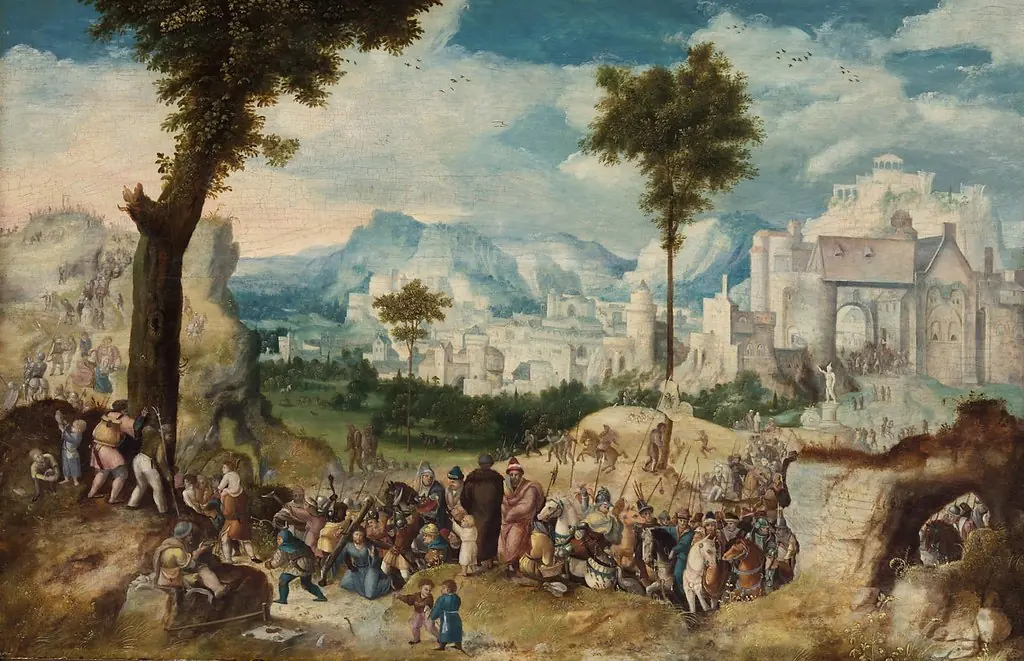 Kreuztragung Christi
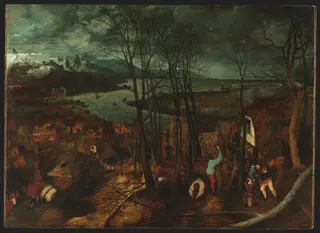 The Gloomy Day
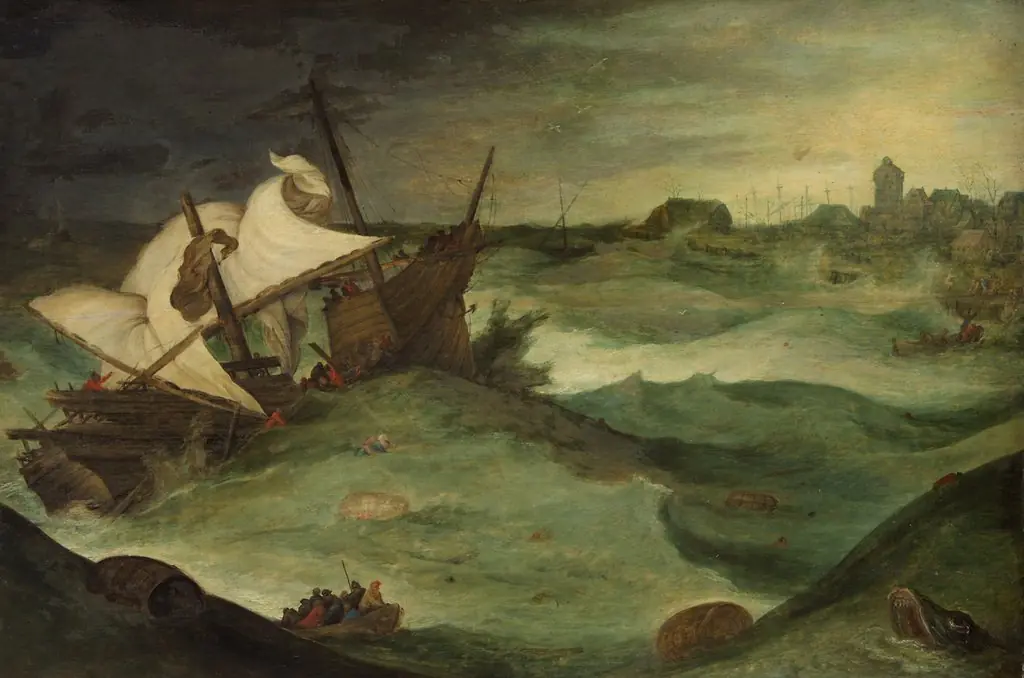 Storm at sea
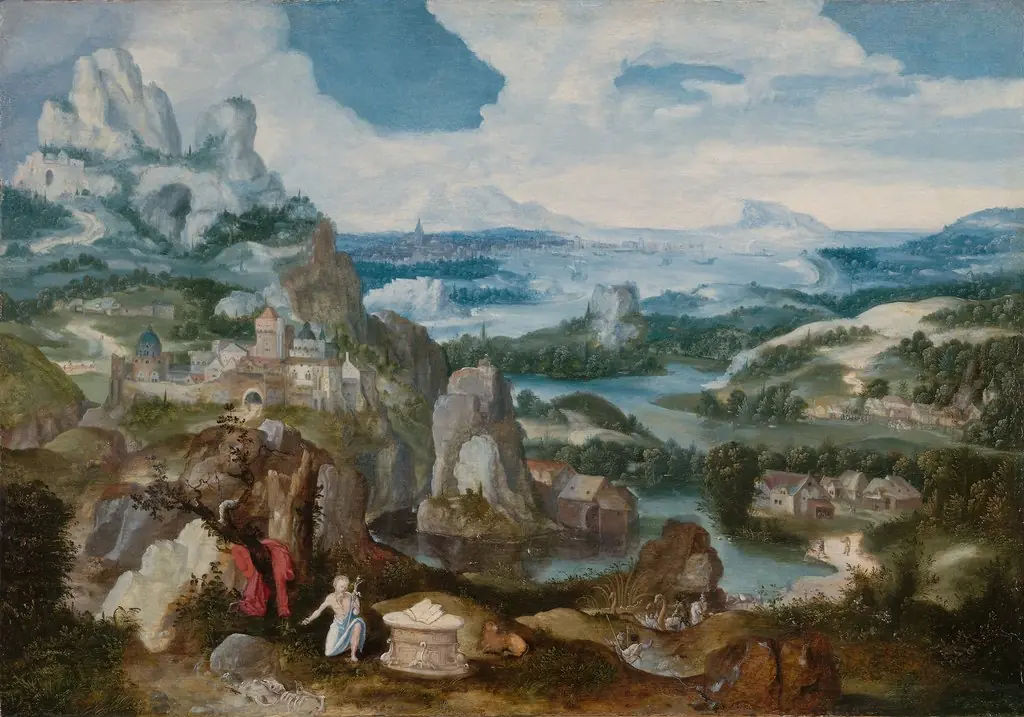 Landscape with the Penitent Saint Jerome
 Landscape with the Flight into Egypt