Artwork
Landscape with Saint John on Patmos
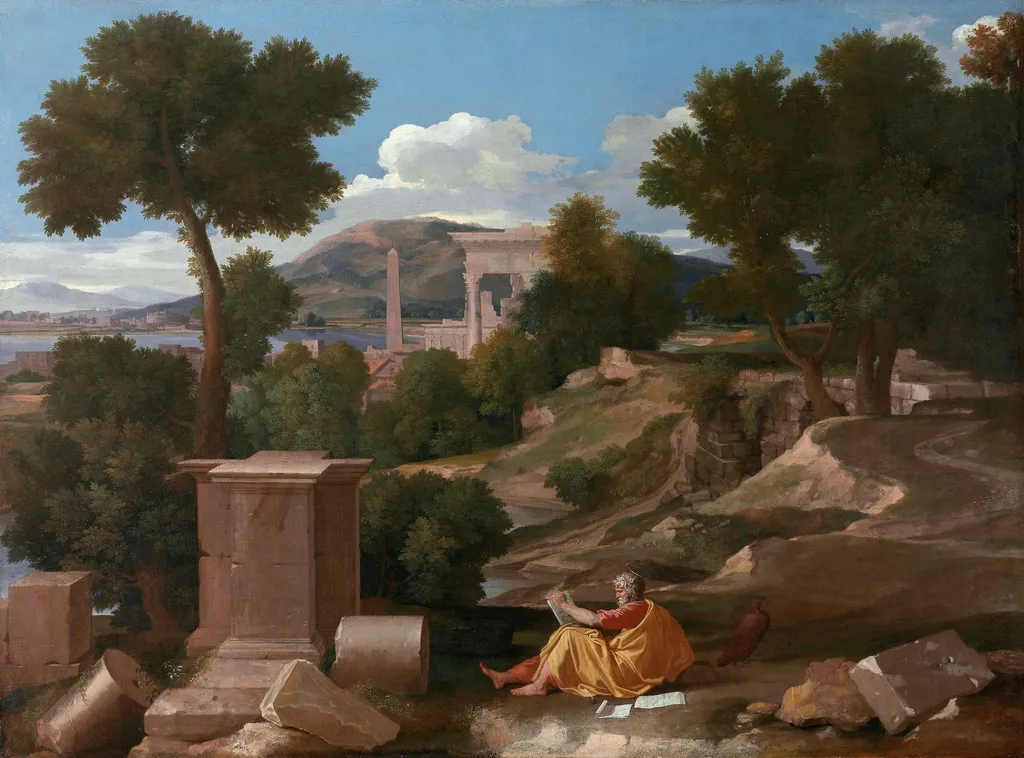
Landscape with Saint John on Patmos is an oil painting by the Early Baroque Italian artist Nicolas Poussin. It dates from 1640 and is held in the collection of the Art Institute of Chicago.
About this work
Subject & Meaning
The painting depicts Saint John the Evangelist on the island of Patmos, where he was exiled by the Roman Emperor Domitian for his Christian beliefs.
The painting depicts Saint John the Evangelist on the island of Patmos, where he was exiled by the Roman Emperor Domitian for his Christian beliefs. The saint is shown recording his visions from the Book of Revelation, seated near an eagle, which serves as his traditional attribute. Posed with the dignity of an Ancient Greek deity, John occupies the foreground of a classical landscape dominated by ruined Greek structures and an ancient temple. These decaying buildings, alongside an obelisk and two oak trees, symbolize the transition from the old pagan world to the new era of Christianity. Poussin constructs an imaginary setting that defies strict atmospheric perspective to emphasize this theological replacement, presenting Patmos as an open environment where a new world emerges from the ruins of the old.
Technique & Style
The work is an oil painting executed on canvas, measuring 100.3 cm by 136.4 cm. Poussin employed oil pigments on a stretched linen support, applying the paint with a smooth, controlled brushstroke that emphasizes the clarity of form and the precise arrangement of elements characteristic of his classical manner. The composition features Saint John seated in a landscape that dominates the picture plane, surrounded by classical ruins, an obelisk, and two oak trees, all rendered with a crisp, almost architectural precision. The handling of light and the avoidance of atmospheric perspective reflect Poussin's pursuit of a timeless, idealized space, while the subject’s act of writing evokes the prophetic act of recording revelation.
History & Provenance
The painting was created in 1640 by Nicolas Poussin as an oil on canvas work for private devotional use, commissioned indirectly through Pope Urban VIII's secretary Gian Maria Rosicoli.
After its creation, the work entered the collection of François-Antoine Robit, later passing to Sir Simon Haughton Clarke, the 9th Baronet, and then to Andrew Geddes before being acquired by Max Rothschild.
The painting remained in the Rothschild family until its acquisition by the Art Institute of Chicago, where it has been part of the permanent collection since 1930.
The work was presented to Pope Urban VIII's secretary as part of a pair with Saint Matthew, linking its early provenance to ecclesiastical patronage.
The painting is held at the Art Institute of Chicago, where it is recorded as accession number 1930.116.
It was acquired by the museum in 1930.
The work has been exhibited at the Art Institute of Chicago and is documented as part of a pair originally presented to Gian Maria Rosicoli, secretary to Pope Urban VIII.
Context
Scholarship positions Landscape with Saint John on Patmos within Poussin’s mature classical phase, aligning it with the artist’s theoretical writings on the “grand manner,” where measure, arrangement, and form order nature and narrative into a rationalized ideal.
The painting’s pairing with Landscape with Saint Matthew reflects Poussin’s late practice of producing pendant religious landscapes that fuse antique ruins and imagined topography to convey spiritual renewal. Critics emphasize how the decaying Greek structures and luminous sky frame Saint John’s visionary act, codifying a typology of the classical religious landscape that influenced later neoclassical and Romantic artists.
Its 1930 acquisition by the Art Institute of Chicago anchored the work in American collections, where it has since functioned as a touchstone for debates on Poussin’s legacy and the European classical tradition in the United States.
Legacy
Landscape with Saint John on Patmos exerted influence through its role in shaping the classical landscape tradition and its symbolic integration of Christian narrative within natural settings. The painting’s composition, featuring Saint John writing the Book of Revelation amid classical ruins on Patmos, established a visual model for depicting apocalyptic themes within idealized environments. Its pairing with Saint Matthew, presented to Pope Urban VIII’s secretary, underscored its contemporary significance and ecclesiastical resonance. The work’s enduring presence in the Art Institute of Chicago’s collection since 1930 has ensured its continued study as a key example of Poussin’s synthesis of religious subject matter and classical form, influencing later interpretations of the Apocalypse in art.
Own this work as a print
Artist & collection
Artist
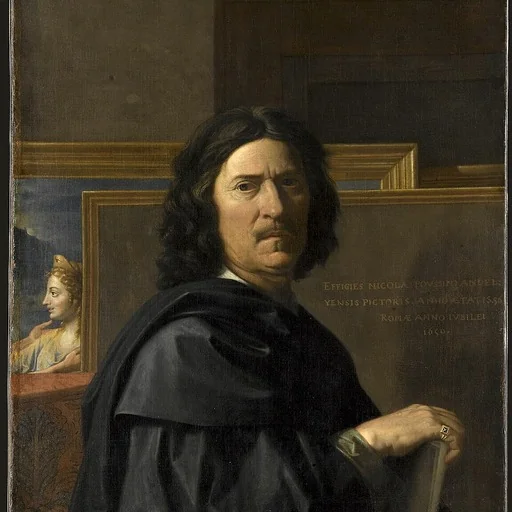
Nicolas Poussin (UK: US: French:; June 1594 – 19 November 1665) was a leading painter of the classical French Baroque style, although he spent most of his working life in Rome.