Artwork
Parnassus
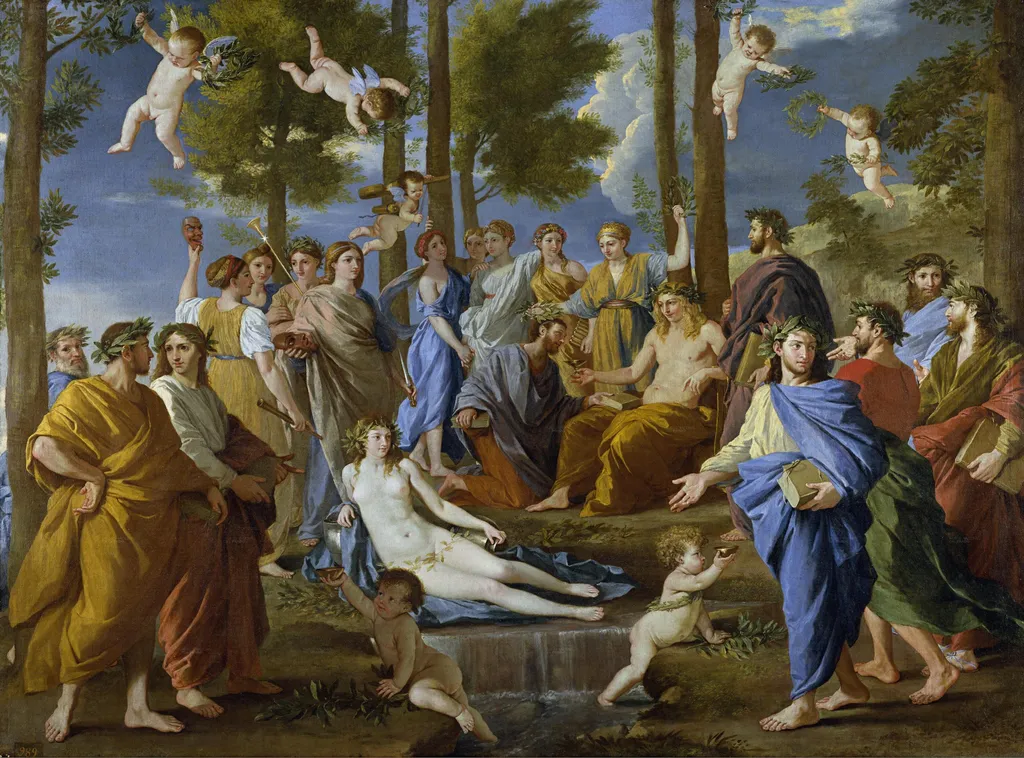
Parnassus is an oil painting by the Early Baroque Italian artist Nicolas Poussin. It dates from 1630 and is held in the collection of the Museo del Prado.
About this work
Subject & Meaning
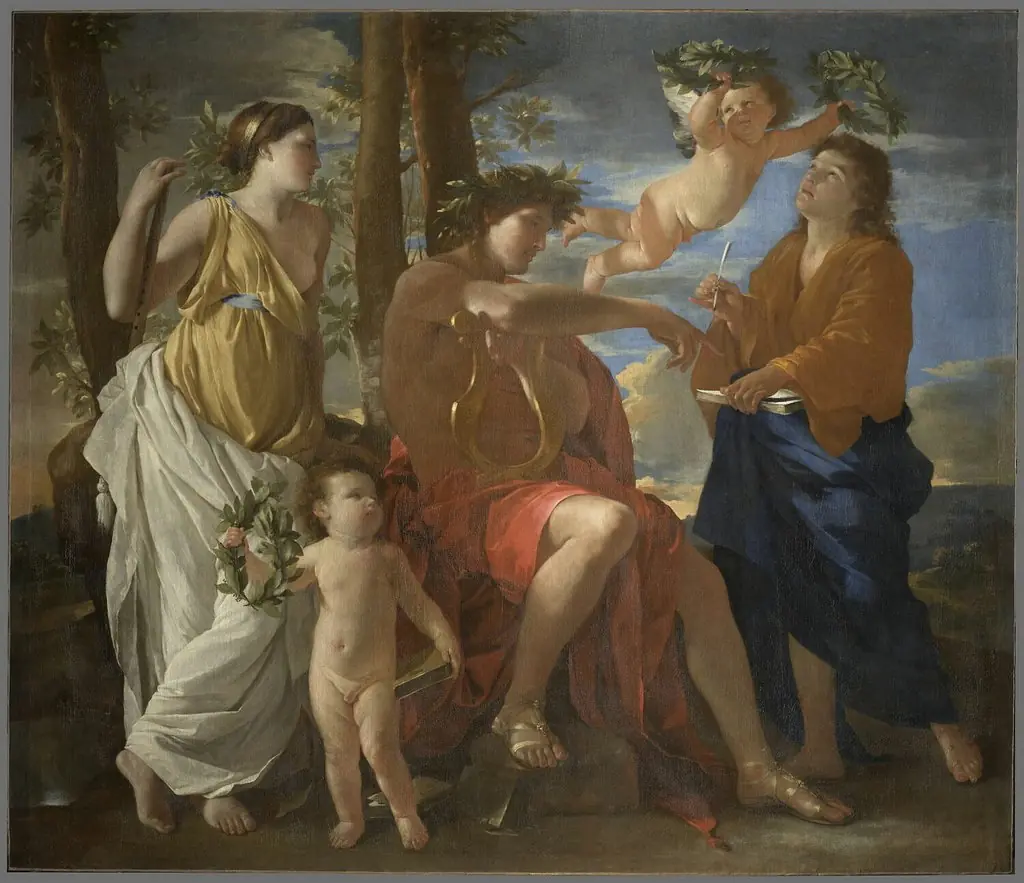
Nicolas Poussin's mythological painting depicts a scene on Mount Parnassus where the god Apollo is surrounded by the nine Muses and various poets.
Nicolas Poussin's mythological painting depicts a scene on Mount Parnassus where the god Apollo is surrounded by the nine Muses and various poets. Inspired by Raphael's fresco in the Stanza della Segnatura, the composition centers on a figure identified as Homer, who kneels before Apollo. In some interpretations, this central poet receives a laurel wreath from the Muse Calliope, symbolizing wisdom, while holding books; other accounts describe him receiving a cup of ambrosia. The Muses are rendered with specific attributes that allow for their individual recognition.
The foreground features the Castalian Spring, personified as a reclining nude nymph holding a vase, representing the source of poetic inspiration. Art historian Erwin Panofsky suggested the work also serves as a homage to Poussin's benefactor, the poet Giambattista Marino, potentially identifying the crowned figure with him rather than Homer.
Technique & Style
Executed in oil paint on canvas, this mythological composition measures 145 cm in height and 197 cm in width. The work depicts a classical scene on Mount Parnassus where Apollo sits enthroned among the nine Muses, who are identifiable by specific attributes they carry. In the foreground, the Castalian Spring is personified as a reclining nude nymph holding a vase, while the central figure, likely Homer, kneels to receive a laurel wreath from Calliope.
The formal arrangement reflects Poussin's engagement with Raphael's earlier fresco of the same subject in the Stanza della Segnatura. The painting's visual record was preserved through an etching by Jean Dughet, created prior to 1667, which required two copper plates to accommodate the artwork's unusually wide format.
History & Provenance
Nicolas Poussin created the oil-on-canvas painting *Parnassus* (also titled *Apollo and the Muses*) between 1630 and 1633, with specific dates cited as 1630, 1630-1631, or 1631-1633. The work was inspired by Raphael's fresco of the same subject in the Stanza della Segnatura and is believed to serve as a homage to Poussin's patron, the poet Giambattista Marino. The painting likely originated from the Meyers collection before entering the Spanish royal holdings. It is first documented in Spain within a 1746 inventory of the La Granja de San Ildefonso palace. Subsequent ownership passed through the Spanish royal line, including Philip V, Charles III, and Ferdinand VII, before the work arrived at the Museo del Prado in Madrid. Parnassus is held in the Museo del Prado in Madrid, where it is part of the museum's collection. According to provenance records, the painting is believed to have originated in the Meyers collection before entering Spanish royal ownership. It was first documented in Spain in a 1746 inventory of the La Granja de San Ildefonso palace. Subsequent Spanish royal owners included Philip V of Spain, Charles III of Spain, and Ferdinand VII of Spain, after whose reign it passed into the Prado's holdings. The work is also associated with the Royal Palace of Aranjuez as a location. No specific exhibition history beyond its long-term display at the Prado is documented in the available sources.
Context
Nicolas Poussin's *Parnassus* (c. 1630-1631) is recognized as a significant work of French Classicism that directly engages with the High Renaissance tradition. The painting is explicitly modeled after Raphael's famous fresco in the Stanza della Segnatura, demonstrating Poussin's dialogue with earlier masters. German art historian Erwin Panofsky interpreted the work as a dual homage to the mythological subject and to Poussin's Roman benefactor, the poet Giambattista Marino, who is likely the kneeling figure receiving a laurel crown. The composition, featuring Apollo, the nine Muses, and the Castalian spring, was widely disseminated through an etching by Jean Dughet, Poussin's brother-in-law, created prior to 1667. This reproduction utilized an unusual double-plate format due to the large dimensions of the original canvas.
Legacy
Nicolas Poussin's *Parnassus* is recognized as a deliberate homage to Raphael's famous fresco of the same theme in the Vatican's Stanza della Segnatura. The work also served as a tribute to Poussin's Roman patron, the poet Giambattista Marino, who is likely depicted as the central figure receiving a laurel crown. The painting's legacy was significantly extended through an etching reproduction by Jean Dughet, Poussin's brother-in-law. This print, created before 1667, is notable for its unusual large format, requiring the image to be engraved on two separate copper plates due to the scarcity of single sheets of that size.
Own this work as a print
Artist & collection
Artist
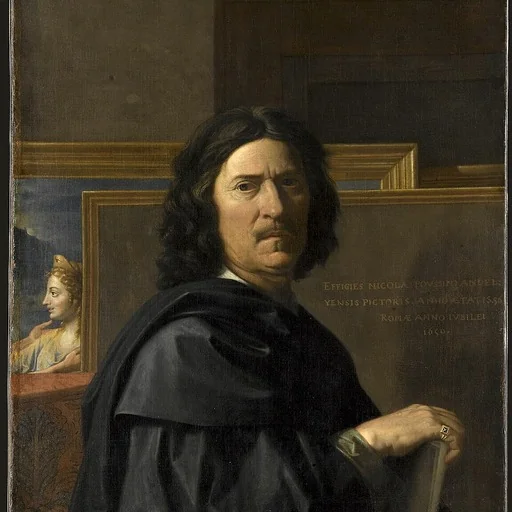
Nicolas Poussin (UK: US: French:; June 1594 – 19 November 1665) was a leading painter of the classical French Baroque style, although he spent most of his working life in Rome.