Artwork
The Inspiration of the Poet
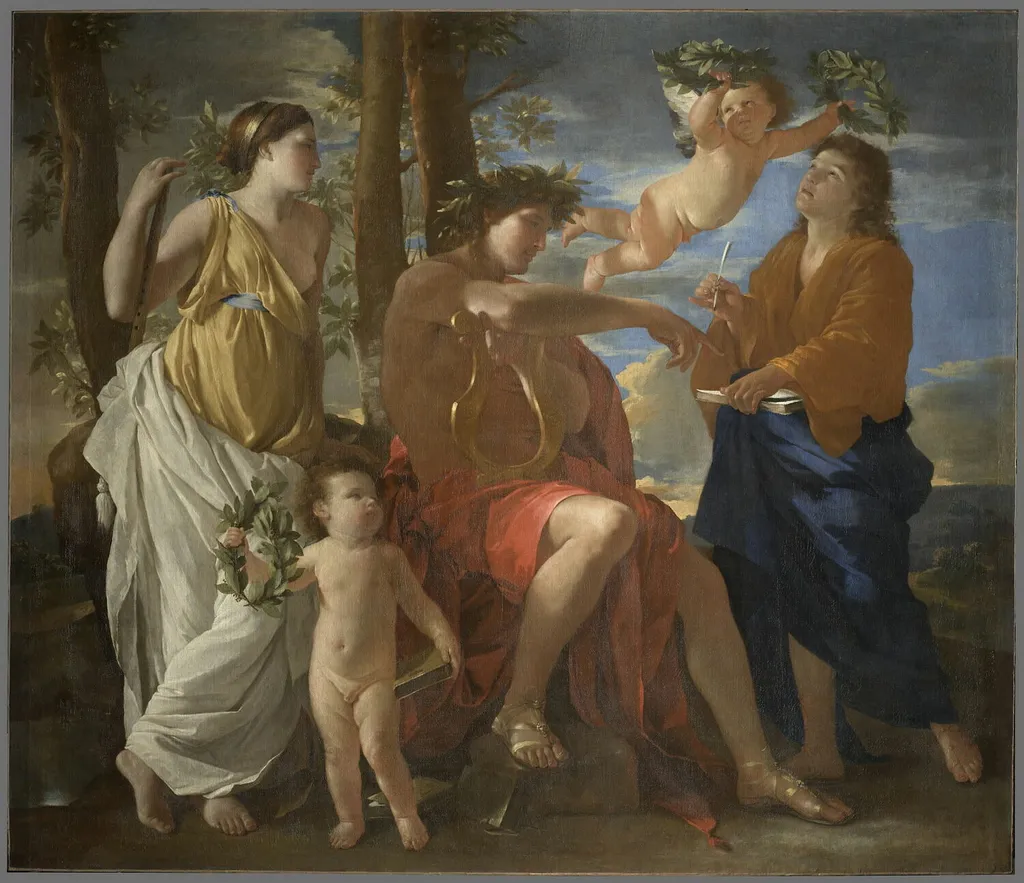
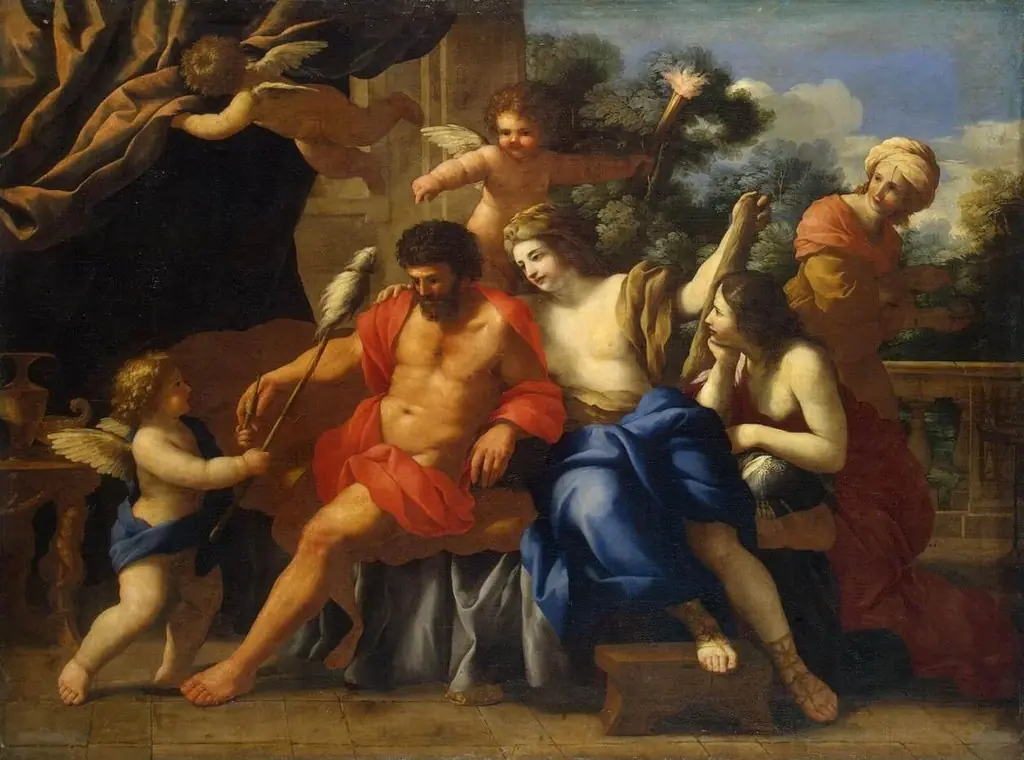
The Inspiration of the Poet is an oil painting by the Classicist painting artist Nicolas Poussin. It dates from 1629 and is held in the collection of the Department of Paintings of the Louvre.
About this work
The Inspiration of the Poet is a painting made with oil paint. It was created in 1629.
The painting is described as being in the classical style. It is said to be held at the Louvre, in Paris, but also mentioned to be at the Museum of Fine Arts of Lyon.
You can learn more about the artist who created this work by looking up the artist: Q41554.
Subject & Meaning
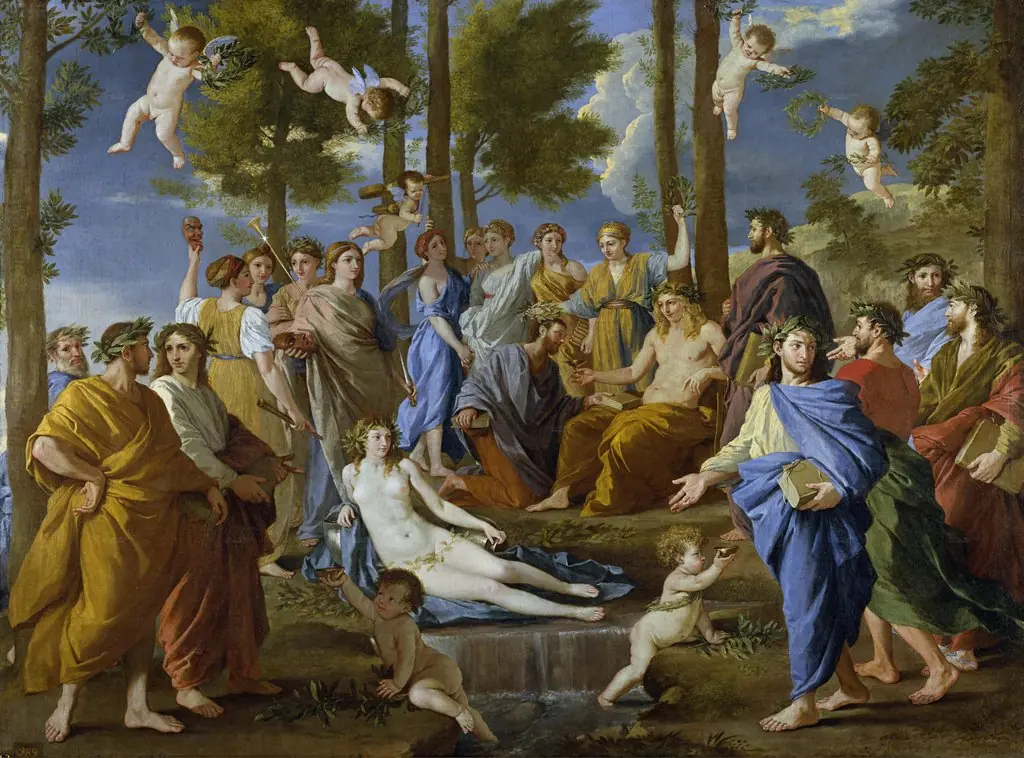
Apollo, seated at center, rests his lyre and points to the poet’s writings, indicating divine inspiration; a putto prepares to crown the poet’s head.
The painting represents a classical allegory set on Mount Parnassus, where the god Apollo crowns a poet with a laurel wreath while a muse assists. Apollo, seated at center, rests his lyre and points to the poet’s writings, indicating divine inspiration; a putto prepares to crown the poet’s head. Behind Apollo stands a muse holding a flute, identified as Euterpe, muse of lyric poetry, creating a balanced triad of Apollo, poet, and muse.
Open books on the ground bear the titles Iliad, Odyssey, and Aeneid, underscoring poetic tradition and the classical sources of inspiration.
Scholars have linked the poet to Virgil, whose epic works are shown, and the muse to Calliope or Euterpe; some propose Anna Dughet as the model for the muse, given Poussin’s marriage in 1630. The scene synthesizes Renaissance and antique traditions, evoking Raphael’s Parnassus and signaling Poussin’s early Roman classicism.
Technique & Style
The Inspiration of the Poet is an oil-on-canvas painting measuring 182.5 × 213 cm, executed in 1629 during Poussin's first Roman period. The work exemplifies the classical style through its rigorous composition, controlled perspective, and symmetrical arrangement of figures. Its warm colouring reveals a Titianesque influence, reflecting Poussin's engagement with Venetian colour during this phase.
A 2019 restoration by the Louvre recovered the original colours and removed later overpaints of modesty that had been applied by a previous owner. The painting's formal qualities, precise draftsmanship, balanced figural grouping, and harmonised light, have led scholars to describe it as a manifesto of classical painting.
History & Provenance
Painted in Rome between 1629 and 1630, likely under the patronage of the collector Cassiano dal Pozzo, this work first appears in historical records within Cardinal Mazarin's collection in 1653. Following Mazarin's death, the painting remained with his descendants before passing to the Marquis de Lassay and subsequently the Countess of Verrue in the early eighteenth century. The Countess is noted for ordering modesty retouches that were later removed during a 2019 restoration.
The canvas eventually left France for Britain, entering the collection of Thomas Charles Hope in Scotland by 1824. In 1693, a related transaction involved the architect André Le Nôtre gifting the work to Louis XIV, though the painting was formally acquired by the Louvre Museum in 1911, where it remains today.
The Inspiration of the Poet is held by the Louvre Museum in Paris within its Department of Paintings. The work entered the museum's collection in 1911, having previously been acquired from the Scottish collector Thomas Charles Hope. Prior to this acquisition, the painting belonged to the Comtesse de Verrue and the Marquis de Lassay, and was recorded in Cardinal Mazarin's inventory in 1653. It was originally given to King Louis XIV in 1693 by the architect André Le Nôtre.
The painting is currently exhibited on the second floor in room 826 of the Louvre. A restoration campaign undertaken by the museum in 2019 removed later overpainting to reveal the original colors.
Context
The painting was acquired by the Louvre in 1911 after passing through several private collections, including those of Cardinal Mazarin, the Marquis de Lassay, the Comtesse de Verrue, and Thomas Charles Hope, as documented in archival inventories and provenance records.
The work reflects Nicolas Poussin's early Roman period, characterized by a synthesis of classical mythology and Christian-influenced compositional harmony, and is closely linked to his broader thematic exploration of poetic inspiration alongside related works such as The Inspiration of Anacreon and the Parnassus, which demonstrate his engagement with Titian's coloristic techniques and Raphael's Renaissance compositions.
Scholarly analyses, including those by Curtis O. Baer and Oskar Bätschmann, interpret the painting as a visual allegory of poetic creation, with its balanced arrangement of Apollo, the Muse, and the crowned poet embodying the classical ideal of artistic genius drawn from Greek and Roman traditions, while its provenance and stylistic analysis underscore its significance within the development of Baroque narrative painting and the philosophical discourse on artistic influence in 17th-century European art.
Overview
Nicolas Poussin’s The Inspiration of the Poet is an oil painting executed on canvas between 1629 and 1630. The work exemplifies the artist’s early adoption of a classical visual language, and it currently forms part of the collection displayed at the Louvre in Paris.
Own this work as a print
Artist & collection
Artist
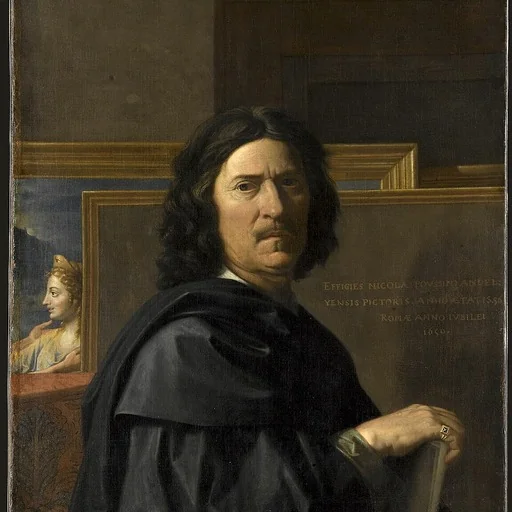
Nicolas Poussin (UK: US: French:; June 1594 – 19 November 1665) was a leading painter of the classical French Baroque style, although he spent most of his working life in Rome.

Museum
Department of Paintings of the Louvre
Continue through works from the same source collection.