Artwork
A Weeping Woman
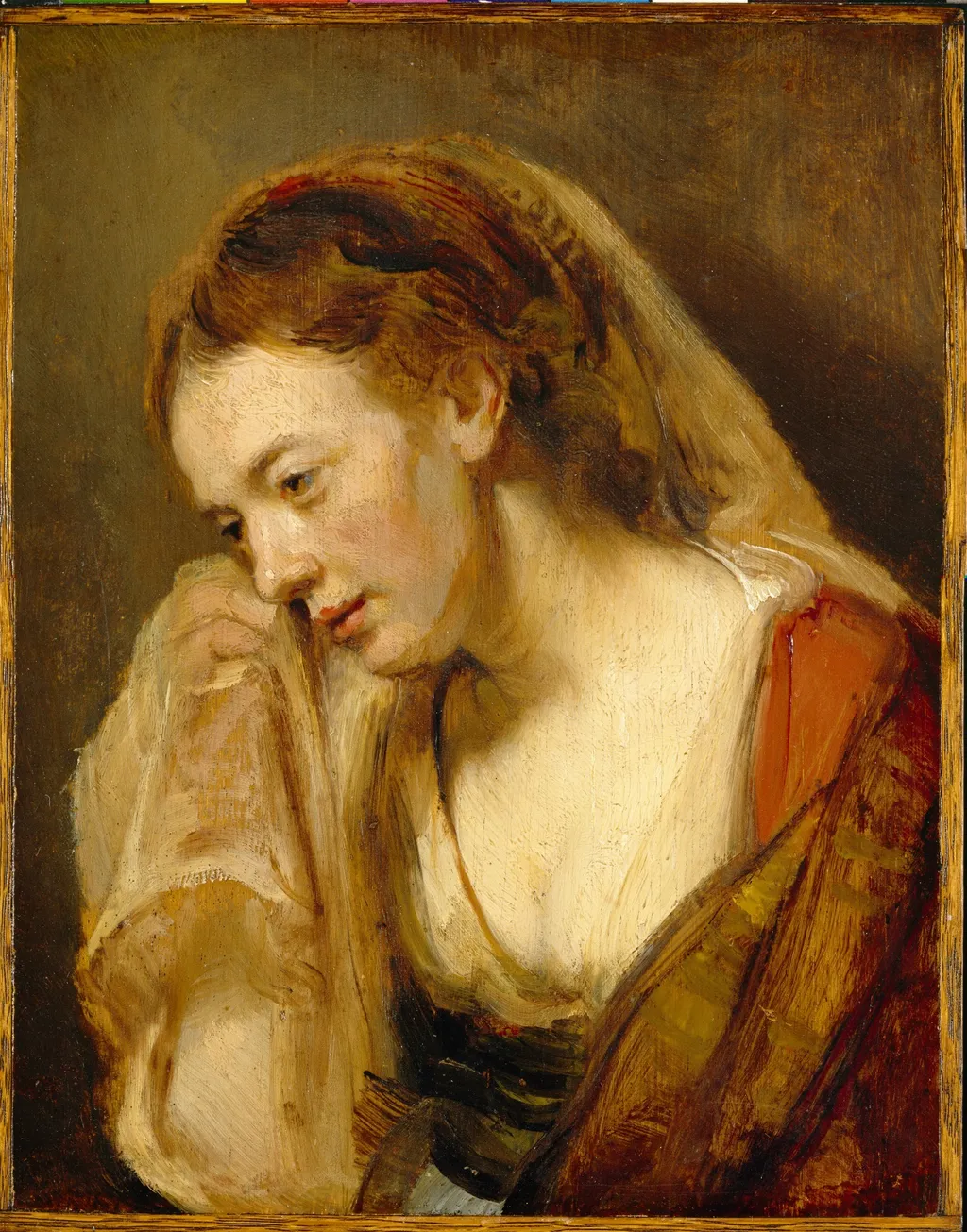
A Weeping Woman is an oil painting by the Dutch Golden Age artist Rembrandt van Rijn. It dates from 1640 and is held in the collection of the Detroit Institute of Arts.
About this work
Subject & Meaning
Stylistic analysis and contemporary records suggest the piece was executed around 1644 in Rembrandt's workshop, likely by a pupil reproducing the London study.
The painting shows a half-length figure of a woman seated and weeping, her head turned slightly to the left and a handkerchief held in her lap. The composition closely mirrors the kneeling woman in Rembrandt's Christ and the Adulteress (National Gallery, London), linking the Detroit work to that prototype. Stylistic analysis and contemporary records suggest the piece was executed around 1644 in Rembrandt's workshop, likely by a pupil reproducing the London study. The work entered the collection of Oscar Huldschinsky in Berlin by 1916 and passed through several dealers before being acquired by the Detroit Institute of Arts in 1956.
Technique & Style
The painting is executed in oil on oak panel, measuring approximately 21.3 cm by 16.8 cm. It depicts a weeping woman holding a handkerchief, positioned half-length and facing left, closely resembling the kneeling woman in Rembrandt’s Christ and the Adulteress in the National Gallery, London. The work is attributed to one of Rembrandt’s students, likely created in his studio around 1644, and is classified as a tronie. Formal analysis emphasizes the expressive handling of light and gesture, characteristic of Rembrandt’s circle, with delicate modeling of facial features and drapery. The surface shows signs of age but remains structurally sound, reflecting careful handling and preservation.
History & Provenance
A Weeping Woman, an oil-on-oak panel painting, was created in 1644 within Rembrandt's workshop, likely as a study for the kneeling figure in his larger work The Woman Taken in Adultery. While traditionally attributed to Rembrandt, scholars such as Kurt Bauch and Werner Sumowski suggest it was executed by a student, proposing candidates like Carel Fabritius, Samuel van Hoogstraten, or Nicolaes Maes. The work first appeared in the Holland collection in London before being auctioned at Christie's in 1914 to a Mr. Smith and subsequently recorded in the possession of F. W. Lippmann. By 1916, it entered the Berlin collection of Oscar Huldschinsky. It was sold by the dealers Cassirer und Helbing in 1928, passed through a Berlin private collection in 1937 and the F. Drey Gallery in 1938, and reached New York with Mrs. Hanni Seligman by 1947. The Detroit Institute of Arts acquired the painting in 1956 through the dealer Rosenberg and Stiebel.
The painting is held by the Detroit Institute of Arts, accessioned as 56.93.
It was first recorded in the Holland collection in London and auctioned at Christie’s, London, in 1914 to a buyer named Smith. By the same year it belonged to F. W. Lippmann in London, and by 1916 it was in the collection of Oscar Huldschinsky in Berlin. Sold at Cassirer und Helbing, Berlin, on 10 November 1928 for 68,000 Marks, it later passed through a Berlin private collection by 1937, F. Drey Gallery, London, in 1938, and Hanni Seligman, New York, by 1947. Acquired in 1956 via Rosenberg & Stiebel, it entered the Detroit Institute of Arts the same year.
Context
Scholarly debate centers on the attribution and function of A Weeping Woman (c. 1644), a small oak panel in the Detroit Institute of Arts. Most specialists regard it as a studio variant or pupil copy after Rembrandt’s autograph study for The Woman Taken in Adultery in London, rather than an original by the master himself.
Kurt Bauch proposed Carel Fabritius as the likely hand, while Werner Sumowski favored Samuel van Hoogstraten and Nicolaes Maes as the strongest candidates among Rembrandt’s circle. The painting’s close correspondence to the kneeling figure in the London work supports its origin in Rembrandt’s workshop during the early 1640s, when such tronies were used for training and compositional reference.
Own this work as a print
Artist & collection

Artist
Rembrandt Harmenszoon van Rijn, known mononymously as Rembrandt, was a Dutch Golden Age painter, printmaker, and draughtsman.

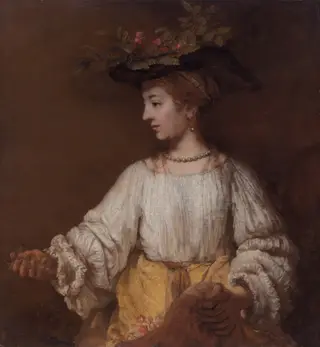



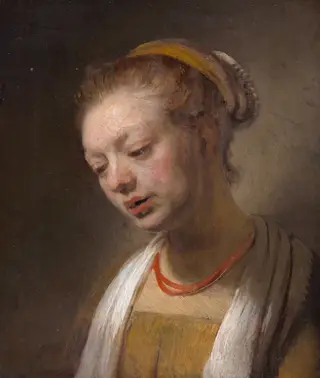
- Young Woman with a Red Necklace
 Hendrickje Stoffels (1626–1663)
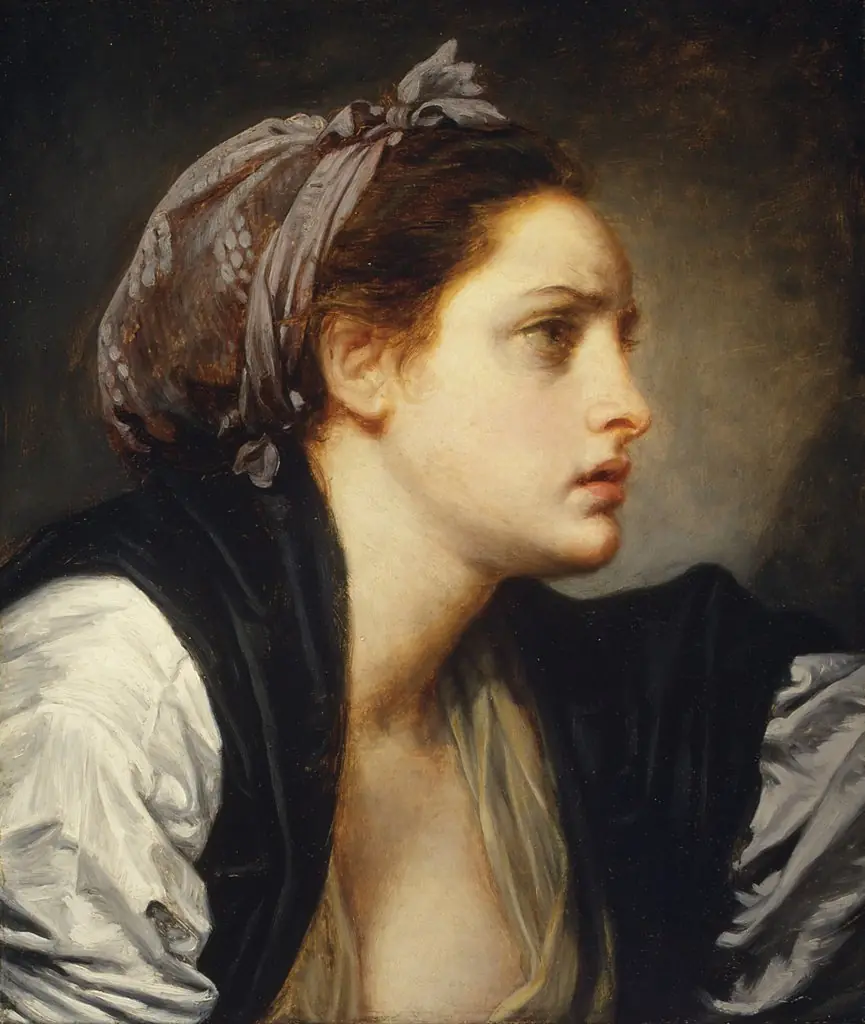 Study Head of a Woman
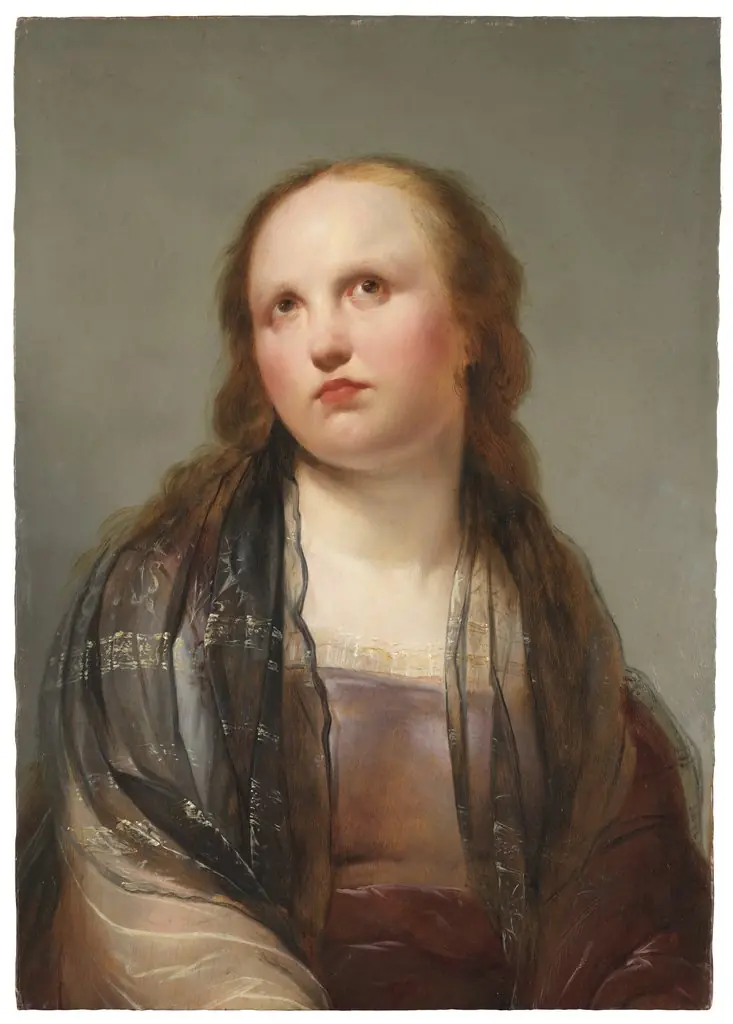 Porträtt av en ung kvinna
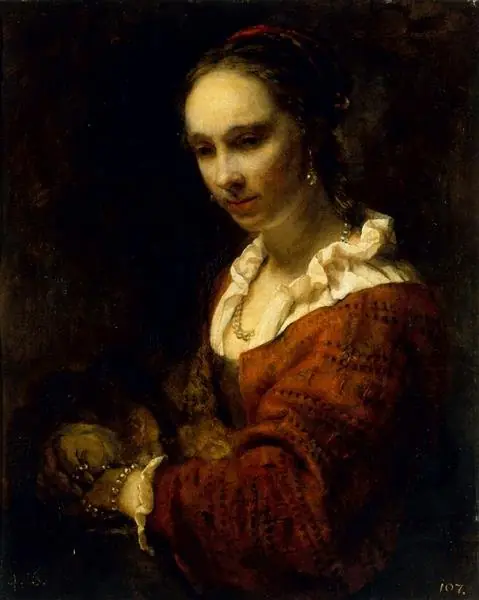 Young Woman with a Pearl Necklace
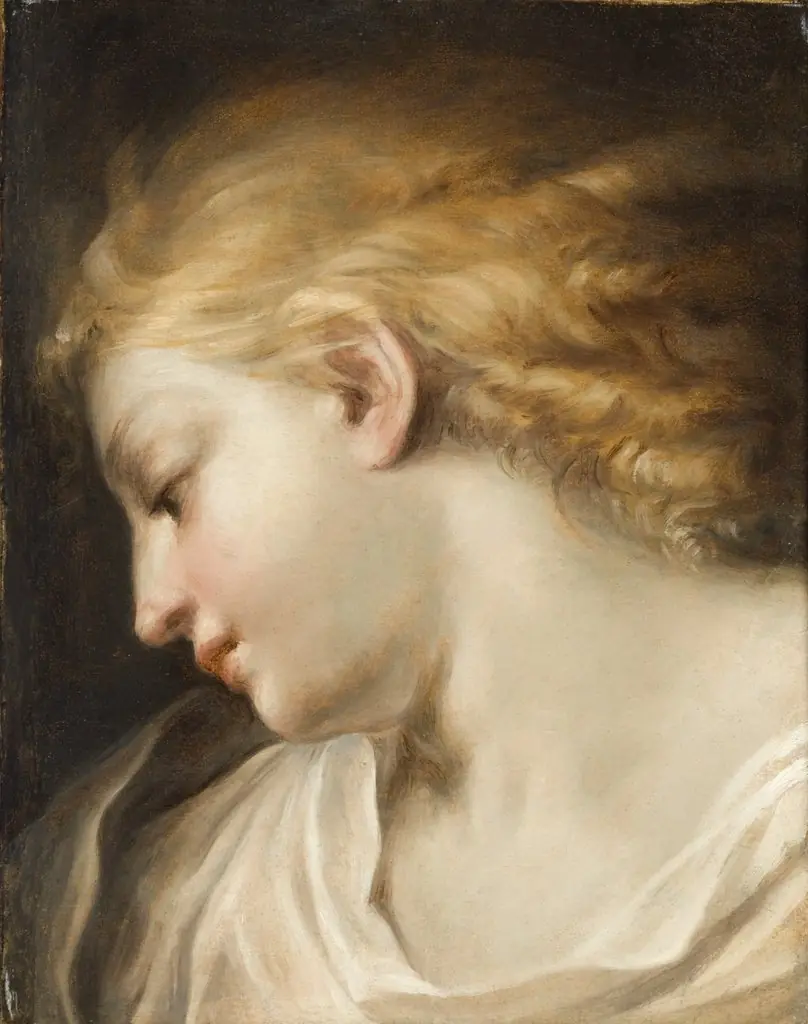 Head of an Angel
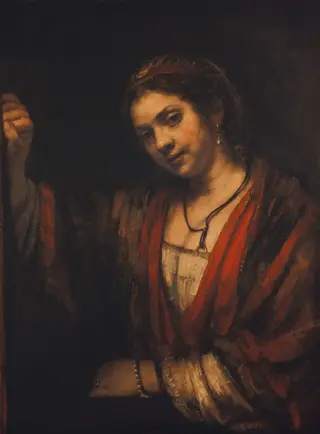 Hendrickje Stoffels by a Door
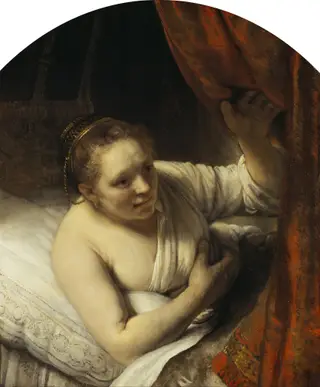 A Woman in Bed
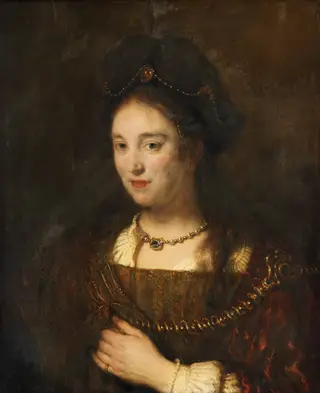 Half-figure of a woman with a beret
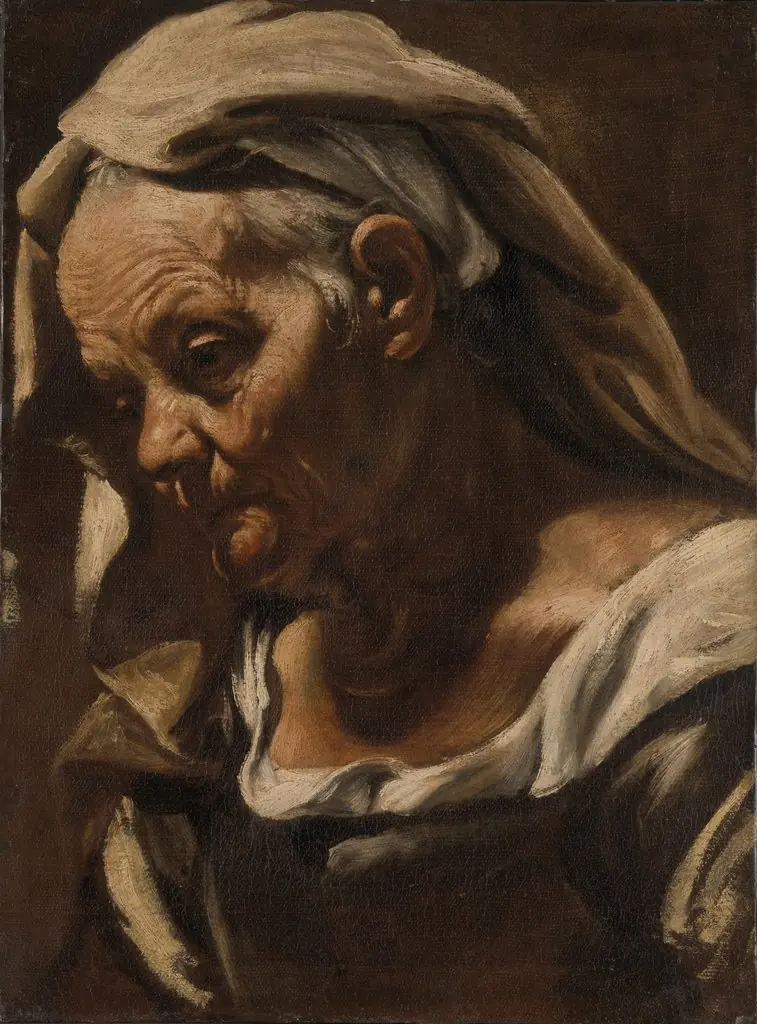 Head of an Old Woman
 The Sibyl
 Head of an Old Woman Looking to Lower Right (Saint Elizabeth)