Artwork
Jacob wrestling with the angel
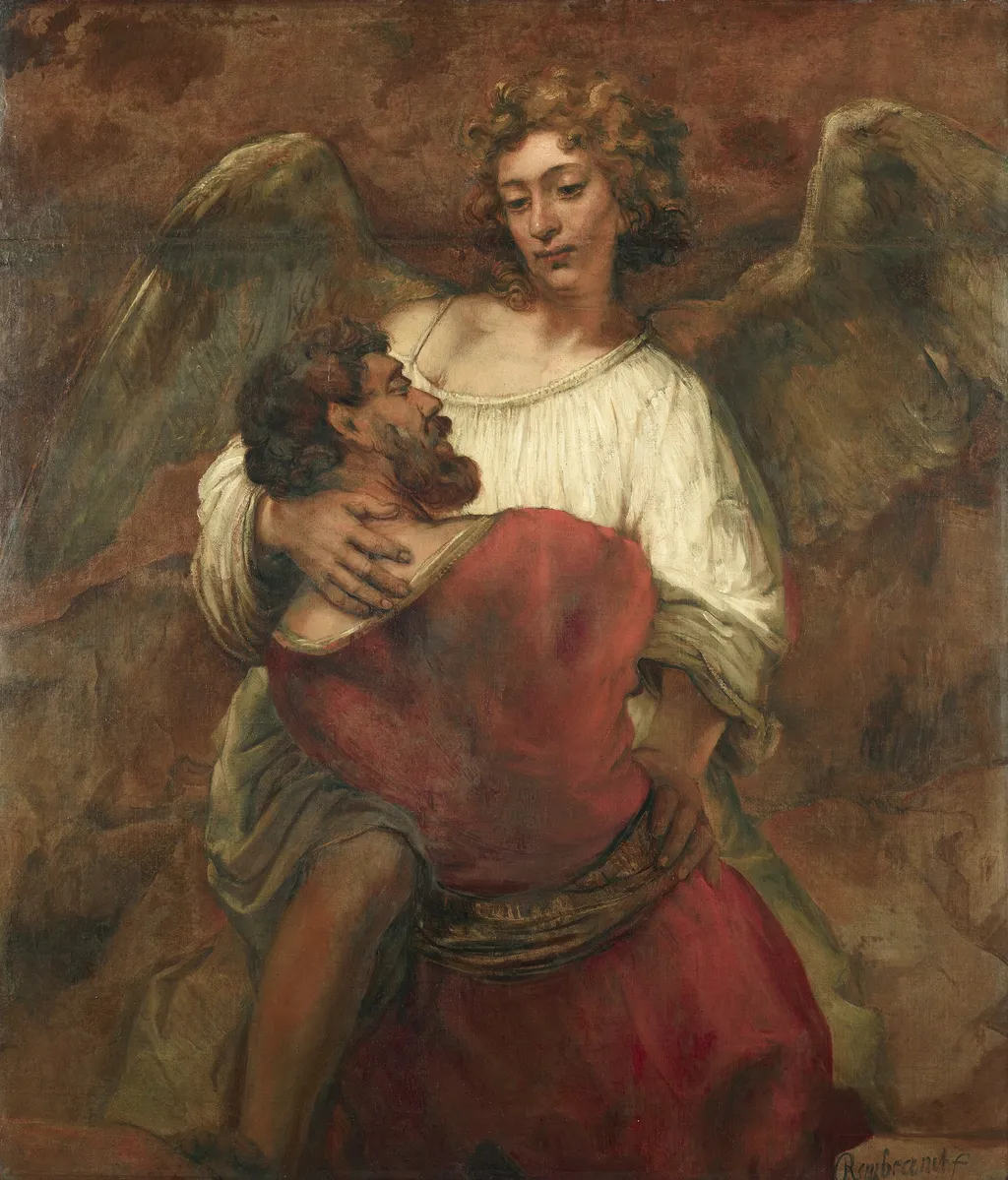
Jacob wrestling with the angel is an oil painting by the Dutch Golden Age artist Rembrandt van Rijn. It dates from 1659 and is held in the collection of the Gemäldegalerie Berlin. This 1659 oil painting by Rembrandt Harmenszoon van Rijn depicts a biblical scene.
About this work
Overview
Jacob wrestling with the angel is an oil on canvas painting by Rembrandt van Rijn, dated 1659, measuring 137 by 116 centimeters.
Jacob wrestling with the angel is an oil on canvas painting by Rembrandt van Rijn, dated 1659, measuring 137 by 116 centimeters. The work depicts the biblical nocturnal struggle between Jacob and a divine messenger, rendered at life size and in close-up. Signed "Rembrandt f" in the lower right, it is held by the Gemäldegalerie Berlin (accession number 828). The painting belongs to Rembrandt's late period, when he increasingly concentrated on essential human drama, and it stands as one of the most celebrated treatments of this rarely depicted Old Testament subject.
Subject & Meaning
The subject derives from Genesis 32:22-31, in which Jacob, returning to Canaan after leaving his father-in-law Laban, remains alone on the banks of the Jabbok River and wrestles with a mysterious being until dawn. Unable to prevail, the being dislocates Jacob's hip but ultimately blesses him and renames him Israel, "one who has prevailed with God." Rembrandt strips the narrative to its emotional core, presenting only the two protagonists in tight physical embrace. Jacob, bearded and clad in a red tunic with a gold belt, leans backward with eyes shut, his body tense with exertion. The angel, slightly higher in the composition, wears a white gathered blouse and possesses large wings; the figure's right arm wraps around Jacob's neck and shoulder in a gesture that reads as simultaneously combative and tender. The angel's calm, almost serene expression contrasts with Jacob's strained effort, suggesting a spiritual dimension beyond mere physical contest. The darkness surrounding the figures evokes the night-time setting while focusing attention on the interior drama of divine-human encounter.
Technique & Style
The painting is executed in oil on canvas with dimensions of 137 by 116 centimeters. Rembrandt employs a restricted palette dominated by deep reds, warm browns, and the stark white of the angel's blouse, with muted greenish-gray in the wings, all set against a dark, indistinct background of brown and earth tones. Light enters strongly from the upper left, illuminating the faces, the white blouse, and Jacob's shoulder while plunging lower portions into shadow. This dramatic chiaroscuro typifies Rembrandt's late style and intensifies the psychological concentration of the scene. The brushwork is loose and visible, particularly in the background and drapery, with thicker paint application in the highlights. Scholars have noted that in his final decade Rembrandt allowed paint itself to become a subject, building pigment with daubing, dragging, and layering that creates monumental physical presence while remaining spiritually luminous. The original format was considerably larger; the canvas has been cropped multiple times over its history, altering its initial proportions.
Context
The subject of Jacob wrestling with the angel was rarely depicted in European art, making Rembrandt's choice characteristic of his late interest in unconventional biblical narratives. During the Dutch Golden Age, Rembrandt increasingly moved away from the detailed narrative settings of his earlier work toward concentrated psychological studies. The painting has been interpreted as reflecting the artist's own spiritual struggles and his lifelong preoccupation with grace and human vulnerability. Critical attention has focused on the work's radical reduction of narrative elements and its transformation of violent struggle into something resembling an intimate embrace. The angel's face has been described as perhaps the most beautiful in all of Rembrandt's painting, with some scholars suggesting it may idealize the features of Titus, Rembrandt's son. The painting's damaged and cropped state has prompted technical study, with consensus that elements in the lower right were taken from cropped sections and added later.
Legacy
Rembrandt's Jacob wrestling with the angel has become the most famous visual treatment of this subject, influencing or standing in dialogue with later interpretations by artists including Eugène Delacroix, Alexander Louis Leloir, Gustave Moreau, and Paul Gauguin. Its fame rests on the universal accessibility of its emotional content, the physical immediacy of its life-size figures, and its radical formal economy. The painting exemplifies how Rembrandt's late work transcends specific religious narrative school to address broader human experience, the struggle for meaning and blessing. Its residence in the Gemäldegalerie Berlin has made it a centerpiece of that museum's Dutch collection and a destination for scholars studying Rembrandt's final decade. The work continues to generate curatorial and scholarly interest, with recent interpretations emphasizing the protective, almost maternal quality of the angel's embrace and the painting's dreamlike, somnambulistic atmosphere.
Own this work as a print
Artist & collection

Artist
Rembrandt Harmenszoon van Rijn, known mononymously as Rembrandt, was a Dutch Golden Age painter, printmaker, and draughtsman.