Artwork
The Dragon Arum, Black Calla or Solomon's Lily
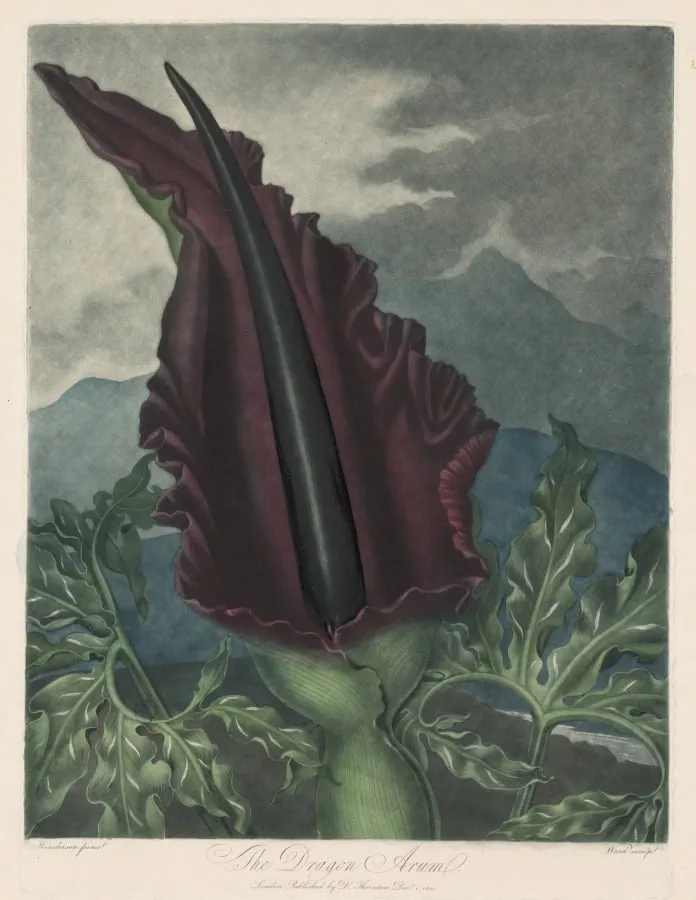
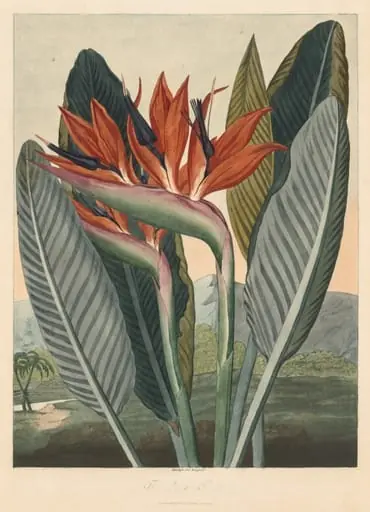
The Dragon Arum, Black Calla or Solomon's Lily is a print by the Romanticist artist Robert John Thornton. It dates from 1803 and is held in the collection of the Cleveland Museum of Art.
- Accession no.
- 1939.291
About this work
Overview
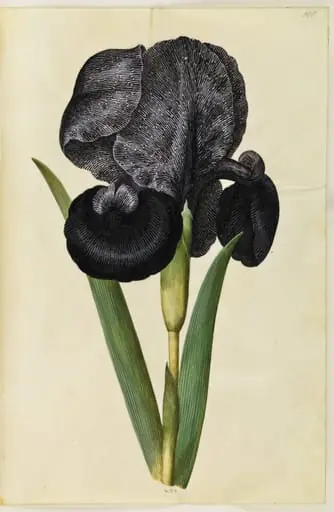
This 18th-century botanical print depicts a single Black Calla lily in a plain glass vase, rendered with precision to capture its natural form.
This 18th-century botanical print depicts a single Black Calla lily in a plain glass vase, rendered with precision to capture its natural form. Emerging from a quiet, unadorned setting, the flower is presented with scientific clarity and aesthetic restraint. The print reflects the period’s growing interest in accurate floral documentation, made possible by advances in reproductive printmaking techniques that allowed for nuanced tonal reproduction.
Subject & Meaning
The Black Calla lily, also known as Solomon’s Lily, is rendered without symbolic embellishment, emphasizing its botanical identity over allegory. Its dark, funnel-shaped spadix contrasts with the pale, waxy spathe, creating a striking visual tension. The composition avoids ornamentation, focusing attention on the plant’s structure and natural elegance, aligning with Enlightenment-era ideals of observation and empirical study.
Technique & Style
The print employs aquatint to achieve the translucent, wash-like qualities of watercolor, capturing subtle gradations of light across the petals and leaves. Delicate shadows and soft highlights suggest volume without heavy modeling, distinguishing it from the richer tones of mezzotint or stipple. The technique mimics the immediacy of direct observation, enhancing the illusion of life while maintaining the precision expected in scientific illustration.
History & Provenance
Created in the 1790s, this print belongs to a wave of botanical publications that leveraged new engraving methods to reproduce plant specimens with unprecedented fidelity. Though the artist’s name is not always recorded, such works were often commissioned by collectors or institutions seeking accurate visual records of exotic flora. The print’s survival in museum collections, including the Cleveland Museum of Art, underscores its role in the history of scientific visual culture.
Context
During the late 18th century, European botanical exploration expanded rapidly, fueling demand for accurate plant illustrations. Printmakers responded by refining techniques like aquatint and mezzotint to replicate the textures and tones of live specimens. This print reflects a broader cultural shift toward empirical science, where visual accuracy replaced stylized representation, serving both scholarly and public audiences interested in natural history.
Legacy
The print stands as an example of how technical innovation in printmaking elevated botanical art beyond mere decoration into a tool of scientific communication. Its restrained composition and faithful rendering influenced later generations of botanical illustrators, reinforcing the value of precision over ornament. Today, it remains a reference point in the study of how visual media contributed to the documentation of the natural world.
Artist & collection

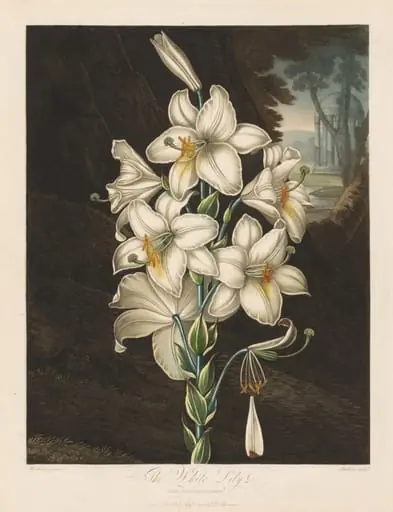 The Temple of Flora, or Garden of Nature: The White Lily with Variegated Leaves
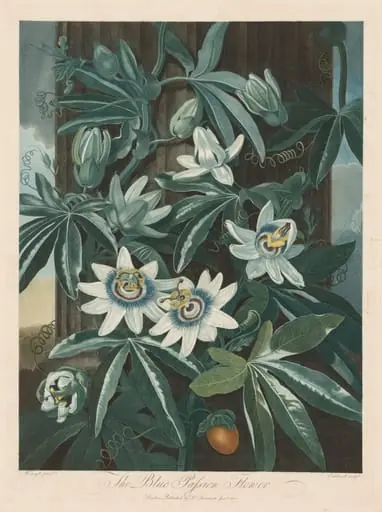 The Blue Passion-flower
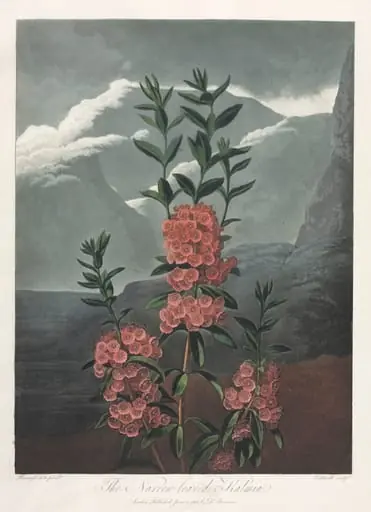 The Temple of Flora, or Garden of Nature: The Narrow-leaved Kalmia
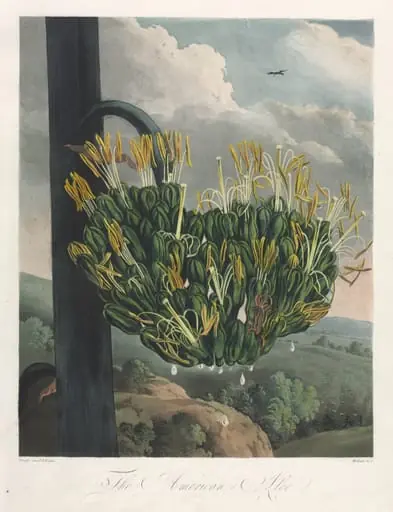 The Temple of Flora, or Garden of Nature: The American Aloe
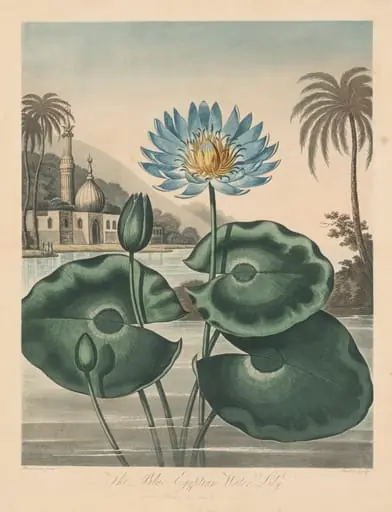 The Temple of Flora, or Garden of Nature: Blue Egyptian Waterlily
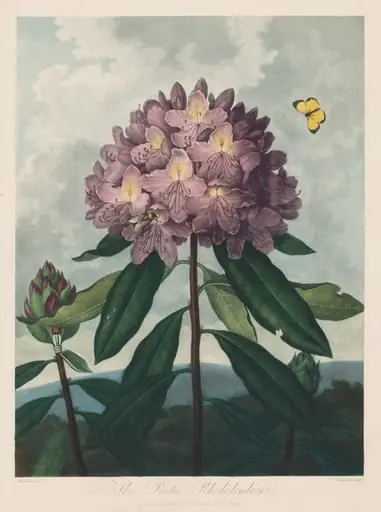 The Temple of Flora, or Garden of Nature: The Pontic Rhododendron
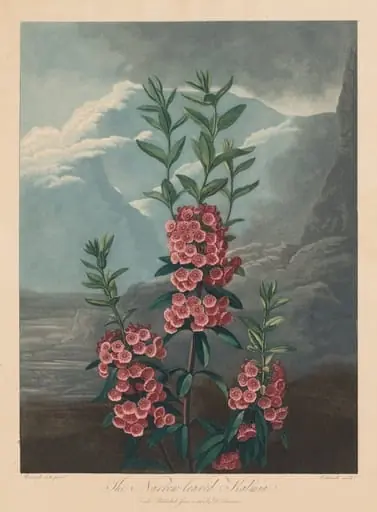 The Temple of Flora, or Garden of Nature: The Narrow-leaved Kalmia, Mountain Laurel
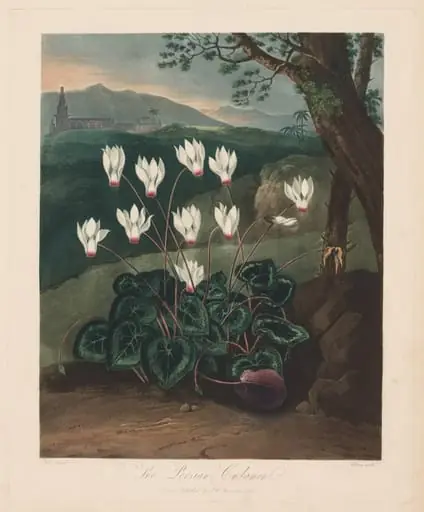 The Temple of Flora, or Garden of Nature: The Persian Cyclamen