Artwork
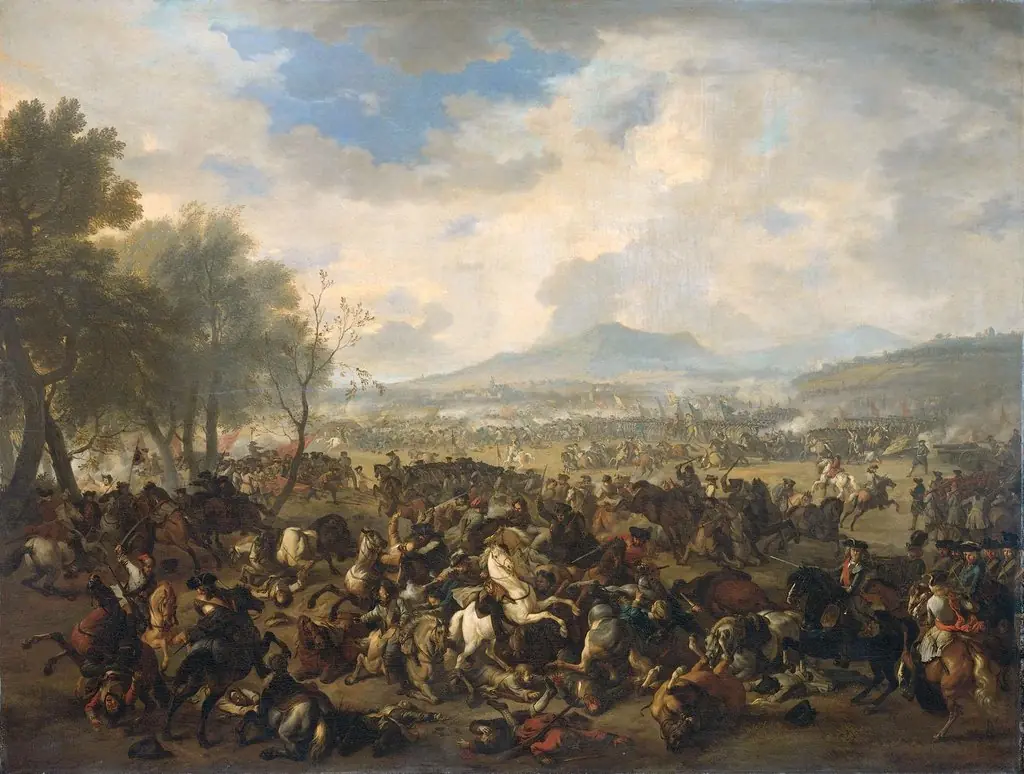
Battle of Vimpfen on 6 May 1622
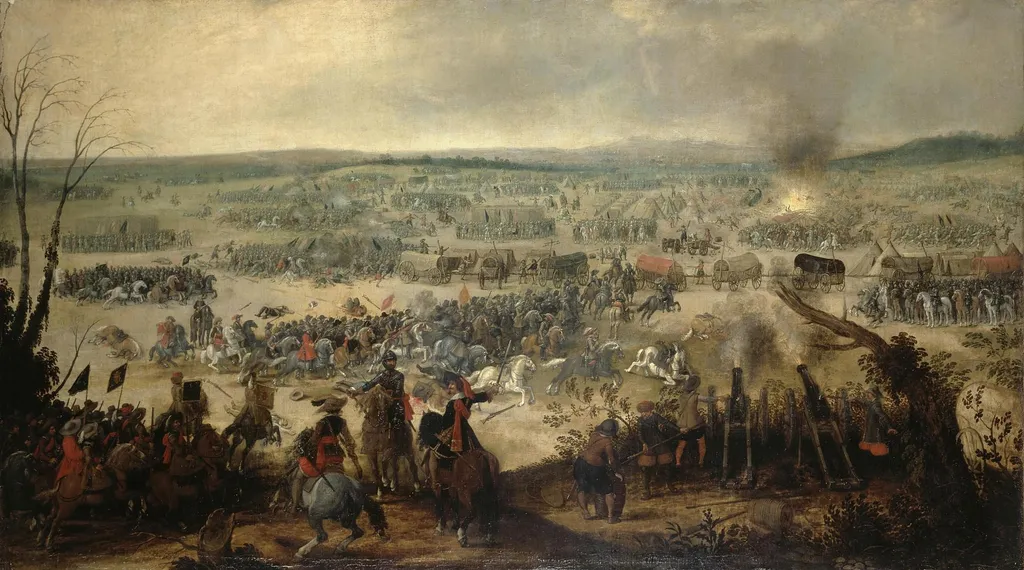
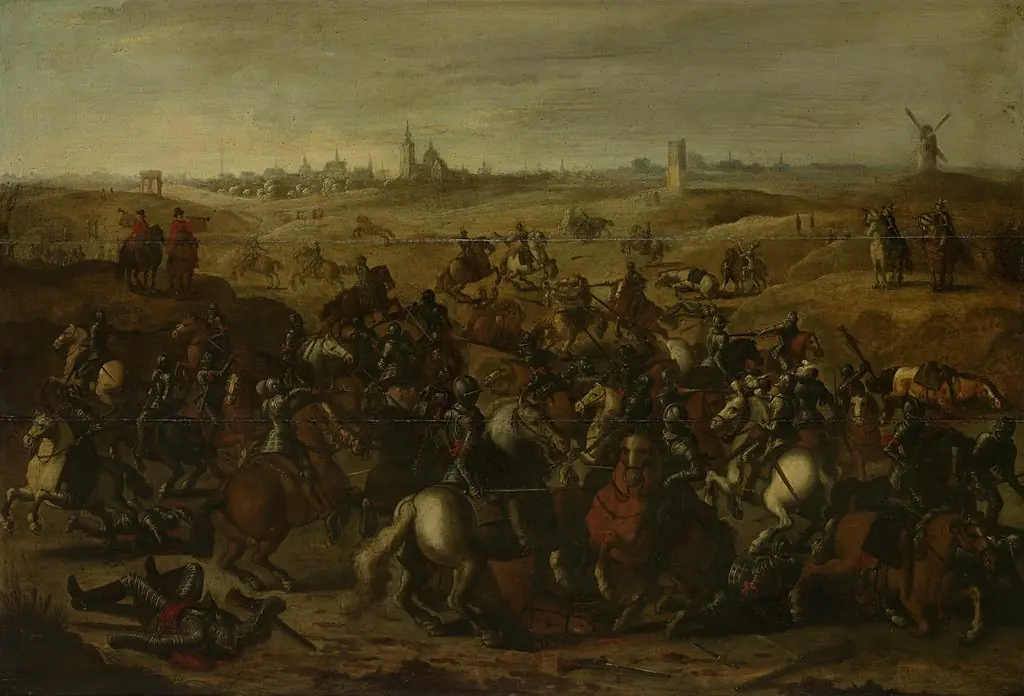
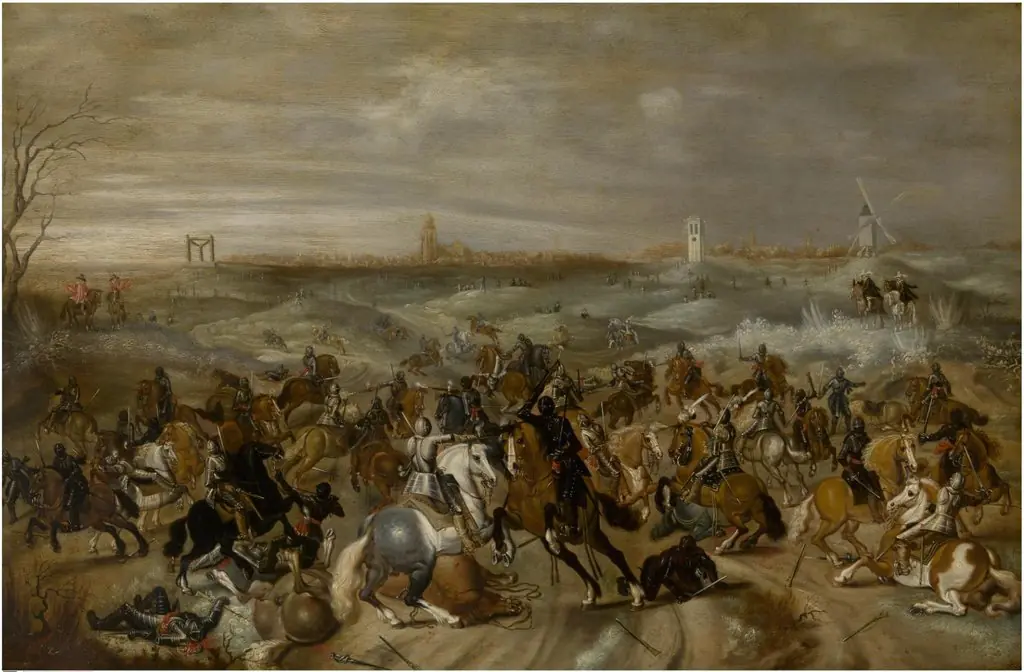
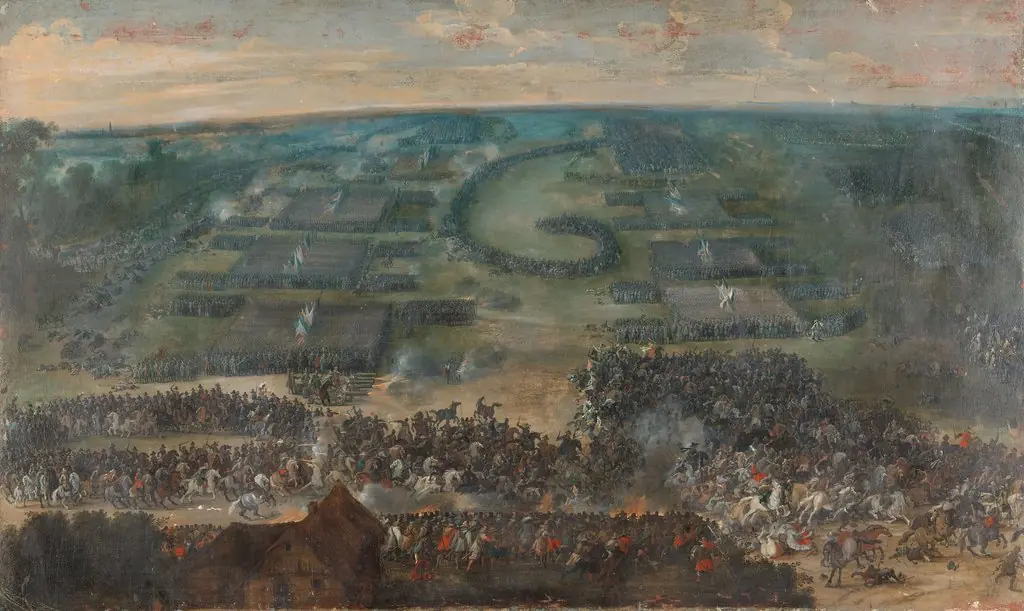
Battle of Vimpfen on 6 May 1622 is an oil painting by the Flemish Baroque painting artist Sebastiaen Vrancx. It dates from 1634 and is held in the collection of the Hermitage Museum.
About this work
Overview
The Battle of Vimpfen on 6 May 1622 is an oil painting on canvas by the Flemish Baroque artist Sebastiaen Vrancx, dated 1634.
The Battle of Vimpfen on 6 May 1622 is an oil painting on canvas by the Flemish Baroque artist Sebastiaen Vrancx, dated 1634. Measuring 115 by 199 centimeters, the work depicts a pivotal engagement of the Thirty Years' War and is held in the collection of the State Hermitage Museum in Saint Petersburg under accession number GE-7164. Vrancx, who pioneered the battle scene genre in Netherlandish painting, created this work during his mature period, bringing firsthand military experience to his depiction of contemporary warfare. The painting stands as a significant example of early seventeenth-century Flemish military art, combining documentary interest in a specific historical event with the panoramic, large-scale compositional approach characteristic of the artist's later style.
Subject & Meaning
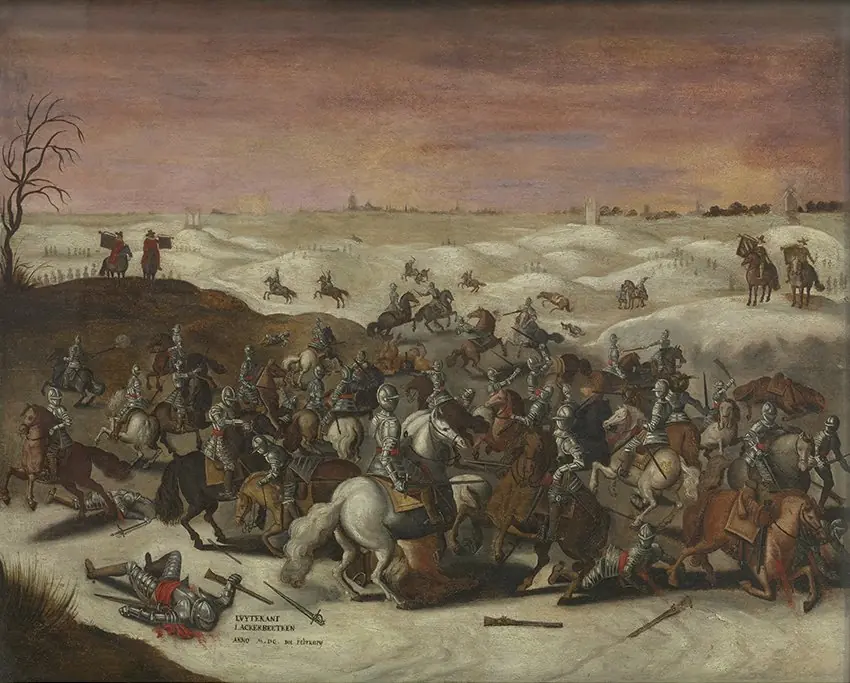
The painting illustrates the Battle of Wimpfen (also known as Vimpfen), fought on 6 May 1622 during the Palatinate campaign of the Thirty Years' War. The period sources describe the engagement as a defeat for Protestant forces under Georg Friedrich, Margrave of Baden-Durlach, and General Ernst von Mansfeld by the combined armies of the Holy Roman Empire and Catholic League commanded by Marshal Tilly and Gonzalo de Córdoba. The composition emphasizes the collective chaos of battle rather than individual heroism, with no clearly distinguishable faces. The iconography includes cavalry clashes in the foreground, artillery positions emitting smoke to the right, supply wagons with canvas covers across the middle ground, and encampments extending into the distance. The supply wagons and tents held particular significance, as the battle turned when a random Spanish countershot exploded the Protestant powder magazine, an event that contemporary etchings by Merian also documented. The painting thus serves as both a historical record and a visualization of the fragility of military fortune, where accidental detonation could decide the fate of armies.
Technique & Style
Executed in oil on canvas, the work displays the technical characteristics of Vrancx's mature period. The wide horizontal format accommodates a panoramic view of the battlefield, with brushwork varying from detailed foreground rendering to looser, smaller marks for distant soldiers. The palette consists of muted earth tones, browns, grays, and dull greens, with occasional touches of red on sashes and flags. Atmospheric perspective flattens the far background into soft blue-gray tones beneath a hazy, overcast sky, while darker smoke clouds rise from the artillery positions on the right. The finish is relatively smooth, and the composition employs leafless trees and dark foliage in the left foreground as framing devices. This handling aligns with scholarly descriptions of Vrancx's mature style from the 1630s onward, characterized by more attenuated and pearly tonalities, less compact but more dynamic execution of landscape elements, and complex figure groups engaging within vast settings. The collective emphasis on military action rather than personal narrative reflects the artist's systematic approach to battle painting, developed through his experience as captain of the Antwerp civic guard.
History & Provenance
The painting was created in 1634 in Flanders, twelve years after the battle it depicts. Its provenance before the twentieth century remains undocumented in the available sources. In 1933, the work was transferred to the Hermitage Museum from the Antikvariat All-Union Association, a Soviet state organization dealing in antiques and art. The painting entered the Hermitage collection with the accession number GE-7164. An earlier attribution to Simon de Vos, possibly originating from the All-Union Society Antiquariat source documentation, was later revised in favor of Sebastiaen Vrancx, the attribution now accepted by the Hermitage and supported by scholarly consensus. The work has been catalogued in major Hermitage publications including Colin Eisler's Paintings in the Hermitage (1990, pp. 572-573) and Natalya Gritsay and Natalya Babina's The State Hermitage Museum Catalogue of Flemish Painting (2008, no. 518). No exhibition history is recorded in the provided sources.
Context
Vrancx occupied a distinctive position in Flemish art as the pioneer of battle scene painting in the Low Countries. Trained in the workshop of Adam van Noort alongside Peter Paul Rubens and Jacob Jordaens, he became a master of the Antwerp Guild of Saint Luke in 1600. His military expertise derived from practical service: he was district head of the civic guard from 1613 and served as its captain from 1626, a position that entitled him to carry a sword and that Anthony van Dyck recorded in his portrait of the artist. Approximately half of Vrancx's known works are devoted to military subjects, informed by this firsthand experience. The Battle of Vimpfen belongs to a category of paintings that sometimes related to actual historical engagements, though Vrancx also produced many imaginary battlefield scenes. The work's creation in 1634 places it in the decade following the artist's personal tragedy, the death of his wife and only child in 1639, and during a period when Jan Brueghel the Younger noted that Vrancx refused studio assistants, producing work slowly and controlling circulation of copies. The painting's subject, the Thirty Years' War, represented contemporary history for Vrancx and his patrons, connecting Flemish art to the broader European conflict that would devastate Central Europe.
Legacy
The Battle of Vimpfen on 6 May 1622 exemplifies the genre that established Vrancx's posthumous reputation as the creator of battle scene painting in the Low Countries. His influence transmitted through his pupil Peter Snayers, who became a leading battle painter in his own right. The work's current residence in the Hermitage ensures its accessibility within one of the world's major collections of European painting, where it is catalogued among the museum's Flemish holdings. The painting's afterlife in popular and scholarly contexts includes its reproduction on historical blogs discussing the Thirty Years' War, where its details, particularly the wagons and tents, have served as visual evidence for understanding the material circumstances of the battle. The shift from attribution to Simon de Vos to accepted authorship by Vrancx illustrates ongoing processes of scholarly reassessment in Flemish Baroque painting. As a document of both artistic and military history, the painting preserves a moment when the genre of battle painting was still being defined, before the more famous specialists of the later seventeenth century would elaborate its conventions.
Artist & collection
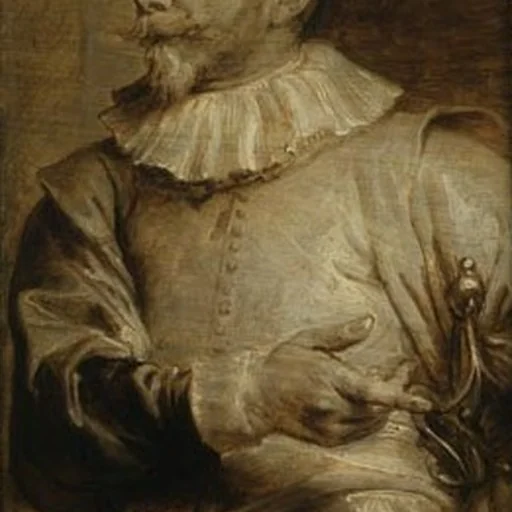
Artist
Sebastiaen Vrancx (pronounced; before 22 January 1573 – 19 May 1647) was a Flemish Baroque painter, draughtsman and designer of prints who is mainly known for his battle scenes, a genre that he pioneered in Netherlandish painting.