Artwork
明/清 沈顥 漁父圖 扇|Qu Yuan and the Fisherman
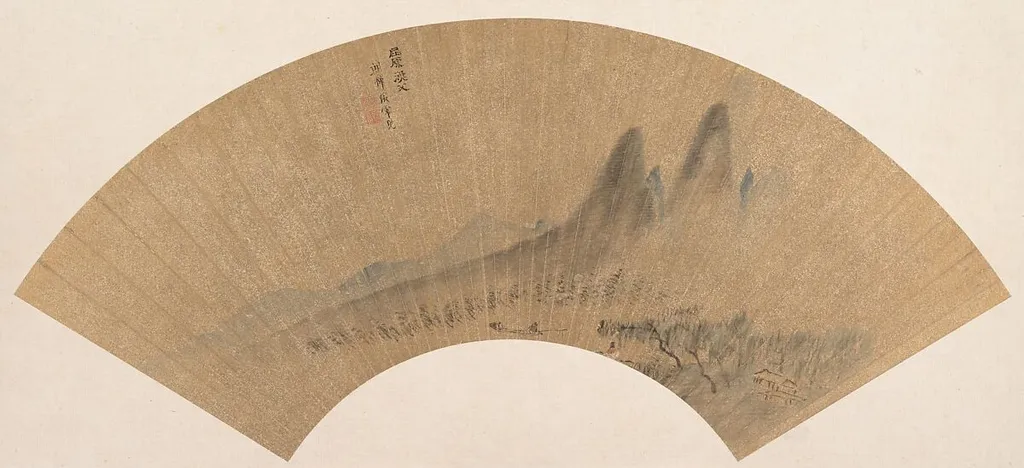
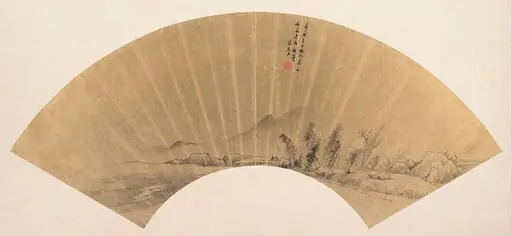
明/清 沈顥 漁父圖 扇|Qu Yuan and the Fisherman is an ink painting by the Baroque artist Shen Hao. It dates from 1683 and is held in the collection of the Metropolitan Museum of Art.
About this work
Technique & Style
Mounted margins remain intact, indicating the fan’s conversion to album format while preserving its original curvature and edge.
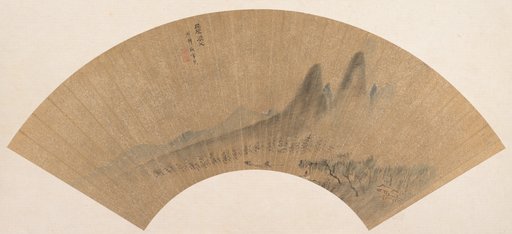
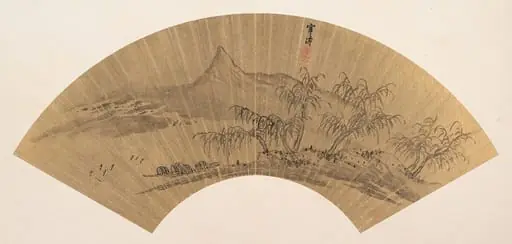
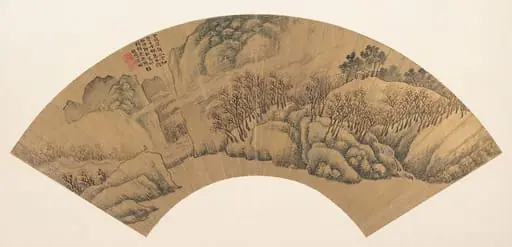
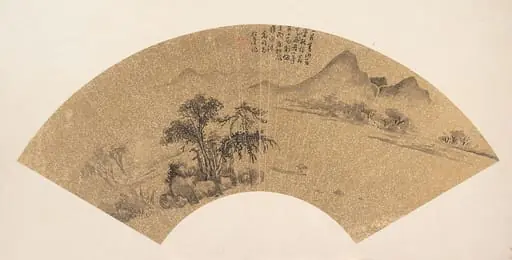
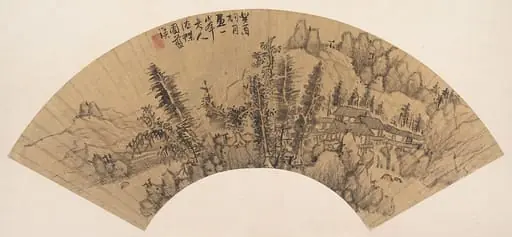
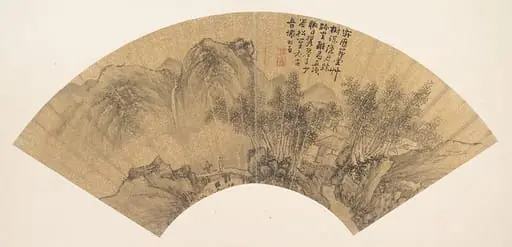
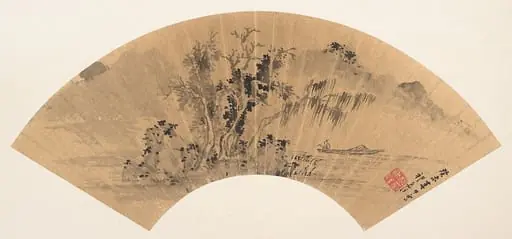
The work is a folding fan remounted as an album leaf, executed in ink on gold paper, a pairing of reflective ground and monochrome wash typical of late imperial scholar-artists. The composition unfolds in a continuous, horizontal register, where abbreviated rocky outcrops and a narrow band of river suggest recession without recourse to full spatial illusionism. The brushwork is spare and modulated, relying on fine, dry lines to define the fisherman’s poised figure and Qu Yuan’s recumbent posture; washes of diluted ink model the water’s surface and distant mist.
Mounted margins remain intact, indicating the fan’s conversion to album format while preserving its original curvature and edge. No losses or abrasions to the gold ground are recorded in the technical summary.
History & Provenance
The work Qu Yuan and the Fisherman was created by the artist Shen Hao in 1683. Executed as a folding fan mounted as an album leaf, the piece features ink on gold paper and is classified as a landscape painting. It originated in China during the late Ming or early Qing period. The artwork is currently held in the collection of the Metropolitan Museum of Art.
Context
Created in 1683 in China, the work is a folding fan mounted as an album leaf, ink on gold paper, classified as a landscape painting within the broader tradition of Qing dynasty art. It is part of the Metropolitan Museum of Art's collection, where it is catalogued with dimensions 16.8 cm × 51.4 cm and identified as a landscape painting.
Scholarly attention focuses on its literary subject, Qu Yuan and the Fisherman, which links the visual motif to the mythic narrative of the patriotic poet. The piece exemplifies how Shen Hao integrated literary themes into fan format, marking his contribution to the evolution of Chinese landscape painting in the late‑seventeenth century.
Overview
This landscape painting, titled Qu Yuan and the Fisherman, was created by Shen Hao in 1683. Originally conceived for a folding fan, it has since been mounted as an album leaf. The artist utilized ink on gold paper, imbuing the work with a soft, luminous quality.
It presents a serene natural vista, characteristic of traditional Chinese landscape art, inviting viewers into a contemplative space.
Subject & Meaning
The artwork depicts a quiet, expansive scene, likely alluding to the ancient Chinese poem The Fisherman. Towering, misty mountains rise in the distance, while a winding path and small figures suggest human interaction with the vast environment. A small house, surrounded by trees and grass, rests by a riverbank in the foreground, completing an idyllic setting that often symbolizes reclusion and moral steadfastness.
Artist & collection