Artwork
Application du Cercle Chromatique de Mr. Ch. Henry
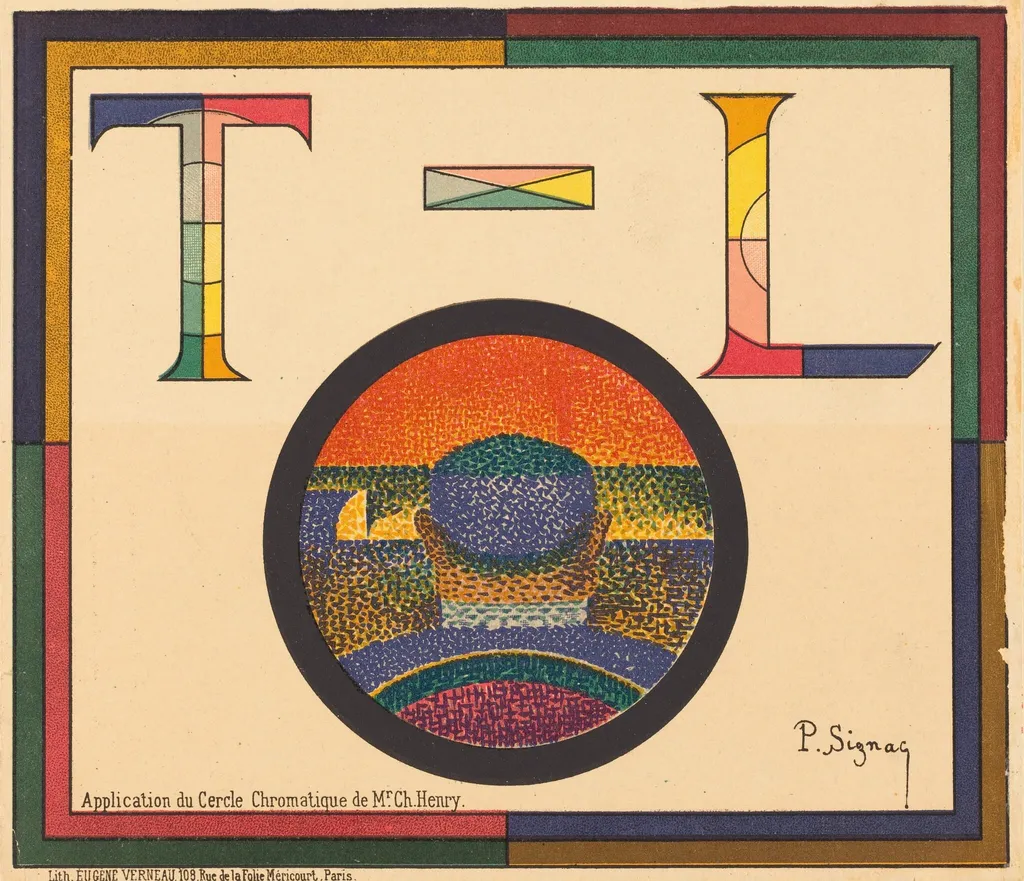
Application du Cercle Chromatique de Mr. Ch. Henry is an ink print by the Impressionist artist Paul Signac. It dates from 1888 and is held in the collection of the National Gallery of Art. Created in 1888, Application du Cercle Chromatique de Mr.
- Inscription
- Inscribed:across top in stone: T-L; lower right in stone: P. Signac; lower left in stone: Application du Cercle Chromatique de Mr. Ch. Henry / Lith. EUGENE VERNEAU, 108, Rue de la Folie Méricort, Paris.; across top verso printed: LE / Théâtre Libre... / Lundi 10 Décembre 1888... / LA CHANCE DE FRANÇOISE... / LA MORT DU DUC D'ENGHIEN... / LE COR FLEURI
About this work
Overview
Created in 1888, Application du Cercle Chromatique de Mr. Ch. Henry is a color lithograph executed on card. The work presents a compact, geometric composition framed by a vivid border of primary hues, with a central circular motif that combines dots and blocks of red, blue, green, and yellow.
Subject & Meaning
The print functions as a visual exploration of the chromatic circle, a tool for understanding color relationships. Within the central circle, simplified forms suggest a chair and a table, serving as a schematic illustration rather than a narrative scene, emphasizing the study of color interaction over representational content.
Technique & Style
Employing the lithographic process, Signac layered flat areas of pigment to achieve crisp edges and uniform tones. The design reflects the Neo‑Impressionist interest in scientific color theory, using unmodulated color fields and a pointillist‑inspired arrangement of dots and blocks to demonstrate optical mixing without traditional shading.
History & Provenance
Paul Signac, a principal exponent of Neo‑Impressionism and collaborator with Georges Seurat, produced this print during a period when he was actively investigating the principles of color harmony. The work was likely created for instructional or demonstrative purposes, illustrating the practical application of Henri Henry’s chromatic circle.
Context
At the close of the 1880s, artists associated with the Neo‑Impressionist movement sought to ground painting in empirical methods, drawing on contemporary scientific research into optics. Signac’s lithograph aligns with this intellectual climate, translating theoretical concepts of hue and contrast into a tangible, graphic format.
Legacy
While primarily a pedagogical piece, the lithograph exemplifies Signac’s commitment to integrating color theory into artistic practice. It offers insight into the experimental strategies that shaped early modernist approaches to abstraction and continues to inform studies of the intersection between art and scientific inquiry.
Own this work as a print
Artist & collection

Artist
Paul Victor Jules Signac ( seen-YAHK, French:; 11 November 1863 – 15 August 1935) was a French Neo-Impressionist painter who, with Georges Seurat, helped develop the artistic technique Pointillism.