Artwork
Application du Cercle Chromatique de Mr. Ch. Henry
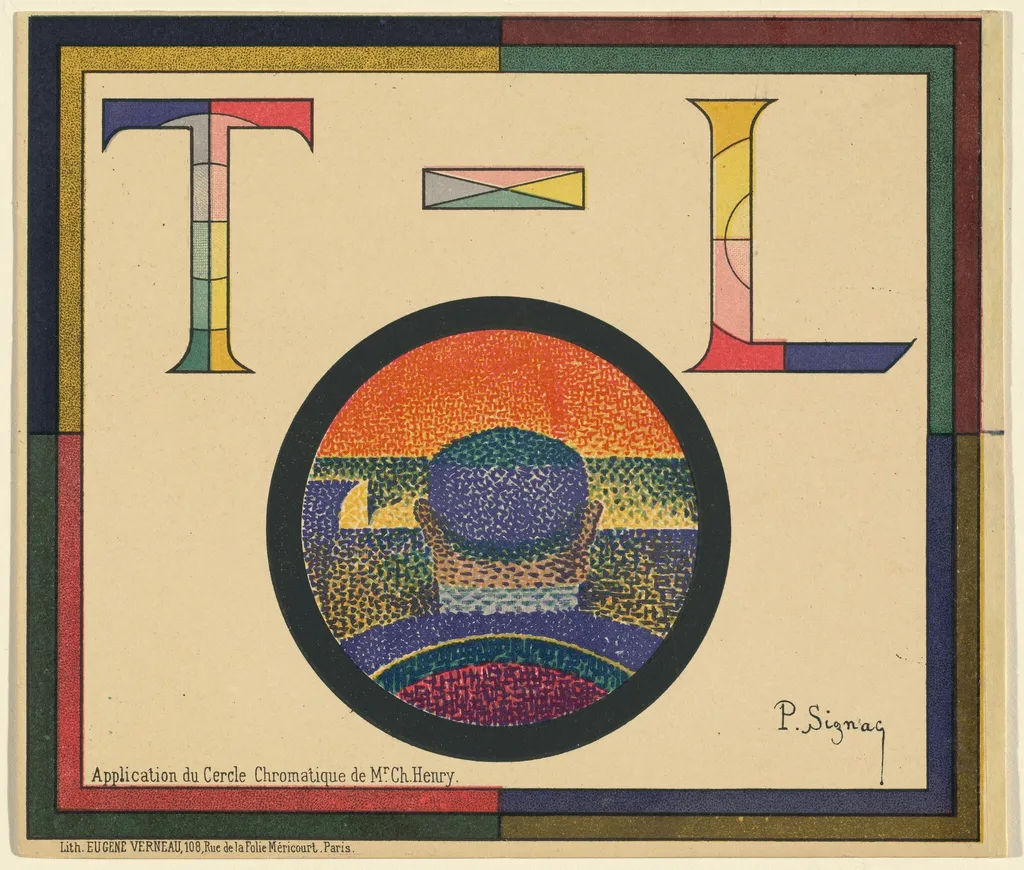
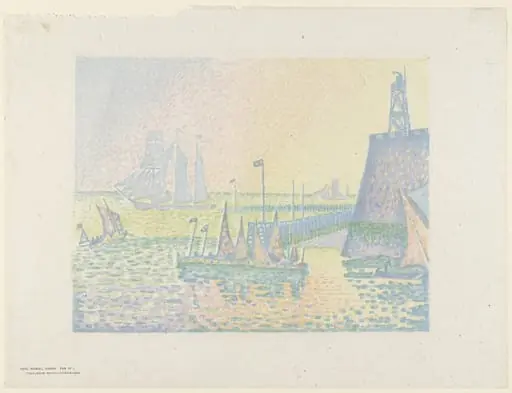
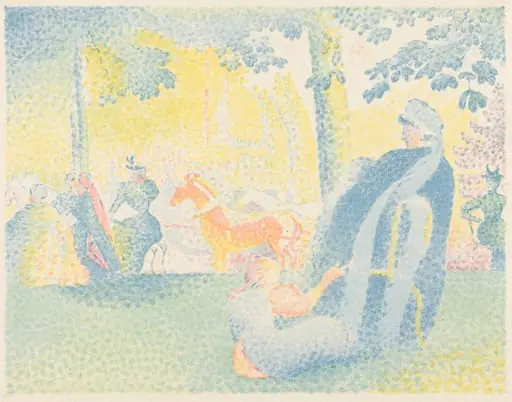
Application du Cercle Chromatique de Mr. Ch. Henry is an ink print by the Impressionist artist Paul Signac. It dates from 1889 and is held in the collection of the National Gallery of Art.
- Inscription
- Inscribed:across top in stone: T-L; lower right in stone: P. Signac; lower left in stone: Application du Cercle Chromatique de M.r Ch. Henry / Lith. EUGENE VERNEAU, 108, Rue de la Folie Méricort, Paris.; across top verso printed: LE / Théâtre Libre... / Jeudi 31 Janvier 1889... / LES RÉSIGNÉS... / L'ÉCHÉANCE
About this work
Overview
The medium of lithography allowed for precise, bold color layering, aligning with Neo-Impressionist goals of optical precision and theoretical rigor.
Paul Signac created this 1889 color lithograph as a visual exploration of color theory, departing from his usual maritime subjects. Printed on cardstock, the work translates scientific principles into a structured graphic composition. It serves as a didactic piece, demonstrating how chromatic relationships can be organized systematically.
The medium of lithography allowed for precise, bold color layering, aligning with Neo-Impressionist goals of optical precision and theoretical rigor.
Subject & Meaning
The composition centers on a chromatic circle divided into primary and secondary hues, red, blue, yellow, and green, reflecting Charles Henry’s theories on color harmony and emotional resonance. Surrounding the circle are three abstract geometric forms: a T, an L, and a diamond, likely symbolizing structural balance or visual rhythm. The work is not a scene but a diagrammatic application of color science, emphasizing perception over representation.
Technique & Style
Signac employed color lithography to achieve sharp, saturated planes of hue, using flat areas and dotted textures to suggest optical mixing without brushwork. The background features alternating bands and stippled fields, echoing Pointillist principles while adapting them to graphic design. The style is reductive and systematic, prioritizing clarity and theoretical expression over naturalism. Each color is deliberately placed to test visual interaction, not to mimic light or form.
History & Provenance
Created in 1889, the print emerged during Signac’s active collaboration with Georges Seurat and engagement with contemporary color theorists like Charles Henry. It was likely produced for intellectual circulation among artists and scientists rather than commercial sale. Few impressions were made, and surviving examples are held in museum collections, reflecting its role as a conceptual artifact rather than a widely distributed image.
Context
This work sits at the intersection of art and science in late 19th-century France, where artists sought to ground painting in empirical studies of vision and color. Signac’s engagement with Henry’s writings on chromatic psychology and rhythm reflected a broader movement to elevate art through scientific methodology. Unlike Impressionist spontaneity, this piece embodies a calculated, almost laboratory approach to visual experience.
Legacy
Though not widely exhibited during Signac’s lifetime, the lithograph influenced later abstract and constructivist artists interested in color as an autonomous system. Its reduction of form to geometric elements and emphasis on theoretical structure prefigured 20th-century movements that prioritized design over representation. It remains a key document in understanding how scientific ideas shaped modernist visual language.
Own this work as a print
Artist & collection

Artist
Paul Victor Jules Signac ( seen-YAHK, French:; 11 November 1863 – 15 August 1935) was a French Neo-Impressionist painter who, with Georges Seurat, helped develop the artistic technique Pointillism.