Artwork
The Dancing Couple
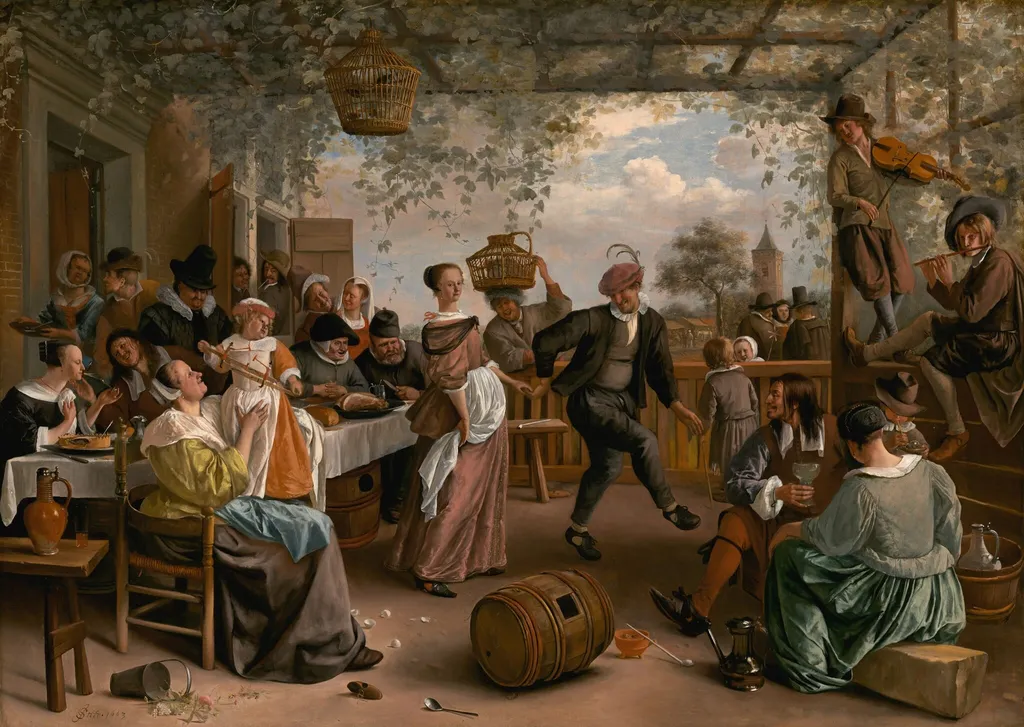
The Dancing Couple is an oil painting by the Baroque artist Jan Steen. It dates from 1663 and is held in the collection of the National Gallery of Art.
- Inscription
- Inscribed:lower left, JS in ligature: JSteen. 1663
About this work
Subject & Meaning
Steen employs specific iconography to convey moral warnings about the impermanence of pleasure and the loss of innocence associated with such festivities.
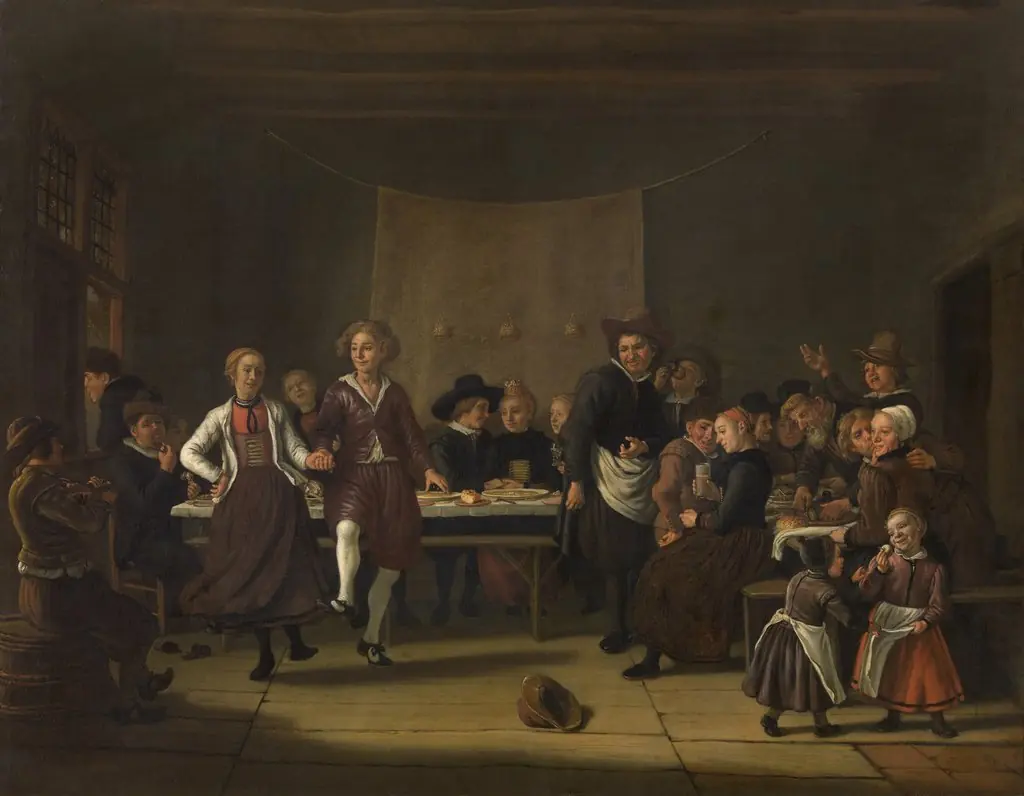
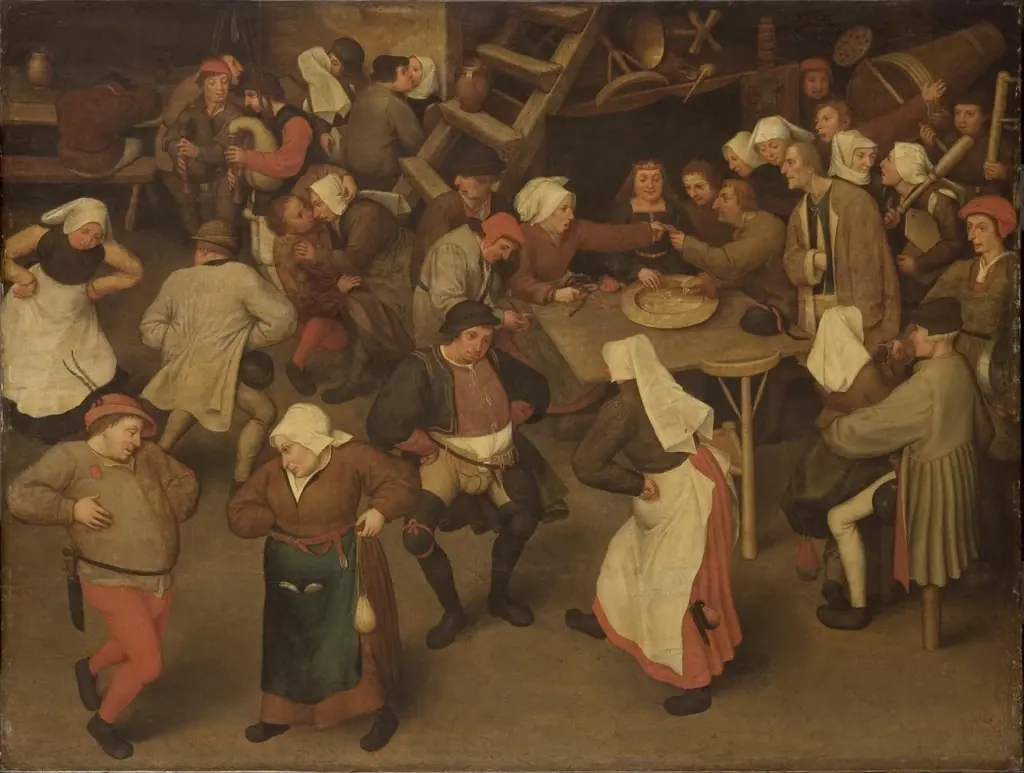
Jan Steen's 1663 painting depicts a boisterous kermis, a traditional Dutch village fair, centered on a couple dancing beneath a grape arbor. The scene includes numerous figures engaging in merriment, such as musicians playing violin and flute, while children play with toys like bubbles in the background. Steen employs specific iconography to convey moral warnings about the impermanence of pleasure and the loss of innocence associated with such festivities.
Symbols include a fallen bucket of flowers at the foreground, suggesting moral decay, alongside scattered eggshells and an empty wine barrel that indicate excessive consumption. Additionally, caged chickens hanging from the trellis and birds serve as further allegorical elements reflecting social and religious beliefs. Through these details, the work realistically portrays rural working-class life while simultaneously offering a critique of the unrestrained behavior often found at these popular social gatherings.
Technique & Style
Executed in 1663, The Dancing Couple is an oil painting on canvas measuring 102.5 × 142.5 cm, now in the National Gallery of Art, Washington, D.C. The horizontal format supports a lively genre scene centered on a dancing pair beneath a pergola adorned with trailing greenish-yellow vines that create spatial depth. The handling combines crisp delineation of costume and gesture with looser, atmospheric passages in the background figures and foliage. The palette is muted, dominantly greys, greens, and blacks, punctuated by accents such as the woman’s salmon-pink dress and the child’s bright orange garment.
Compositionally, Steen orchestrates more than a dozen figures across foreground, midground, and background, uniting music-making youths, seated diners, and onlookers in a rhythmic choreography of glances and movement.
Pictorial symbols reinforce moral commentary: spilled flowers at the lower edge signal lost virtue, while caged birds and overturned eggs evoke transience and intemperance. The scene’s exuberance is tempered by these details, which underscore the fleeting pleasures of the kermis festivity.
History & Provenance
Created in 1663, Jan Steen's The Dancing Couple is an oil-on-canvas painting that entered the historical record with a possible sale in The Hague on April 24, 1737. The work likely passed through the collection of Graf van Hogendorp before appearing in his sale on July 27, 1751. By 1752, it was held by Pieter and Jan Bisschop in Rotterdam, who sold the piece in 1771 to Adrian Hope and his nephew, John Hope.
Following Adrian's death, John inherited the painting, which subsequently passed to his three sons: Thomas, Adrian Elias, and Henry Philip Hope. After Henry Philip Hope's death in 1839, ownership transferred to his nephew, Henry Thomas Hope, and later to his wife, Adèle Bichat Hope. The work eventually reached the 8th Duke of Newcastle-under-Lyme before being sold in 1901 to Peter A.B. Widener.
It remained in the Widener estate until Joseph E. Widener gifted it to the National Gallery of Art in Washington, D.C., in 1942.
The Dancing Couple entered the National Gallery of Art in Washington, D.C., in 1942 as a gift from the estate of Peter A.B. Widener, executed through the power of appointment by his son, Joseph E. Widener. Prior to this acquisition, the painting belonged to the Widener family collection at Lynnewood Hall in Elkins Park, Pennsylvania, having been purchased by Peter A.B. Widener in 1901 from the London dealers Thomas Agnew & Sons. The work's earlier provenance includes ownership by the Hope family in Amsterdam and London throughout the nineteenth century, following its sale from the Bisschop collection in 1771.
Sources confirm its current residence within the museum's Widener Collection, though specific inventory numbers and detailed exhibition histories are not provided in the available records.
Context
Jan Steen’s The Dancing Couple (1663) is emblematic of the Dutch Golden Age’s genre tradition, where kermis scenes became a vehicle for moral reflection amid festive chaos. Scholars note the painting’s alignment with the Bruegelian lineage of peasant revelry, yet its 1663 execution marks a deliberate shift toward urbanized, middle-class spectatorship rather than rustic idealization. Steen’s reputation as a genre specialist was already established by this point; at 37, he leveraged such scenes to critique societal mores through layered iconography.
The fallen bucket of flowers in the foreground, for instance, signals moral dissipation, a trope repeated in his oeuvre. While later critics emphasized the work’s ethnographic realism, contemporaries valued its synthesis of humor, sensuality, and didactic warning, a balance that secured its place in Dutch art history as both entertainment and social commentary.
Legacy
The Dancing Couple is regarded as one of the few paintings that helped inaugurate a new direction in Dutch art, shifting focus toward realistic depictions of the rural working class and their values during the Dutch Golden Age []. It is frequently cited as an example of how prevalent peasant themes had become in seventeenth-century Dutch genre painting []. The work passed through several distinguished collections before entering the Widener Collection, and in 1942 it was gifted to the National Gallery of Art in Washington, D.C., where it remains part of the museum's holdings [][][].
Overview
Jan Steen's 1663 oil-on-canvas painting, The Dancing Couple, captures a vibrant social gathering. At its heart, a spirited couple whirls amidst a boisterous party scene, offering a glimpse into communal festivities of the era. This work is held within the Widener Collection at the National Gallery of Art in Washington, D.C.
Own this work as a print
Artist & collection

Artist
Jan Steen painted one lively scene: a village fair where everyone’s let loose. In The Dancing Couple you see a room packed with noisy drinkers, kids peeking between legs, and a fiddler sawing away in the corner, all lit…