Artwork
Peasants Celebrating Twelfth Night
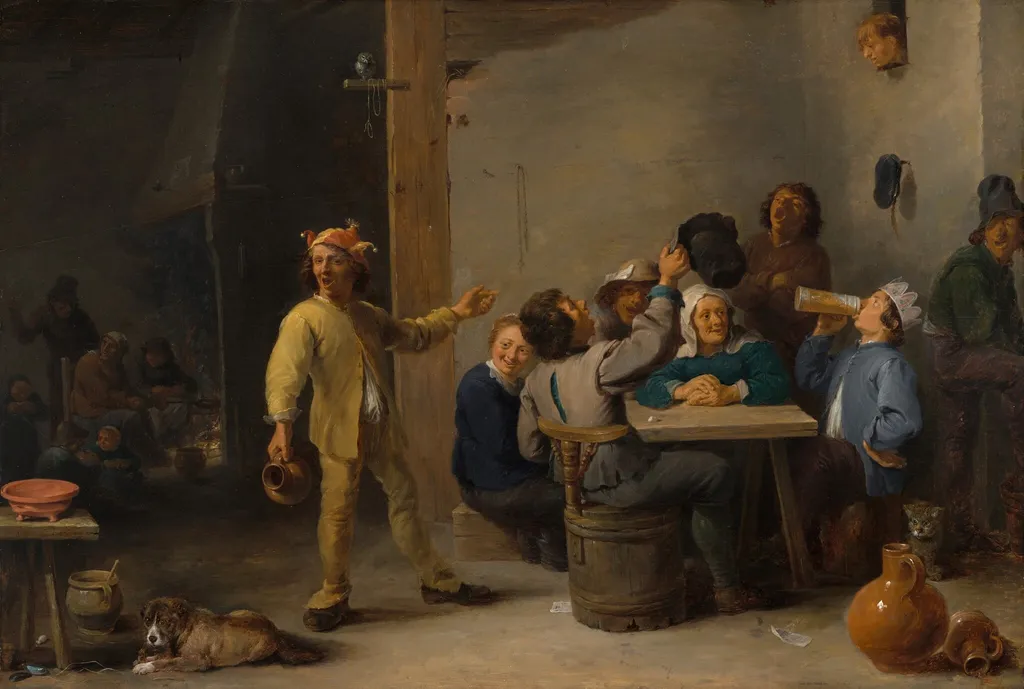
Peasants Celebrating Twelfth Night is an oil painting by the Baroque artist David Teniers the Younger. It dates from 1635 and is held in the collection of the National Gallery of Art.
- Inscription
- Inscribed:lower left on table edge: D. TENIERS F 1635; reverse: E'd Ladd Betts, Esq.
About this work
Subject & Meaning
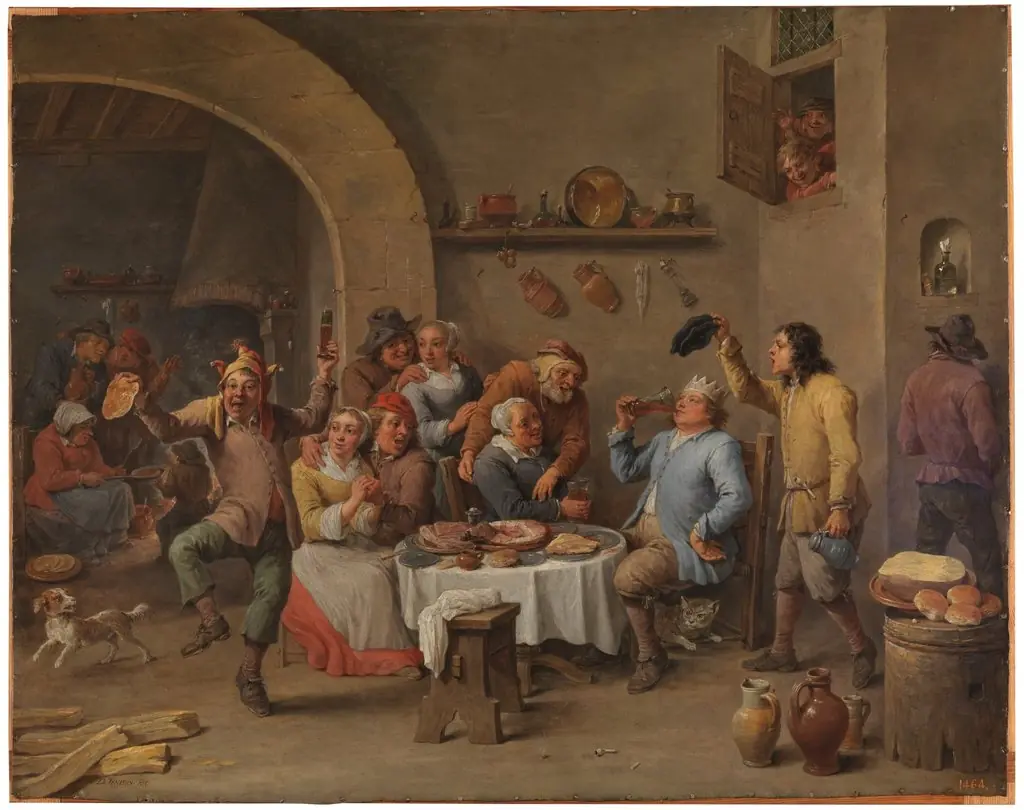
In the shadows, a second group gathers by the hearth, where a woman fries pancakes for children as a pipe-smoking man converses.
The painting depicts a raucous Twelfth Night celebration in a tavern, centered on the election of a "king" through a lottery of slips drawn from a hat or scattered on the floor. The newly crowned figure, distinguished by a paper crown, raises a jug in the traditional toast Le roi boit! ("The king drinks!"), while companions cheer and a drunken man relieves himself into a bucket. A jester capers, an elderly woman in a kerchief admires the scene, and a bystander peers through the doorway.
In the shadows, a second group gathers by the hearth, where a woman fries pancakes for children as a pipe-smoking man converses.
Teniers uses the motif to contrast folly and wisdom: above the jester's staff hangs an owl, a symbol of discernment, ignored by the revelers absorbed in their fleeting, chance-made authority.
Technique & Style
Executed in 1635, this work is an oil painting on a wooden panel. The artist signed the piece "D. TENIERS F 1635." The composition measures 47.2 cm in height and 69.9 cm in width.
Stylistically, the painting functions as a genre scene depicting a Twelfth Night celebration within an inn. Teniers employs dramatic lighting to isolate the main group of figures against a plastered wall, while a secondary gathering sits near a hearth in the darker left background. The narrative includes specific details such as lottery slips scattered on the floor and a hat, alongside symbolic elements like an owl perched above a jester, representing the ignored capacity to distinguish truth from falsehood.
History & Provenance
Painted in 1635, Peasants Celebrating Twelfth Night is signed and dated by David Teniers the Younger on the front. The work's early English provenance traces to Edward Ladd Betts, who died in 1695. By 1785 it belonged to M. Belinarde, and by 1936 it formed part of the Paris collection of Alfred and Jacques Pereire.
After passing through Mme. I. Pereire's estate, it was sold at Galerie Jean Charpentier, Paris, in 1937. It then entered the Brussels collections of Baron Alex. Gendebien in 1937 and Baron Robert Gendebien by 1955.
Between 1939 and 1941 the painting moved via Dutch and Antwerp dealers to the Goudstikker firm in Amsterdam and was acquired by Professor Hoffmann in Munich in December 1941. It returned to Baron Robert Gendebien in 1955 and passed through Eric-Emil Lyndhurst and Kunsthandel Gebr. Douwes before appearing at Sotheby's, London, in 1963.
Subsequent owners included Mrs. Pethick, Mrs. M. Polak, Kunsthandel Gebr. Douwes in 1964, and Dr. Heinrich Becker by 1967. The National Gallery of Art, Washington, acquired it from Schaeffer Galleries, New York, on 3 February 1972.
Legacy
David Teniers the Younger's 1635 depiction of Twelfth Night festivities established a narrative template for the genre, following the precedent set by Maerten van Cleve. The work's thematic resonance is evidenced by the subsequent adoption of the subject by other prominent Flemish and Dutch painters, including Jan Steen and Jacob Jordaens, who also explored the moral and social implications of the celebration. While Teniers utilized specific iconography, such as an owl symbolizing the ability to distinguish truth from falsehood, to critique the revelers' ignorance, the painting itself remains a primary reference for the genre.
Today, the work is housed in the National Gallery of Art in Washington, D.C., where it continues to be recognized as a definitive example of Teniers's genre scenes.
Overview
Peasants Celebrating Twelfth Night is an oil painting by David Teniers the Younger, created in 1635. This genre scene captures a boisterous celebration of Twelfth Night, a traditional winter festival. Executed on a wooden panel, the work exemplifies the artist's focus on everyday life, presenting a detailed glimpse into the festivities of common people during the 17th century.
Context
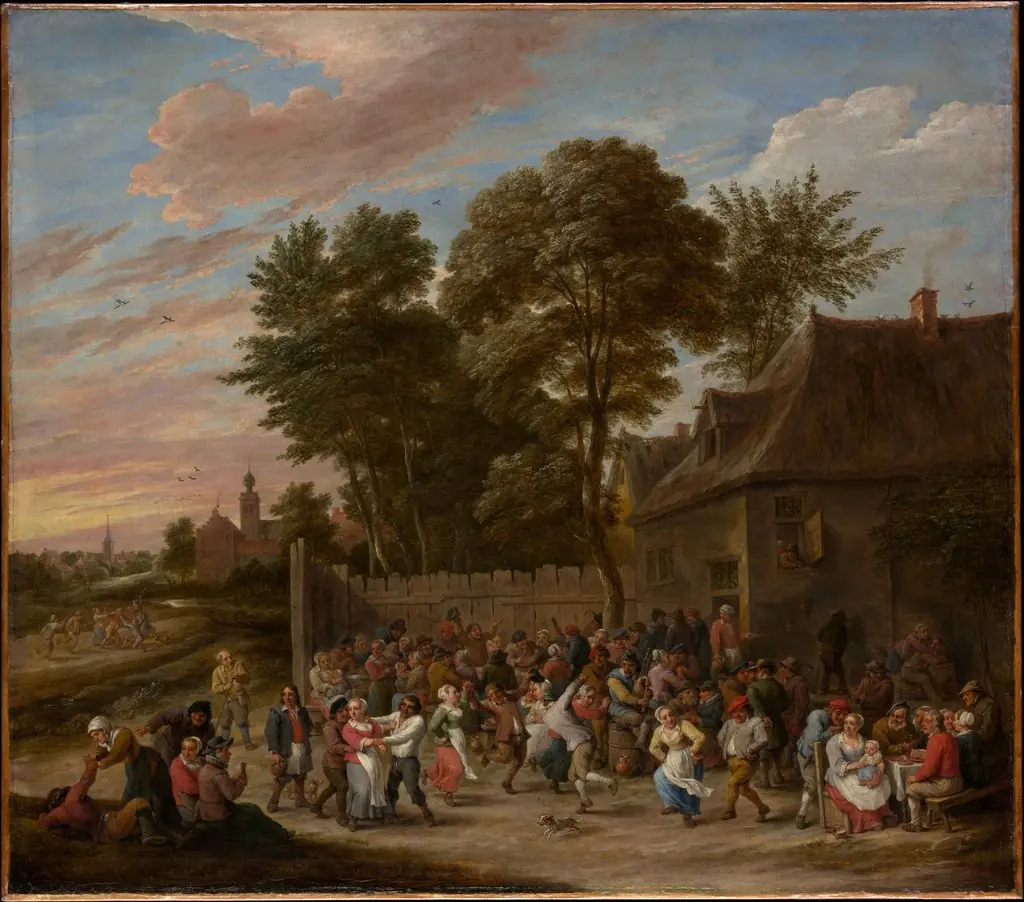
This work is characteristic of the genre painting popular in the 17th-century Low Countries, which focused on scenes of everyday life. David Teniers the Younger was a prominent practitioner of this style, often depicting peasant life and tavern scenes. The dramatic use of light and shadow, along with the dynamic composition and rich detail, aligns the painting with broader trends of the Baroque movement, which emphasized emotion and movement.
Own this work as a print
Artist & collection
Artist
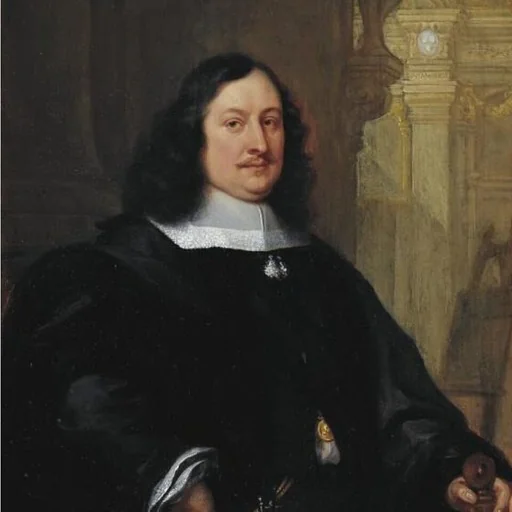
David Teniers the Younger or David Teniers II was a Flemish Baroque painter, printmaker, and artist.