Artwork
Apollo Pursuing Daphne
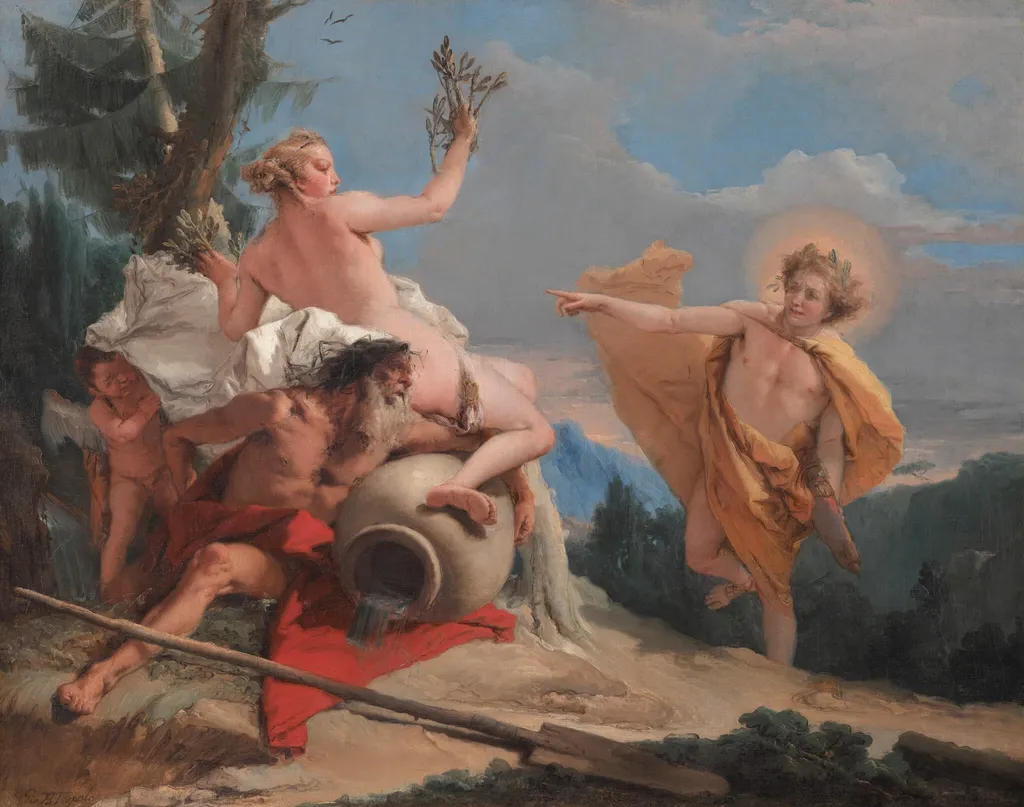
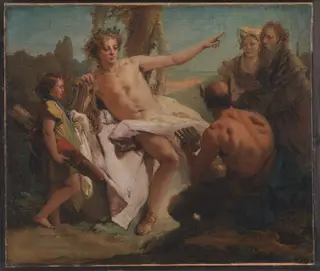
Apollo Pursuing Daphne is an oil painting by the Rococo painting artist Giovanni Battista Tiepolo. It dates from 1758 and is held in the collection of the National Gallery of Art.
- Inscription
- Inscribed:lower left: Gio. B. Tiepolo
About this work
Subject & Meaning
The elderly, bearded Peneus crouches beside a water‑filled jar, symbolizing his river godhood, and the winged Eros hides behind Daphne’s mantle.
The work illustrates the Ovidian myth of Apollo’s pursuit of the nymph Daphne, capturing the instant she calls upon her father Peneus and begins to turn into a laurel tree to escape the god’s unwanted affection. Apollo is shown in a yellow mantle, wearing a laurel wreath and holding a quiver, while Daphne, semi‑nude, twists backward with her legs and hands already sprouting foliage and her drapery slipping away. The elderly, bearded Peneus crouches beside a water‑filled jar, symbolizing his river godhood, and the winged Eros hides behind Daphne’s mantle.
The laurel signifies both victory and chastity, the flowing water represents the divine river that effects the metamorphosis, and the composition’s diagonal split visualizes the tension between desire and flight.
Technique & Style
The work Apollo Pursuing Daphne is executed in oil on canvas, a medium confirmed by the artist’s catalogue entry and the Kress collection record. Its support is a stretched canvas typical of mid‑18th‑century easel paintings, and the paint layer has been examined without reported structural deterioration, indicating stable handling over time. Stylistically, the composition relies on dramatic diagonal divisions that separate Apollo’s soaring figure, clothed in a yellow mantle and crowned with laurel, from the group of Eros, Peneus and Daphne, whose forms are rendered with Rococo elegance.
The palette combines luminous yellows with deep reds and earth tones, while the chiaroscuro modeling accentuates the moment of Daphne’s metamorphosis into a laurel tree.
History & Provenance
Giovanni Battista Tiepolo created Apollo Pursuing Daphne around 1755–1760, with a specific date of 1757 often cited based on its stylistic relationship to his 1757 frescoes at Villa Valmarana. Although the oil on canvas work is signed, it lacks a date. The painting originally formed a pair with a companion piece titled Venus and Vulcan.
Its documented ownership begins with Friedrich Jakob Gsell in Vienna, who acquired it after 1849. The work was sold at the Künstlerhaus in Vienna in March 1872, subsequently passing through Parisian collections including those of M. de Villars, Édouard Kann, and Mme Delaney before being purchased by dealer Fort in 1933. After further transactions involving Pierre Lauth and Rosenberg and Stiebel in New York, the Samuel H. Kress Foundation acquired the painting in 1950 and gifted it to the National Gallery of Art in Washington, D.C., in 1952.
Context
Apollo Pursuing Daphne is an oil on canvas dated to 1757, exemplifying Tiepolo’s Rococo style and belonging to the Samuel H. Kress Collection at the National Gallery of Art in Washington. Its technique and luminous palette align with the frescoes he executed at Villa Valmarana in the same year, and it was conceived as a pendant to a companion work, Venus and Vulcan. Tiepolo returned to the Apollo and Daphne myth on several occasions, notably a grisaille fresco in the Palazzo Archinto (c. 1730‑31) and a Louvre painting from around 1743‑44, situating the Washington canvas within his broader exploration of the theme.
Overview
Giovanni Battista Tiepolo's oil on canvas painting, Apollo Pursuing Daphne, captures a pivotal moment from classical mythology. The artwork depicts the god Apollo reaching for the nymph Daphne just as her transformation into a laurel tree begins. The scene is rendered with a luminous quality, highlighting the figures' dynamic movement and the ethereal nature of Daphne's metamorphosis.
Own this work as a print
Artist & collection

Artist
Giovanni Battista Tiepolo, also known as Giambattista Tiepolo, was an Italian painter and printmaker from the Republic of Venice who painted in the Rococo style, considered an important member of the 18th-century Venetian school.