Artwork
A Young Woman Reading
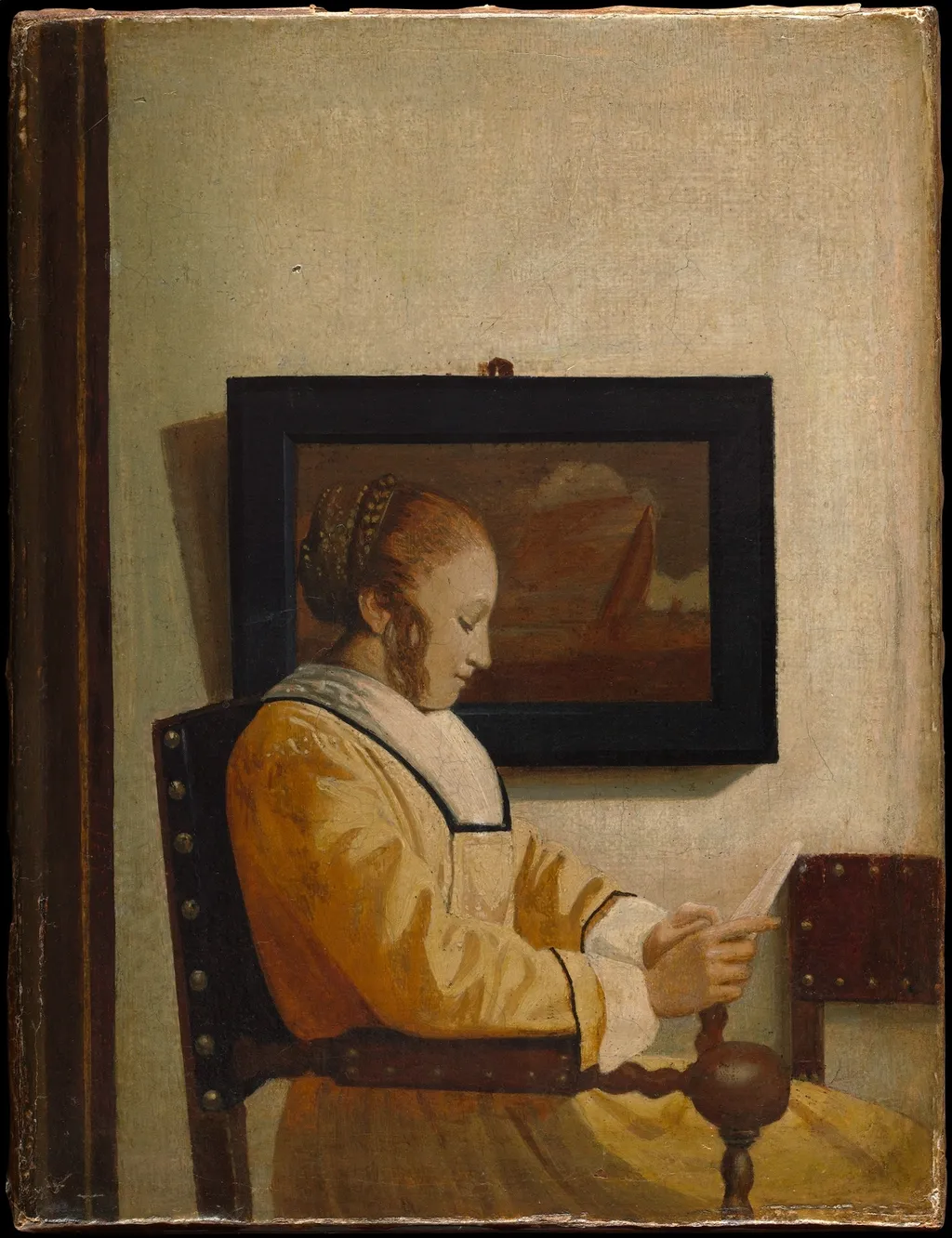
A Young Woman Reading is an oil painting. It dates from 1926 and is held in the collection of the Metropolitan Museum of Art.
About this work
Subject & Meaning
Art historically, the image is read as a quiet meditation on private, domestic reading, a theme central to seventeenth-century Dutch genre painting.
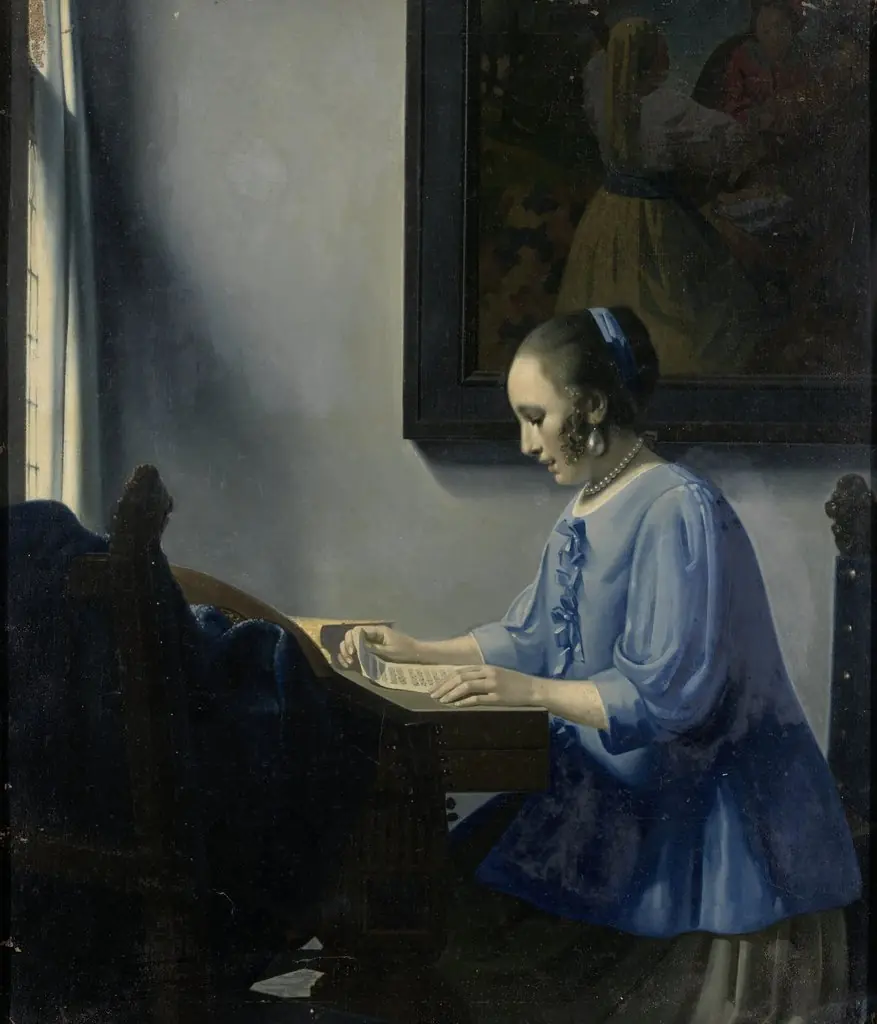
The painting depicts a woman absorbed in reading, shown in profile. According to the catalogue record, the work portrays a woman, the act of reading, and a profile view.
Art historically, the image is read as a quiet meditation on private, domestic reading, a theme central to seventeenth-century Dutch genre painting. The composition is closely linked to Vermeer's known works: the head is compared to that in Girl Reading a Letter at an Open Window, and the seascape element is associated with The Love Letter. These parallels, originally cited by Vitale Bloch in 1928 as evidence of authenticity, were reinterpreted by W.R. Valentiner as grounds for suspicion, since the painting appeared to be a pastiche of motifs drawn from Vermeer's own compositions rather than an independent work.
The painting thus stands as a witness to the early twentieth-century appetite among American collectors for Vermeer and works "in the manner of" Vermeer, while its iconography of a solitary female reader, a familiar Dutch Golden Age subject, masks its later-identified status as a modern imitation.
Technique & Style
The work is an oil painting on canvas, measuring 19.7 cm by 14.6 cm, and is classified as a 20th‑century painting that imitates the compositional conventions of the Dutch Golden Age. Its formal qualities include a profile view of a woman absorbed in reading, set within a quiet interior that recalls Vermeer’s handling of light and spatial depth. The surface is built up with oil paint applied to a stretched canvas support, a technique typical of the period.
Scholars have noted that the attribution to Vermeer was later questioned, leading to doubts about its authenticity and, by extension, its preserved condition.
History & Provenance
The work was created after the 1670s by an unknown painter in the manner of Johannes Vermeer and later identified as a modern forgery.
It entered the collection of Jules Bache, who purchased it in 1928 for $134,800 from Wildenstein, which had acquired it from Dr. G.A. Rademaker of The Hague. Bache bequeathed the painting to the Metropolitan Museum of Art in 1949. Early attributions were contested shortly after acquisition; critics such as W.R. Valentiner questioned its authenticity following a 1928 article by Vitale Bloch that compared its details to other Vermeer works.
A Young Woman Reading is held in the collection of the Metropolitan Museum of Art in New York. The work, an oil on canvas measuring 19.7 cm × 14.6 cm, was created in 1926 and entered the museum through the bequest of collector Jules Bache, who acquired it in 1928 after purchasing it from Wildenstein. Bache’s donation in 1949 placed the painting formally in the museum’s holdings.
Its attribution as a Vermeer imitation has been questioned, with scholars noting doubts about its authenticity and the uncertain link to Han van Meegeren.
Context
A Young Woman Reading entered the Metropolitan Museum of Art as part of the wave of Vermeer enthusiasm among early twentieth-century American collectors. Jules Bache acquired it in 1928 from Wildenstein, who had obtained it from Dr. G.A. Rademaker of The Hague, paying $134,800 under the assumption that it was an autograph Vermeer; he bequeathed it to the museum in 1949 with that attribution intact. The work is now classified as a painting by an unknown imitator of Johannes Vermeer, dating from around 1926 rather than the seventeenth century, and is regarded as a modern forgery, though a specific link to Han van Meegeren has not been confirmed.
The painting's scholarly reassessment began soon after its acquisition. In 1928, the Dutch critic Vitale Bloch published an article in which he noted similarities between its seascape and Vermeer's Love Letter and between its head and Girl Reading a Letter at an Open Window, treating these as evidence of authenticity. The critic W.R. Valentiner read the same observations as cause for suspicion, remarking that the near-annual discovery of "new" Vermeers should itself raise doubts.
The case parallels that of A Lady Playing the Guitar, another Bache purchase that was likewise re-evaluated, and together they illustrate how connoisseurship of Vermeer was being tested by forgeries circulating in the interwar market.
Legacy
The painting's history has shaped its legacy as a cautionary example in the study of Vermeer attributions. Acquired by Jules Bache in 1928 and bequeathed to the Metropolitan Museum of Art in 1949 as an authentic Vermeer, it was later recognized as a modern forgery, though the attribution of the forgery to Han van Meegeren remains uncertain. Vitale Bloch's 1928 article, which cited similarities to works such as the Love Letter and Girl Reading a Letter at an Open Window, was read by W.R. Valentiner as grounds for suspicion rather than authentication.
The work stands alongside related pieces, such as A Lady Playing the Guitar, as evidence of the strong early twentieth-century appetite among American collectors for Dutch Golden Age paintings attributed to Vermeer.
The painting remains part of the Metropolitan Museum of Art's collection and is catalogued by the RKD.
Overview
A Young Woman Reading is an oil on canvas painting from the Dutch Golden Age, created by an unknown artist sometime after the 1670s. This work reflects stylistic characteristics associated with the renowned Dutch master Johannes Vermeer. It is currently held in the collection of the Metropolitan Museum of Art, representing a quiet moment of domestic life from the period.
Artist & collection