Artwork
Young Woman in an Interior
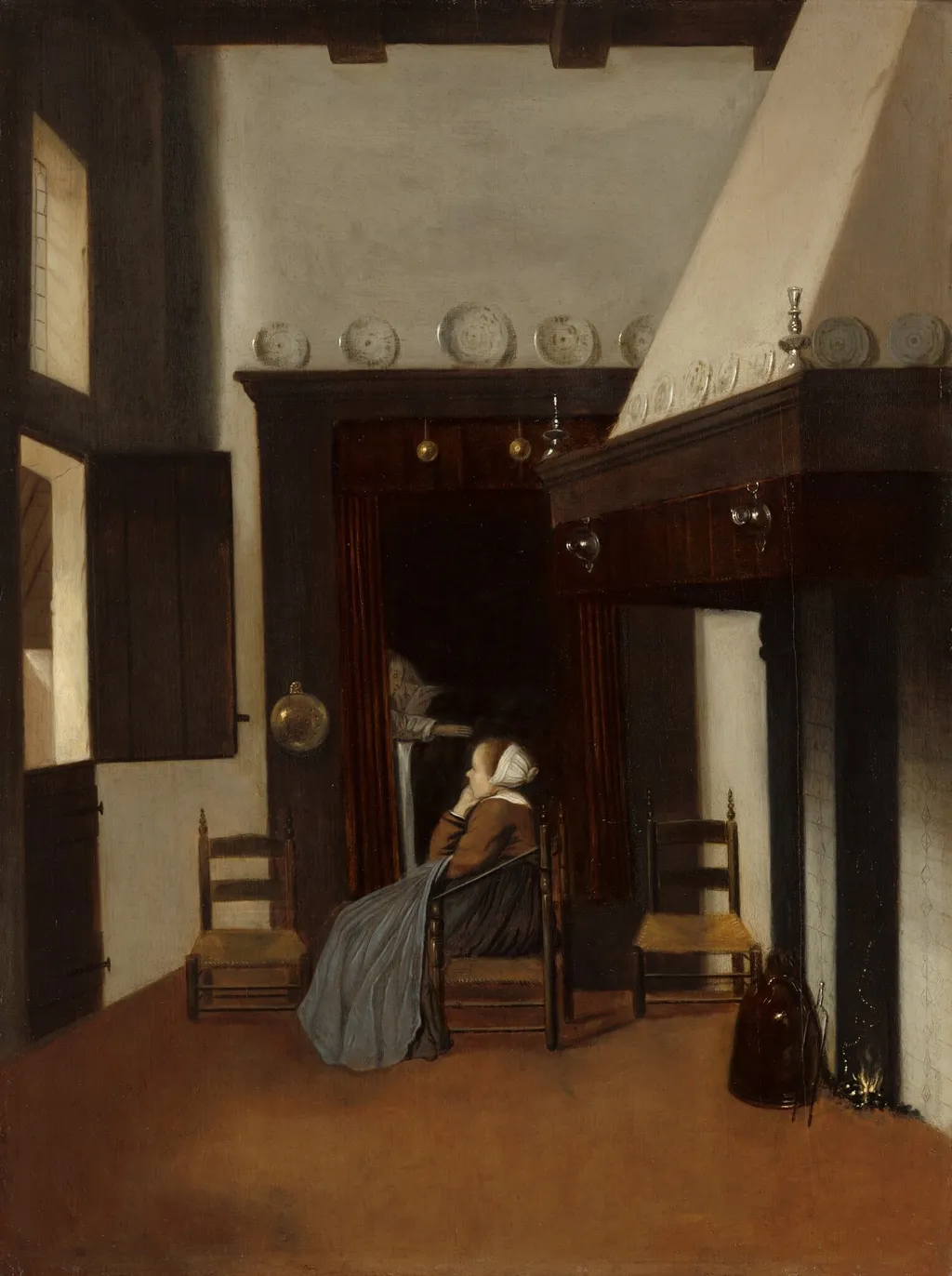
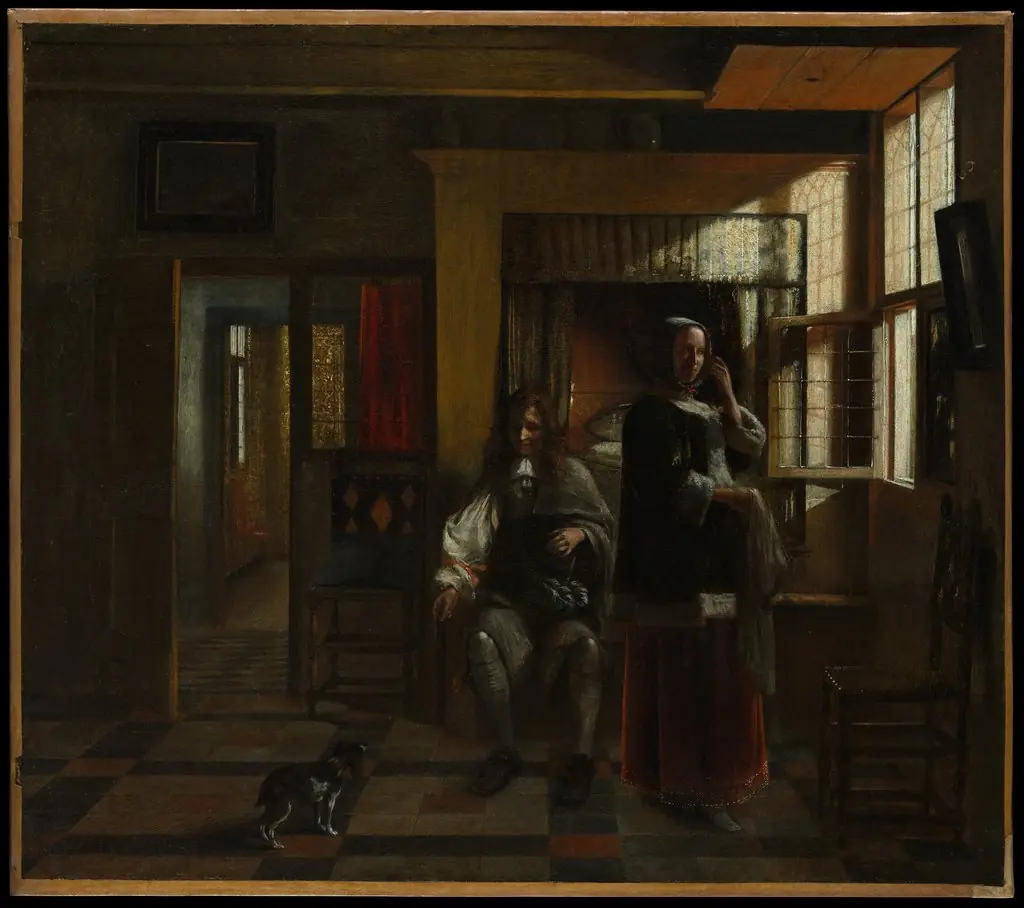
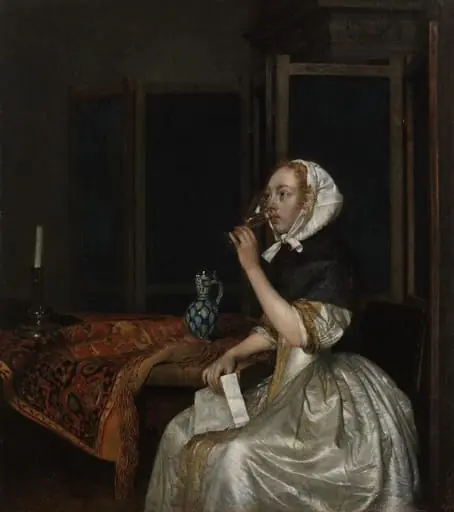
Young Woman in an Interior is an oil painting by the Baroque artist Jacob Vrel. It dates from 1660 and is held in the collection of the National Gallery of Art.
About this work
Subject & Meaning
The absence of explicit narrative invites interpretation, aligning with the era’s fascination with ordinary yet evocative moments.
Jacobus Vrel’s Young Woman in an Interior (1660) depicts a solitary woman in a modest domestic setting, characterized by the presence of a box-bed, a common feature in seventeenth-century Dutch homes. The scene exemplifies genre painting, focusing on everyday life rather than grand narratives. The woman’s quiet demeanor and the enclosed space, emphasized by the box-bed’s partial concealment, suggest themes of privacy, introspection, or domestic routine.
While Vrel’s work lacks the overt symbolism of contemporaries like Vermeer, the composition’s intimacy may evoke the virtues of domesticity or the isolation of urban life in the Dutch Golden Age. The absence of explicit narrative invites interpretation, aligning with the era’s fascination with ordinary yet evocative moments.
Technique & Style
Executed in 1660, this work is an oil painting on a wooden panel support. The composition measures 55.7 by 41.3 centimeters and depicts a solitary woman situated within a domestic interior featuring a box-bed. Stylistically, the piece is classified as a genre scene, characterized by an intimate focus on everyday life.
While the artist is primarily identified as Jacobus Vrel, some attributions have historically associated the work with Pieter de Hooch, reflecting shared stylistic qualities in the rendering of Dutch interior spaces. The handling of the medium creates a quiet, contemplative atmosphere typical of mid-seventeenth-century Netherlandish art, though specific details regarding the current physical condition or surface preservation are not provided in the available records.
History & Provenance
Dated to 1660, this oil on panel by Jacobus Vrel entered the documented ownership chain with Frits Lugt of Maartensdijk prior to 1929. By 1935, the work belonged to M. van Leeuwen-Boomkamp in Oud-Bussum, passing to P. van Leeuwen-Boomkamp at the same location by 1955, when it was lent to a Rotterdam exhibition. The painting was sold at Sotheby's in London on December 8, 1971, subsequently entering the collection of the J. Paul Getty Museum in Los Angeles as accession number 71.PB.61.
The Getty deaccessioned the work in 2007, selling it at Sotheby's New York on January 25 of that year to June deH. Weldon of New York. In 2012, Weldon gifted the piece to the National Gallery of Art in Washington, D.C.
Jacob Vrel’s painting Young Woman in an Interior is currently held by the National Gallery of Art in Washington, D.C., where it was gifted in 2012 after being deaccessioned from the J. Paul Getty Museum; its accession there followed a sale at Sotheby’s New York in January 2007. The work was previously owned by Frits Lugt, Maartensdijk (before 1929), and later by M. van Leeuwen‑Boomkamp and P. van Leeuwen‑Boomkamp before 1955, when it was lent to an exhibition in Rotterdam. It entered the Getty collection in 1971 as accession 71.PB.61 and was exhibited there prior to its 2007 sale.
Context
Jacobus Vrel painted Young Woman in an Interior in 1660, an oil on panel genre scene that shows a woman beside a box‑bed. Contemporary scholarship, notably Clotilde Brière‑Misme’s 1935 article, characterized Vrel as an “Intimiste hollandaise,” highlighting his focus on private domestic interiors. The work was lent to an exhibition in Rotterdam in 1955, indicating sustained interest in Vrel’s oeuvre.
After entering the Getty Museum collection as accession 71.PB.61, the painting was deaccessioned in 2007 and later acquired by the National Gallery of Art, where it remains on public view. Its depiction of interior space contributes to understanding of Dutch Golden Age genre painting and the development of domestic genre scenes.
Overview
Young Woman in an Interior, painted by Jacobus Vrel in 1660, is an oil-on-panel work depicting a solitary figure within a confined domestic space. The composition centers on a woman seated inside a box bed, a common piece of furniture in 17th-century Dutch interiors, with a curtain drawn partially across the opening. She is dressed in a dark gown and a white linen cap, her posture suggesting a moment of quiet repose or contemplation.
Vrel employs a restrained palette and soft, diffuse lighting to emphasize the textures of the wood and fabric, creating an atmosphere of stillness and intimacy. The artist frames the scene through the bed's structure, which acts as a proscenium, isolating the subject from the viewer while inviting close observation of her private world. This work exemplifies Vrel's unique contribution to Dutch genre painting, characterized by a distinctive, almost naive perspective and a focus on the psychological weight of everyday solitude.
Created during the height of the Dutch Golden Age, the painting reflects a shift away from moralizing narratives toward a more observational, empathetic portrayal of domestic life, distinguishing Vrel's oeuvre from his contemporaries.
Own this work as a print
Artist & collection
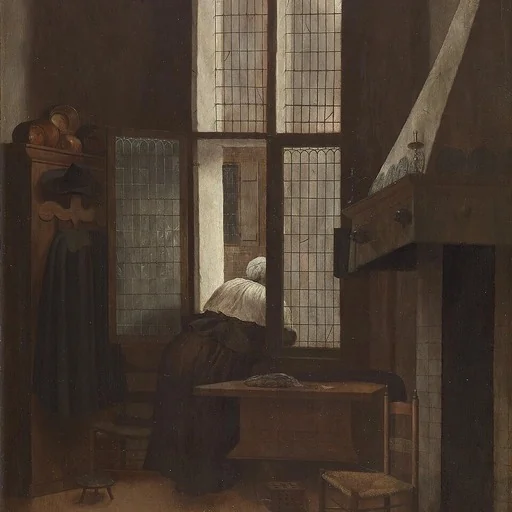
Artist
Jacob Vrel (fl. 1654 – c.1670) was a Dutch, Flemish, or Westphalian painter of interiors and urban street scenes during the Dutch Golden Age (1588–1672). He was likely most active from 1654 to 1662.

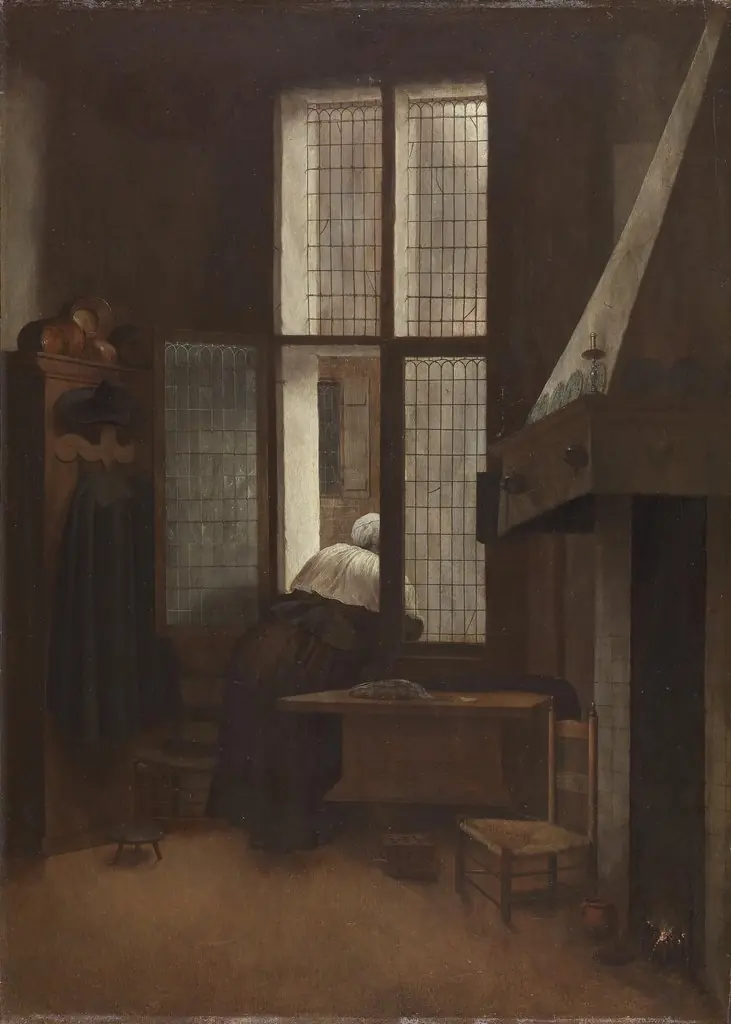 Women at the window
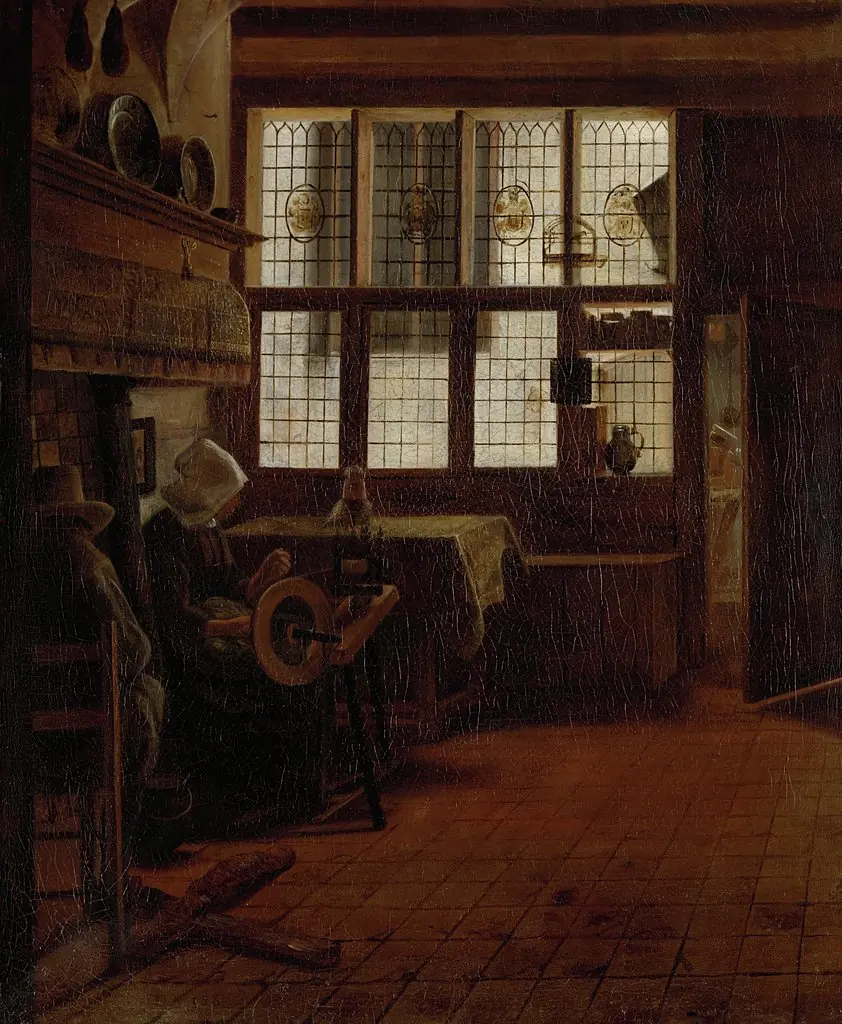 Interior with Woman at the Spinning Wheel
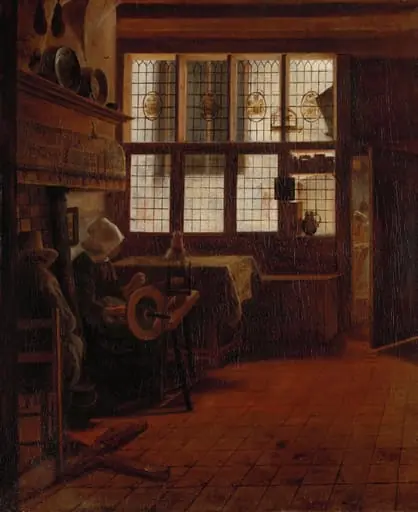 Interior with Woman at the Spinning Wheel
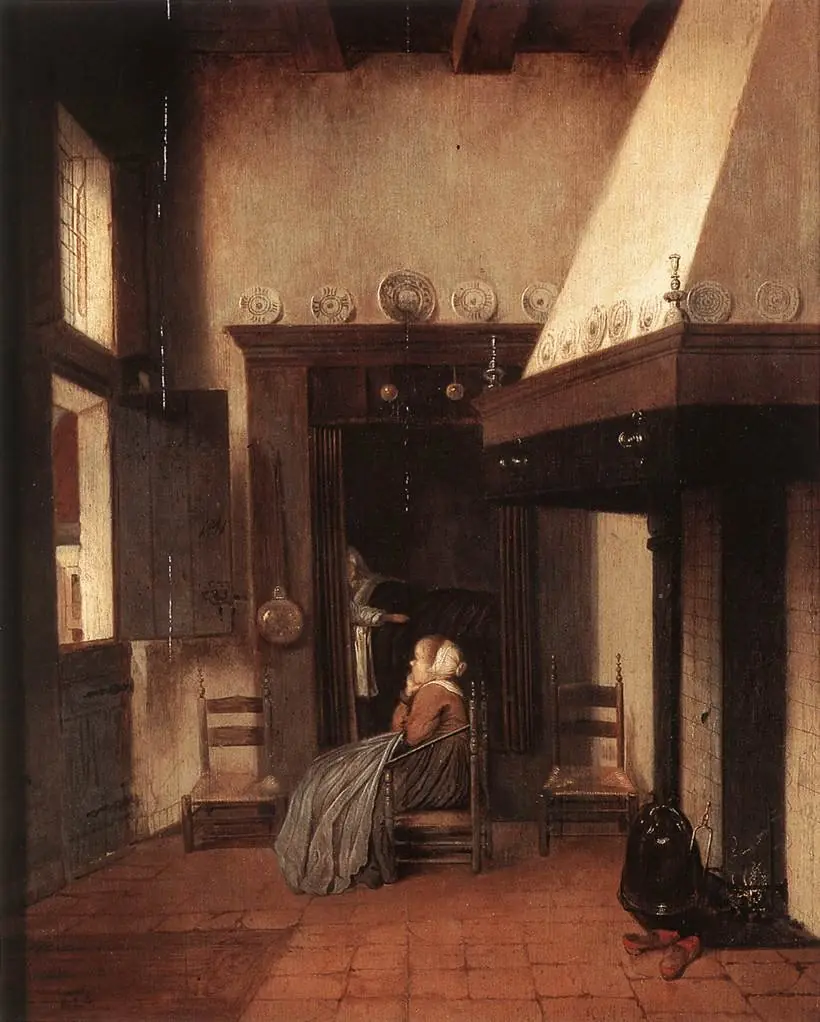 The little Nurse
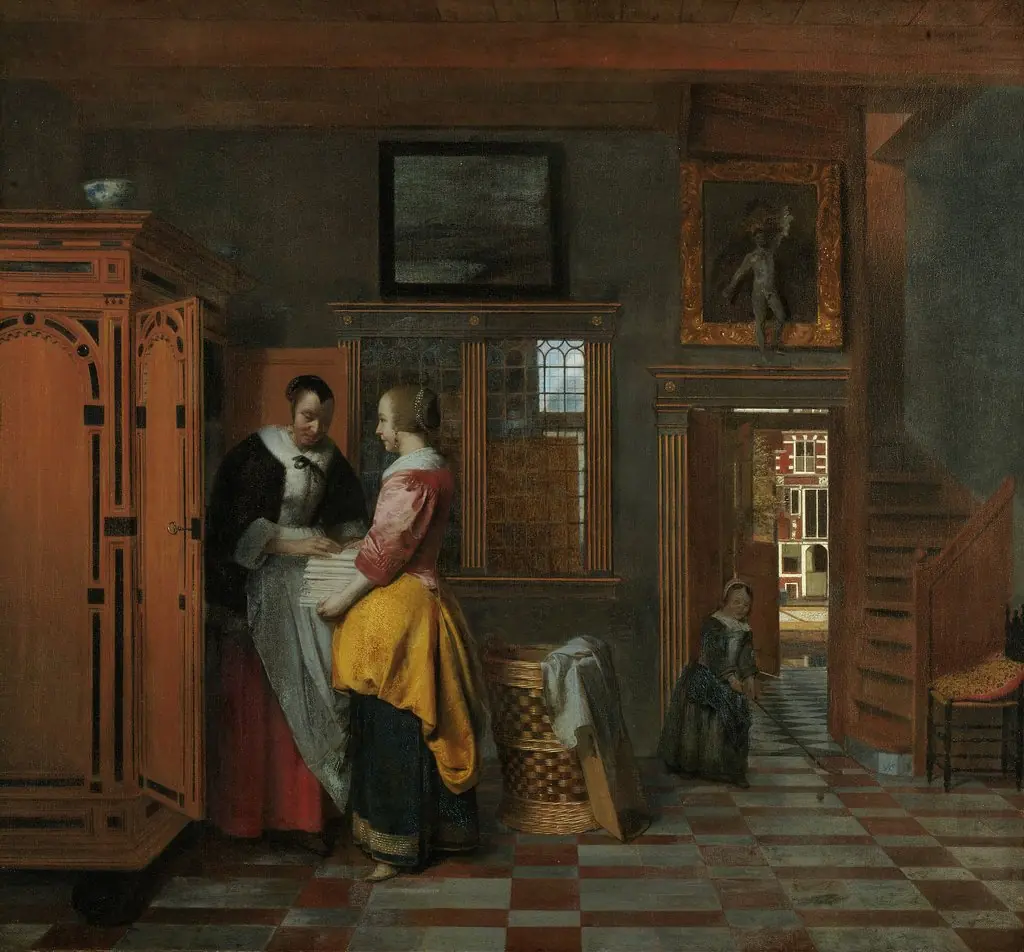 Interior with Women beside a Linen Cupboard
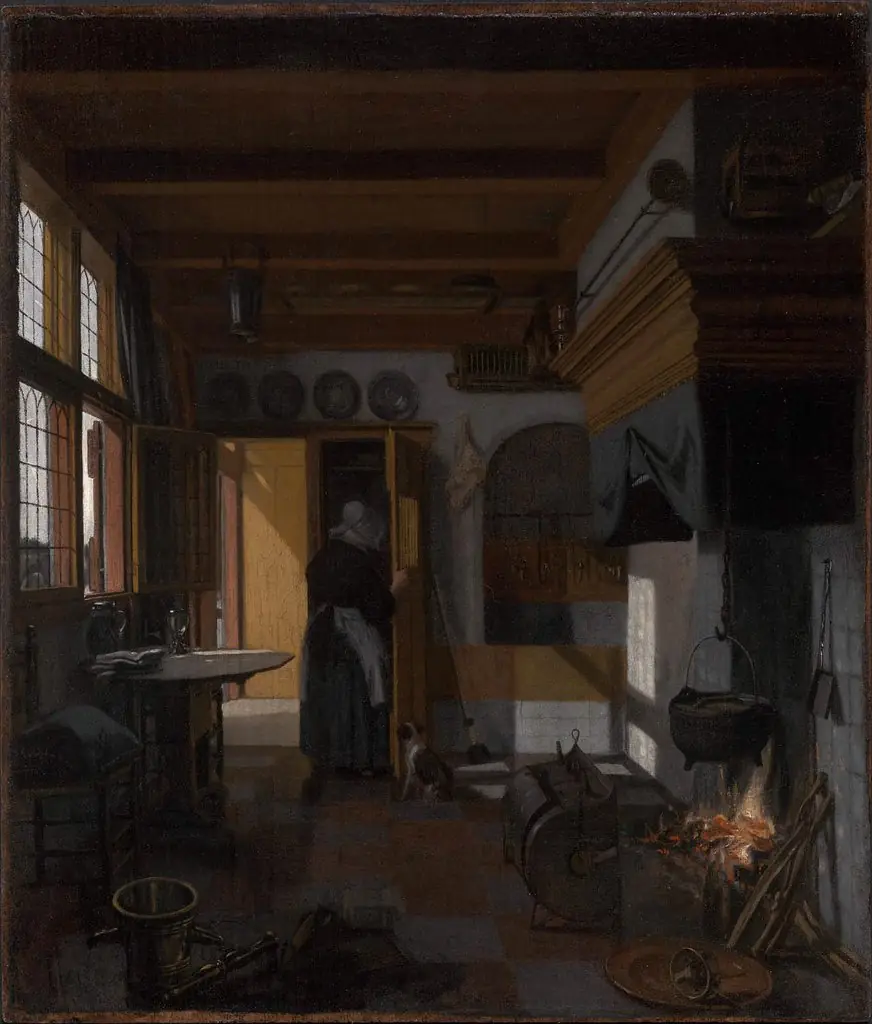 Kitchen Interior
 Indulgent Old Lady
 The Bedroom
 Nursing Mother, and Child with Serving Maid
 A Woman Preparing Bread and Butter for a Boy
 Viiniä juova nainen kirje kädessään
- Interior with a Young Couple