Artwork
Brahma
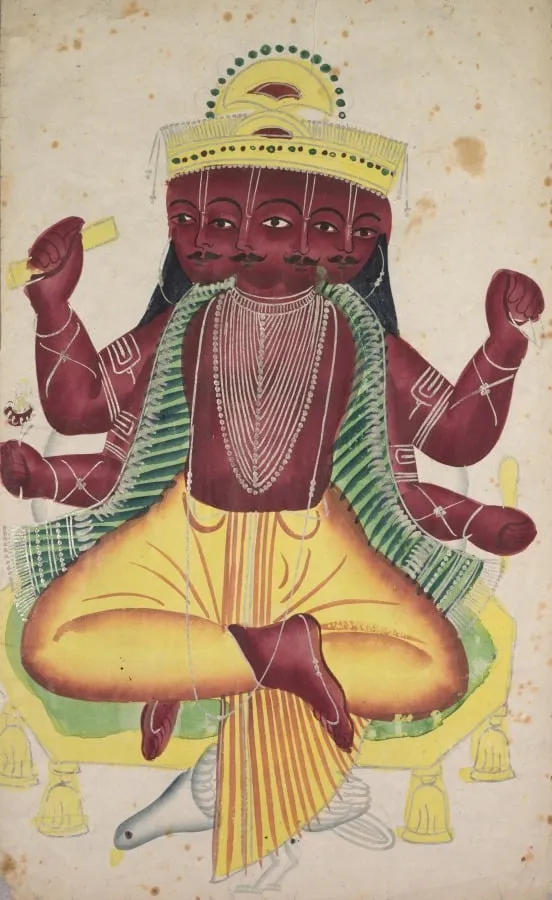
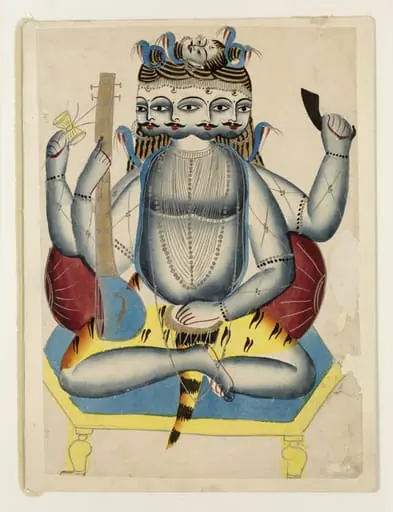
Brahma is an unspecified painting by the Bengal School artist Unknown. It dates from 1890 and is held in the collection of the Cleveland Museum of Art.
- Accession no.
- 2003.148
About this work
The style is Kalighat, quick, bold lines made for cheap, mass-produced images.
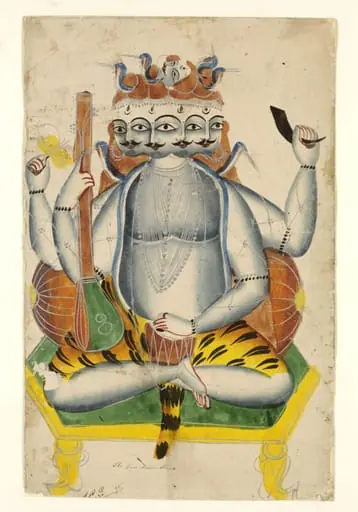
A blue-skinned god sits on a lotus, four heads facing every direction. He holds a book, a flower, and two other objects that blur at the edges. A white goose peeks at his feet.
This is Brahma, the Hindu creator god, painted in Kolkata around 1890. The style is Kalighat, quick, bold lines made for cheap, mass-produced images. Artists left out fine details to work fast. The goose, his ride, looks almost curious, like a pet watching its owner.
Look up kalighat to see more of these lively, everyday devotional pictures.
Overview
This late nineteenth‑century painting depicts Brahma, the Hindu deity associated with creation. He is shown seated on a lotus, his four heads turned toward the cardinal points. In his upper right hand he holds a manuscript, while a lotus blossom rests in his lower right.
A white goose stands at his feet, and two additional objects are suggested in his left hands, their outlines softened by the rapid brushwork.
Subject & Meaning
The four heads symbolize Brahma’s all‑seeing nature, and the lotus signifies both purity and the emergence of life. The manuscript in his right hand identifies him as the source of sacred knowledge, echoing the concept of the ultimate reality, Brahman. The lotus flower in the opposite hand alludes to birth and procreation, reinforcing his role as the creator within the Hindu pantheon. The goose, his traditional vehicle, adds a domestic, attentive presence.
Technique & Style
Executed in the Kalighat tradition of Kolkata, the work employs bold, sweeping lines and a simplified palette designed for quick reproduction. Details are intentionally minimized; the edges of the objects in Brahma’s left hands blur, reflecting the genre’s emphasis on immediacy over fine rendering. This economical approach allowed artists to produce affordable devotional images for a wide audience, favoring expressive outlines over intricate modeling.
History & Provenance
Created circa 1890 in the bustling artistic workshops of Kolkata, the painting originates from a period when Kalighat studios catered to popular religious demand. Such works were typically sold in street markets and temples, circulating among devotees. While the specific artist remains unidentified, the piece exemplifies the mass‑produced devotional art that characterized the era’s visual culture.
Context
Kalighat paintings emerged as a response to the growing urban middle class in colonial Bengal, offering accessible religious imagery that blended traditional iconography with contemporary aesthetics. Brahma’s depiction here reflects both canonical symbolism and the informal, lively character of everyday devotional practice, illustrating how sacred themes were adapted for mass consumption during a time of social and cultural transition.
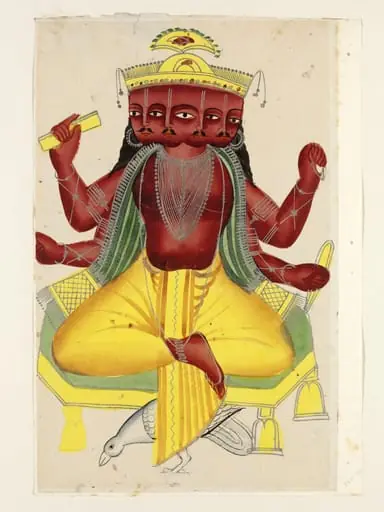
Artist & collection