Artwork
Feeding horses
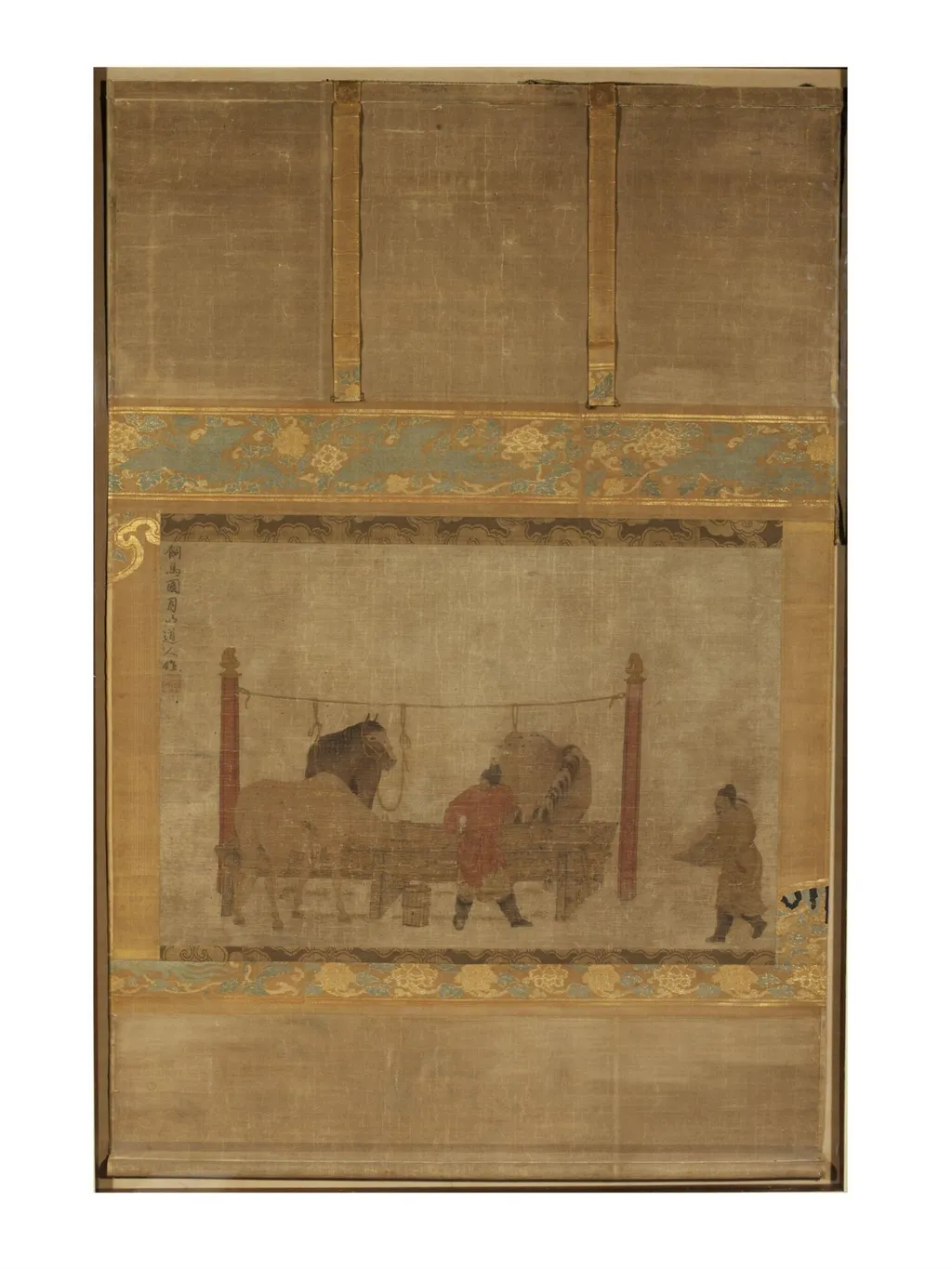
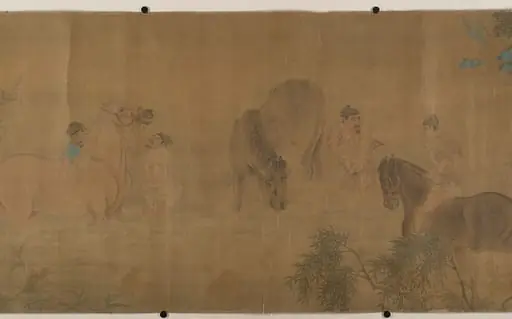
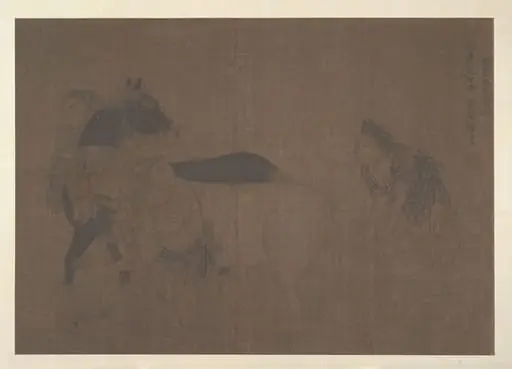
Feeding horses is a paint painting by the Ming dynasty painting artist Unknown. It dates from 1 and is held in the collection of the Victoria and Albert Museum. This painting depicts two horses being tended by a stable attendant, rendered in muted earth tones with soft black outlines.
About this work
Overview
This painting depicts two horses being tended by a stable attendant, rendered in muted earth tones with soft black outlines.
This painting depicts two horses being tended by a stable attendant, rendered in muted earth tones with soft black outlines. Though once attributed to the Yuan dynasty artist Ren Renfa, stylistic analysis reveals a looser, less refined brushwork, suggesting it was produced by an anonymous hand. It functions as a reversed variant of the final section of Ren’s 'Nine Horses' handscroll, now held by the Nelson-Atkins Museum, and shares strong visual ties to a 1603 woodblock print from Master Gu’s Picture Album.
Subject & Meaning
The scene captures a quiet, everyday moment in a stable, emphasizing routine care over grandeur. The reversed composition introduces subtle shifts in the horses’ postures and spatial arrangement, transforming the original’s narrative flow. This inversion, combined with the absence of overt symbolism, suggests the work may have served as a study or imitation rather than a ceremonial or imperial commission, reflecting a broader interest in replicating established models within late Ming artistic circles.
Technique & Style
The brushwork is more fluid and less precise than in Ren Renfa’s original, lacking the controlled linework and tonal gradation characteristic of Yuan court painting. Colors are subdued, dominated by ochres, browns, and grayed blacks, with minimal use of pigment. Outlines are delicate and uneven, indicating a hand less trained in the formal conventions of horse painting. The overall effect is intimate and unadorned, contrasting with the polished execution of the Nelson-Atkins version.
History & Provenance
The painting was falsely signed to mimic Ren Renfa’s authority, likely to enhance its value. It traveled to Japan before entering Western collections, as did the Nelson-Atkins scroll. In Japan, the original scroll inspired three Kano School artists to copy its sections individually, now preserved in Tokyo National Museum.
The V&A painting’s connection to the 1603 woodblock print suggests it may have been the source for the print, not the other way around, challenging earlier assumptions about its origin.
Context
During the late Ming period, reproductions and adaptations of Yuan dynasty works were common, especially among collectors and artists seeking to engage with classical traditions. The circulation of images through woodblock prints allowed for wider dissemination, often blurring authorship. This painting reflects a broader trend in which established compositions were reinterpreted, sometimes inaccurately, as part of a living dialogue with the past rather than mere forgery.
Legacy
Though not the work of a named master, the painting contributes to understanding how Yuan imagery was transmitted and transformed across centuries. Its link to both the Nelson-Atkins scroll and the Master Gu print highlights the role of replication in preserving and recontextualizing artistic heritage. It stands as a quiet testament to the enduring influence of Ren Renfa’s compositions, even when mediated by lesser-known hands.
Artist & collection