Artwork
Folio from a Manuscript of the Pancavimsatisahasrika Prajnaparamita
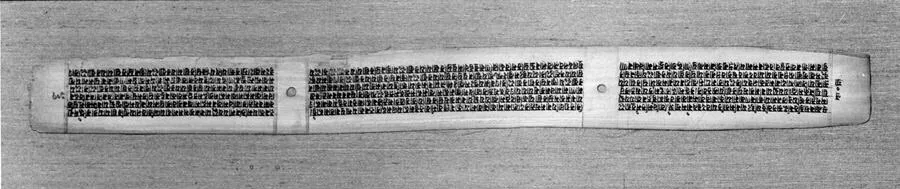
Folio from a Manuscript of the Pancavimsatisahasrika Prajnaparamita is an unspecified painting by Unknown. It dates from 1096 and is held in the collection of the Metropolitan Museum of Art. This folio is part of a handwritten manuscript containing the Pancavimsatisahasrika Prajnaparamita, a Mahayana Buddhist scripture.
About this work
Overview
Small perforations along the top and bottom edges suggest it was once bound with other folios into a codex, typical of South Asian manuscript traditions.
This folio is part of a handwritten manuscript containing the Pancavimsatisahasrika Prajnaparamita, a Mahayana Buddhist scripture. Executed on light-colored paper, it features dense black script in a small, uniform script that fills nearly the entire surface. Small perforations along the top and bottom edges suggest it was once bound with other folios into a codex, typical of South Asian manuscript traditions.
Subject & Meaning
The text is a section of the Prajnaparamita sutra, which expounds on the nature of emptiness and transcendent wisdom in Mahayana Buddhism. As a devotional object, its primary function was ritual and meditative rather than decorative. The absence of imagery reflects an emphasis on the sacred power of the written word, where the act of copying and reciting the text was itself an act of spiritual practice.
Technique & Style
The script is meticulously rendered in fine brushwork, likely using iron gall ink on handmade paper. The uniformity of letter size and spacing indicates a trained scribe working under strict conventions. No illumination, borders, or ornamentation are present, aligning with ascetic traditions that prioritized textual purity over visual embellishment.
History & Provenance
The folio originates from a larger manuscript produced in eastern India or Nepal, likely between the 11th and 13th centuries. It entered the collection of The Metropolitan Museum of Art through documented acquisitions of South Asian religious manuscripts, though its specific provenance prior to the 20th century remains undocumented.
Context
During the late medieval period in the Indian subcontinent, Buddhist monasteries maintained scriptoria where monks copied sacred texts by hand. These manuscripts were often stored in temple libraries and used in liturgical recitations. The lack of imagery on this folio reflects a textual tradition that valued precision and continuity over artistic interpretation.
Legacy
This folio represents the enduring practice of manuscript preservation in Buddhist communities, where the physical act of transcription was seen as a meritorious deed. Though visually austere, it embodies centuries of scholarly and devotional labor, serving as a tangible link to the transmission of Buddhist thought across Asia.

Artist & collection









 Text, Folio 83 (verso), from a Manuscript of the Perfection of Wisdom in Eight Thousand Lines (Ashtasahasrika Prajnaparamita-sutra)
 Text, Folio 72 (verso), from a Manuscript of the Perfection of Wisdom in Eight Thousand Lines (Ashtasahasrika Prajnaparamita-sutra)
 Text, Folio 82 (verso), from a Manuscript of the Perfection of Wisdom in Eight Thousand Lines (Ashtasahasrika Prajnaparamita-sutra)
 Text, folio 54 (verso), from a Manuscript of the Perfection of Wisdom in Eight Thousand Lines (Ashtasahasrika Prajnaparamita-sutra)
 Untitled
 Text, Folio 63 (verso), from a Manuscript of the Perfection of Wisdom in Eight Thousand Lines (Ashtasahasrika Prajnaparamita-sutra)
 Text, Folio 69 (verso), from a Manuscript of the Perfection of Wisdom in Eight Thousand Lines (Ashtasahasrika Prajnaparamita-sutra)