Artwork
Garden of love at the court of Philippe the Good, Duke of Burgundy
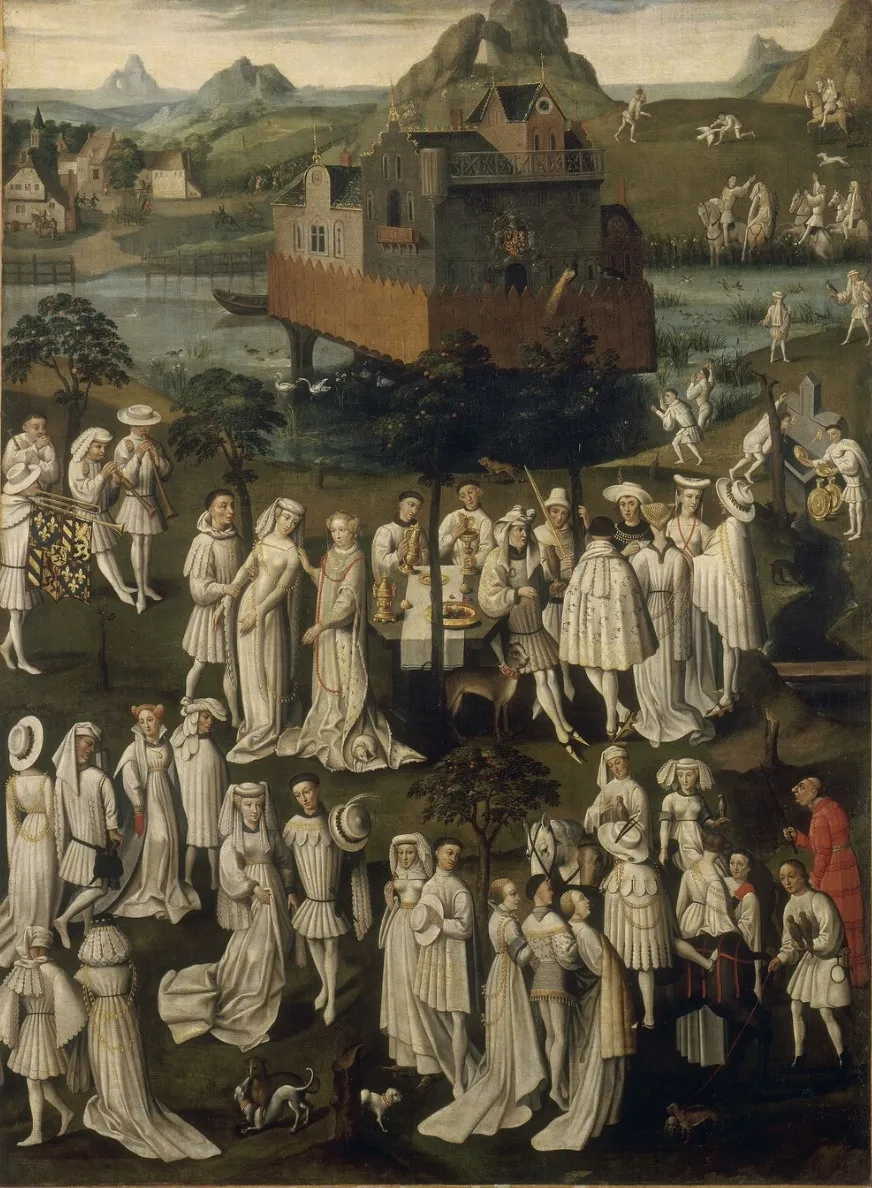
Garden of love at the court of Philippe the Good, Duke of Burgundy is an oil painting. It dates from 1460 and is held in the collection of the Palace of Versailles.
About this work
Subject & Meaning
These scenes reflect the Burgundian court’s cultural emphasis on chivalry and courtly love, with hunting symbolizing both noble privilege and romantic pursuit.
The painting depicts a courtly gathering in an idealized garden setting, where nobles dressed predominantly in white and gold engage in leisurely activities such as music, dancing, feasting, and falconry. These scenes reflect the Burgundian court’s cultural emphasis on chivalry and courtly love, with hunting symbolizing both noble privilege and romantic pursuit. A central pond supports a pavilion on stilts, evoking the legendary Fountain of Youth, a motif tied to themes of fleeting youth and earthly pleasure.
A lone fool, clad in red, disrupts the otherwise harmonious scene, serving as a visual memento mori that underscores the vanitas of courtly pleasures. The presence of the Burgundian coat of arms on a musician’s flag anchors the event in the duchy’s political and cultural milieu during Philippe le Bon’s reign. Scholars link the composition to specific festivities, such as the 1430–1431 nuptials of André de Toulongeon, though attributions to Jan van Eyck or his circle remain debated.
Technique & Style
The painting is executed in tempera and oil paint, originally applied to canvas before being marouflé onto a wooden panel support. Measuring 164 cm in height and 120 cm in width, the work adopts a vertical format typical of mid-16th-century production. Stylistically, it depicts a courtly allegory where figures are arranged across two registers on a sparse meadow dotted with shrubs.
The composition features a dominant color scheme of white and gold for the nobility, contrasted by a single jester clad in red holding a staff. Iconographic details include hunting dogs, falcons, and a hunting scene in the upper right, alongside a distinctive building on stilts over a pond. The background landscape reflects mid-16th-century artistic conventions rather than the earlier 15th-century costumes worn by the figures.
History & Provenance
The painting is a mid-16th-century anonymous copy, possibly of a lost 15th-century original by Jan van Eyck or his circle. It is held at the Musée national des châteaux de Versailles et de Trianon under inventory number MV 5423.
At the end of the 19th century, the work was in Mannheim in the collection of M. Maas. Recommended by the curator of the Carlsruhe museum to Paul Leprieur, deputy curator at the Louvre, it was acquired for the national collections in 1897 and entered the Versailles collections on 28 September 1898.
A later 17th-century version, inventory number 3981, is held at the Musée des Beaux-Arts de Dijon. The Versailles museum had possessed another version since 1844 from the collection of M. Despaux, erroneously said to come from the Gaignières collection; this inferior, more recent canvas was later deposited at the Musée des Beaux-Arts de Dijon in 1951.
The painting is held in the collections of the Musée national des châteaux de Versailles et de Trianon, where it is inventoried as MV 5423. It entered the Versailles holdings on 28 September 1898 after its acquisition by the Musées nationaux in 1897 from the Mannheim collection of M. Maas, arranged by Paul Leprieur, then assistant curator at the Louvre.
A later copy, attributed to the seventeenth century, is preserved at the Musée des Beaux-Arts de Dijon under inventory number 3981.
Overview
This painting, titled "Garden of Love at the Court of Philippe the Good, Duke of Burgundy," is a tempera work depicting a lively outdoor gathering. The scene is populated by numerous figures in elaborate 15th-century attire, engaged in various activities such as walking, making music, and serving food. A castle-like structure by a body of water, accessible via a bridge, forms the background. The palette predominantly features muted tones, accented by occasional bright reds and greens.
Context
The painting offers a glimpse into the opulent court culture of Philippe the Good, Duke of Burgundy, a prominent patron of the arts in the 15th century. Such gatherings in a "garden of love" were popular themes, reflecting ideals of courtly romance and leisure. The depiction of a bustling scene with varied social roles underscores the complexity and hierarchical structure of ducal life during this period.
Artist & collection

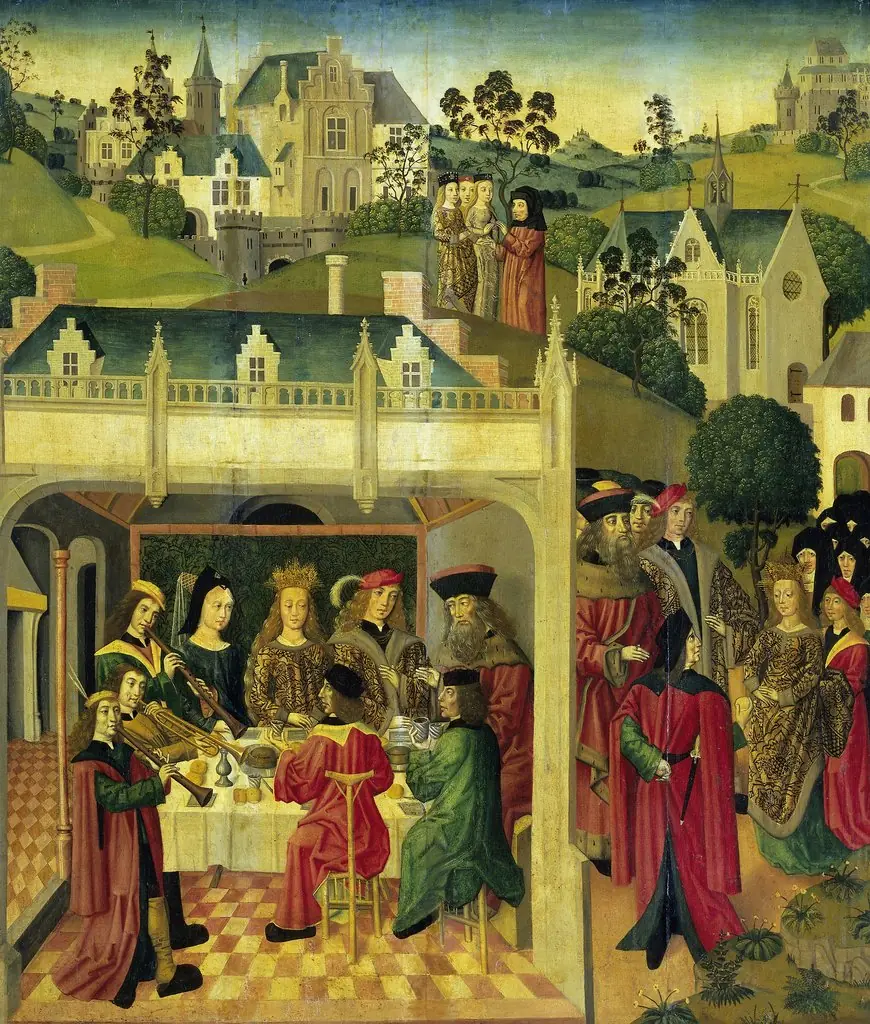
- Inner left wing of an altarpiece with the wedding feast of St Elizabeth and Louis of Thuringia in the Wartburg
 An historical scene
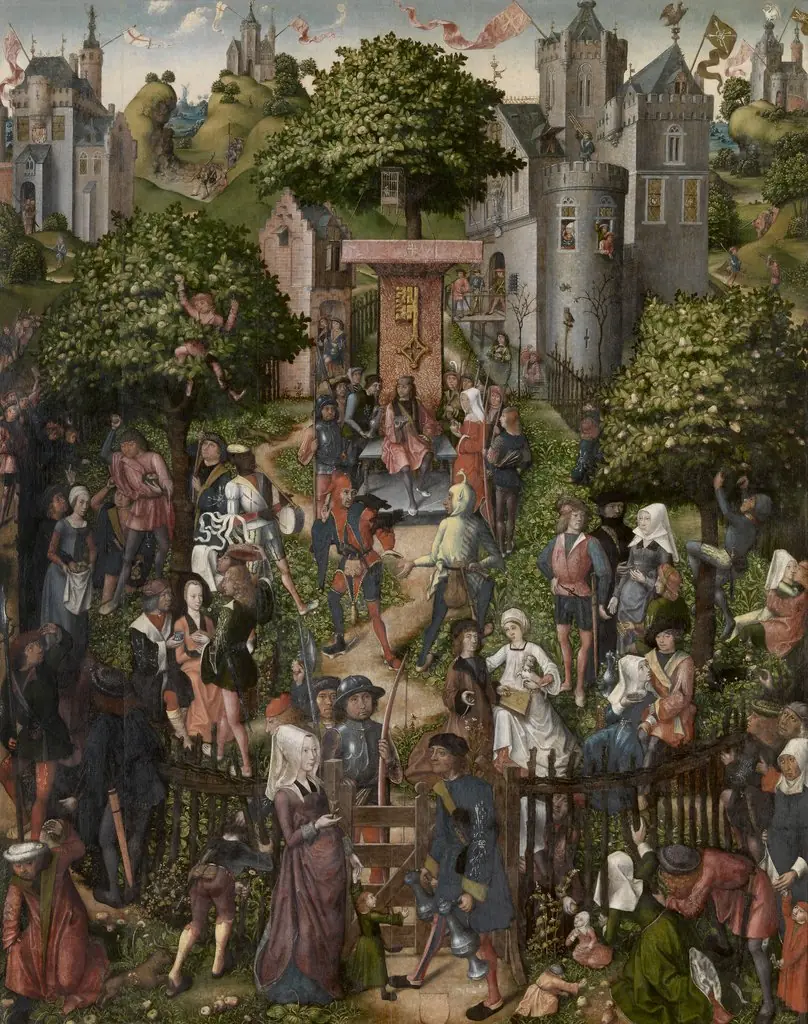 Festival of the Archers
 De boom van Jesse
 Wedding Feast of Saint Elizabeth of Hungary and Louis of Thuringia in the Wartburg, inner left wing of an altarpiece made for the Grote Kerk in Dordrecht
 The Flight of the Vestal Virgins
 Martírio das onze mil Virgens
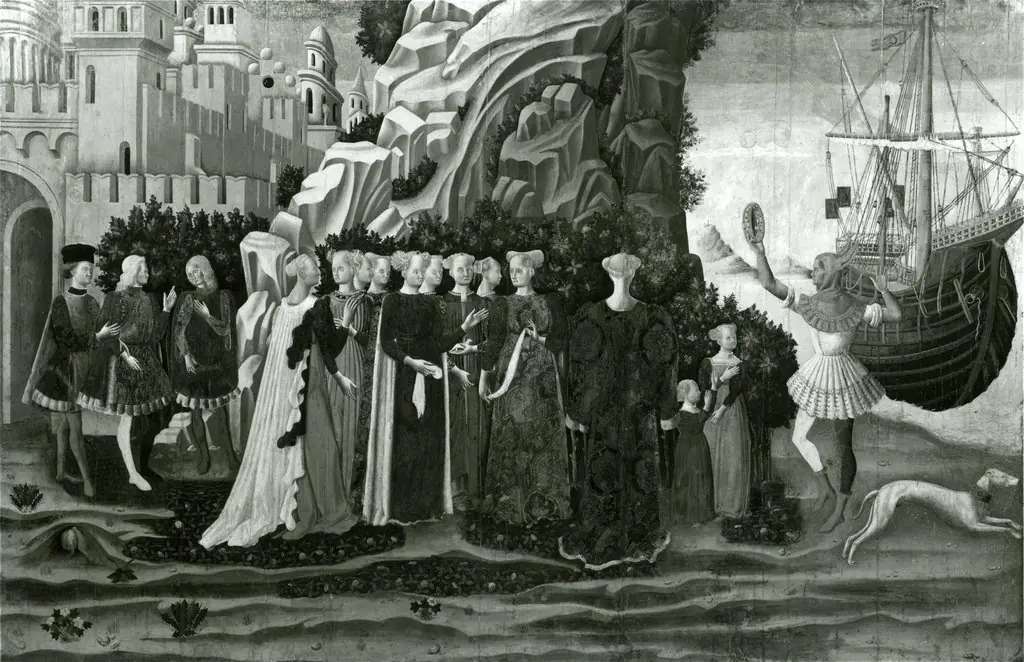 The Embarkation of Helen for Cythera
 The Adventures of Ulysses
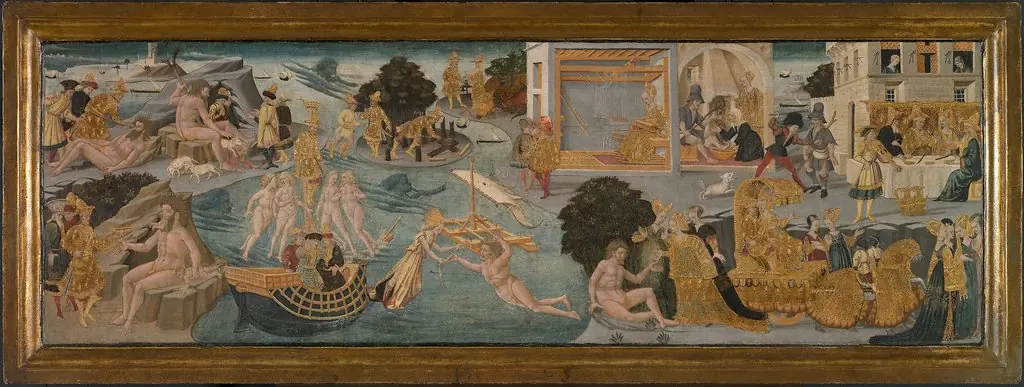 The Adventures of Ulysses
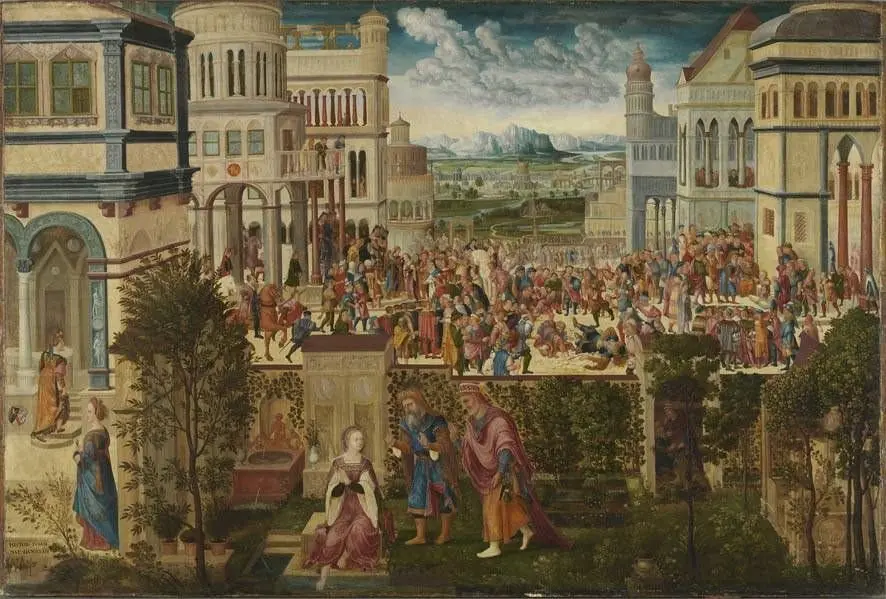 Historienzyklus: Geschichte der Susanna
 Portrait of Philip the Good, Duke of Burgundy