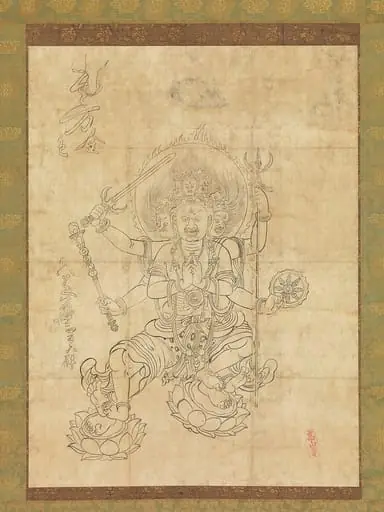
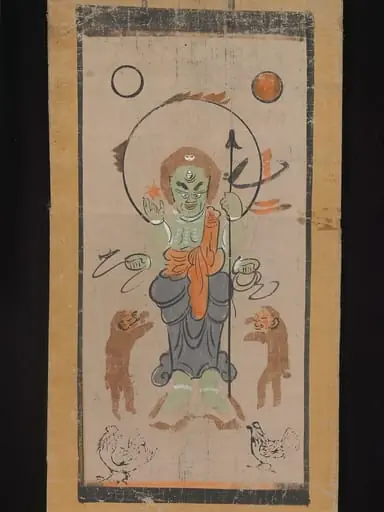
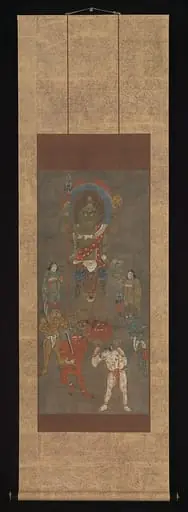
Artwork
金剛夜叉明王|Kongōyasha Myōō
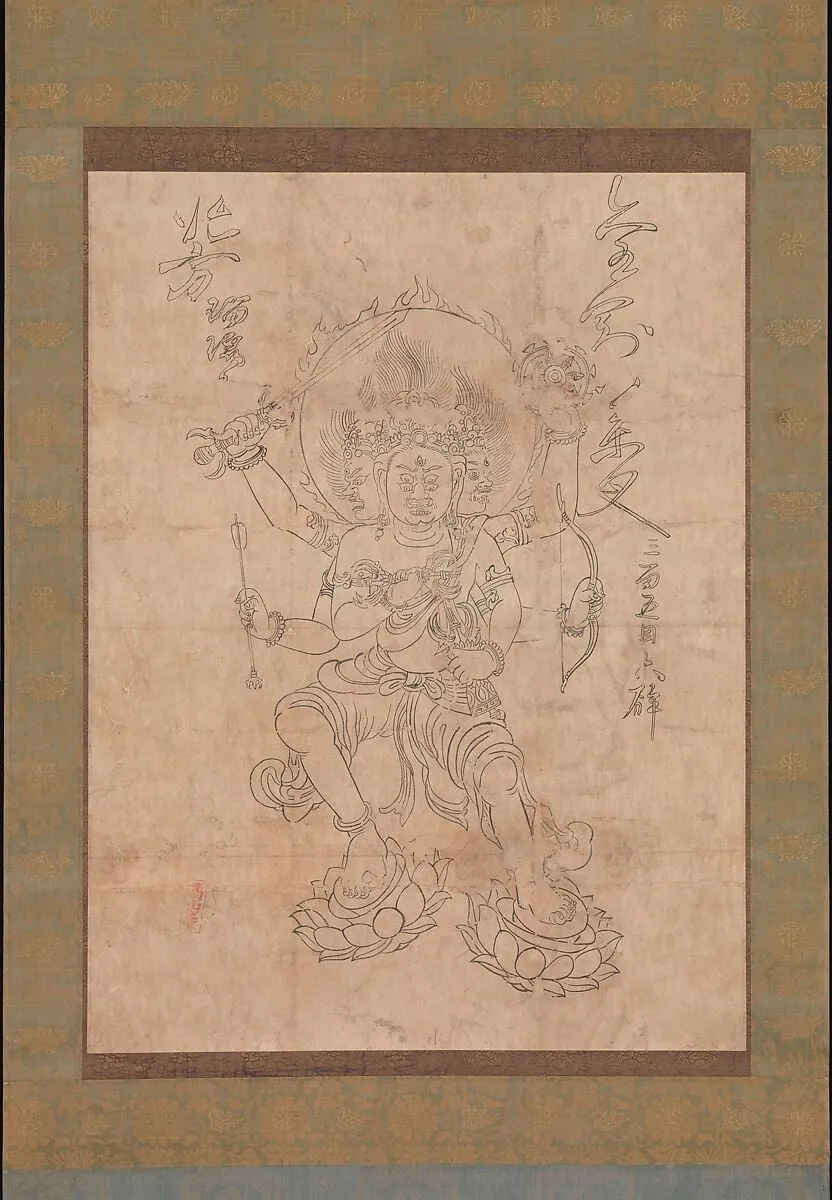
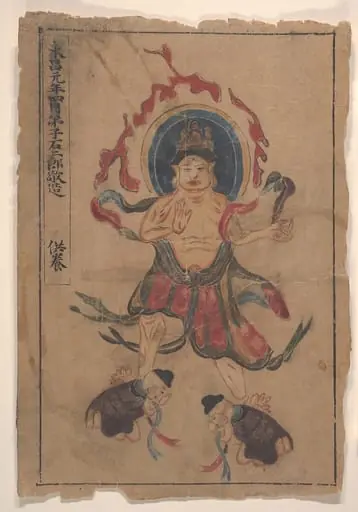
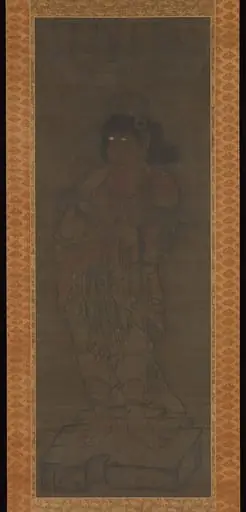
金剛夜叉明王|Kongōyasha Myōō is an ink painting. It dates from 1142 and is held in the collection of the Metropolitan Museum of Art. Kongōyasha Myōō is an ink-on-paper hanging scroll depicting a powerful Buddhist guardian.
About this work
Subject & Meaning
The 1142 dating situates this representation within the Heian period, reflecting the transmission and adaptation of Esoteric Buddhist iconography in Japan.
Kongōyasha Myōō is depicted as a fierce guardian figure in Japanese Buddhist iconography, wielding a bow and arrow alongside a sword, embodying protective and punitive roles within esoteric traditions. The subject represents a myōō, or ‘wisdom king,’ tasked with subduing malevolent forces and enforcing moral order. The bow symbolizes the swift and precise eradication of ignorance, while the arrow signifies the piercing of illusion.
The presence of the sword underscores authority and the severing of delusion. Together, these attributes convey the deity’s role as a defender of the Buddhist dharma, vanquishing spiritual obstacles to enlightenment. The 1142 dating situates this representation within the Heian period, reflecting the transmission and adaptation of Esoteric Buddhist iconography in Japan.
Technique & Style
This work is executed as a hanging scroll in monochrome ink on paper, a format and medium consistent with mid-twelfth-century Japanese Buddhist devotional painting. The composition is rendered entirely in ink, without color, relying on brushwork and tonal modulation to define the wrathful deity, the bow and arrow, and the sword held as attributes. Such ink-on-paper hanging-scroll treatment is typical of religious paintings of the Heian period intended for ritual use and rolled for storage.
The sources confirm only the medium, format, and date of production, and do not provide details on brush technique, pigment preparation, support construction, mounting, or current condition, so further technical description cannot be grounded in the available material.
History & Provenance
The work 金剛夜叉明王|Kongōyasha Myōō is a 12th‑century Japanese hanging scroll painted in ink on paper around 1142. The anonymous artist created the piece in Japan, and it entered the collection of the Metropolitan Museum of Art, where it remains on display. Its iconography includes a king, bow and arrow, sword, and Buddhist symbolism.
The scroll is classified as religious painting and is documented in both scholarly catalogues and the museum’s records.
The work titled 金剛夜叉明王|Kongōyasha Myōō, dated 1142, is housed in the Metropolitan Museum of Art in New York. It is part of the museum’s collection of religious paintings, though no specific inventory or accession number is recorded in the available documentation. The painting, an ink on paper hanging scroll attributed to an anonymous Japanese artist, depicts a Buddhist king with a bow, arrow, and sword.
According to the sources, its provenance is limited to the museum’s acquisition, and no exhibition history is mentioned in the provided records.
Legacy
The painting’s designation as a Heian‑period religious work, documented with a precise 1142 date and depiction of a king bearing a bow, arrow, and sword, has secured its standing as an important exemplar of early Japanese Buddhist art. Its inclusion in the collection of the Metropolitan Museum of Art provides ongoing scholarly attention and public exhibition, reinforcing its reputation as a representative piece of the genre. The work’s iconography, recorded in both primary sources, continues to inform studies of protective deities in East Asian Buddhism, contributing to its enduring legacy within museum discourse.
Overview
Kongōyasha Myōō is an ink-on-paper hanging scroll depicting a powerful Buddhist guardian. This painting presents a multi-faced, multi-armed blue-skinned deity, poised on a cloud. Its primary function is to ward off malevolent forces, embodying a fierce protective aspect within the Buddhist pantheon. The artwork is notable for its age, being an early example of this specific subject matter.
Artist & collection