Artwork
Maharaja Chattarsol of Kota Shooting Lions
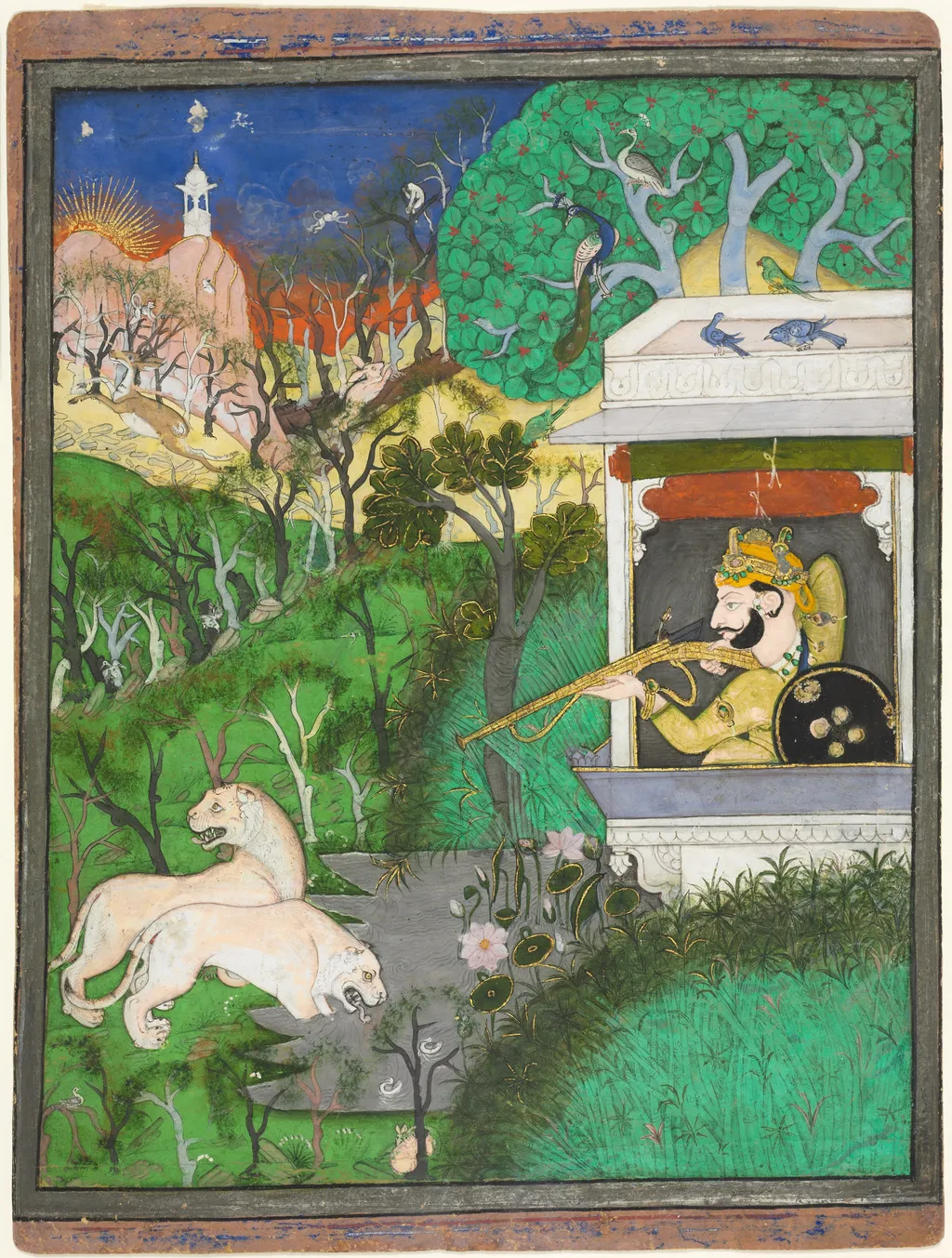
Maharaja Chattarsol of Kota Shooting Lions is an unspecified painting. It dates from 1860 and is held in the collection of the Cleveland Museum of Art.
About this work
Overview
The canvas portrays a princely figure dressed in yellow, complete with a matching turban, seated within a white pavilion topped by a red awning. He holds a rifle, aiming at two lions positioned before him amid a verdant landscape that includes trees, flowering plants, and birds, all set against a bright blue sky and a sunlit horizon.
Subject & Meaning
The central narrative captures a dramatic hunting scene: the ruler confronts a white lion that appears to be leaping or falling, alongside a beige counterpart. The composition emphasizes tension between human authority and wild animal, underscored by the ruler’s solemn expression and prominent moustache.
Technique & Style
The artist employs a vivid palette, contrasting the yellow attire and red awning with the lush greens of the surroundings. Spatial depth is achieved through layered foliage, a distant rocky hill crowned by a white tower, and atmospheric perspective that guides the eye toward the central action.
Context
Set within an idealized Indian hunting ground, the work reflects the traditional royal pastime of big‑game hunting, a practice that symbolized power and prestige among Indian maharajas. The inclusion of architectural elements such as the pavilion and tower situates the scene within a cultivated estate rather than a wild savanna.
Legacy
The painting serves as a visual record of aristocratic sport in pre‑colonial India, illustrating both the cultural significance of the hunt and the aesthetic conventions of courtly art that combined realistic detail with dramatic storytelling.
Artist & collection

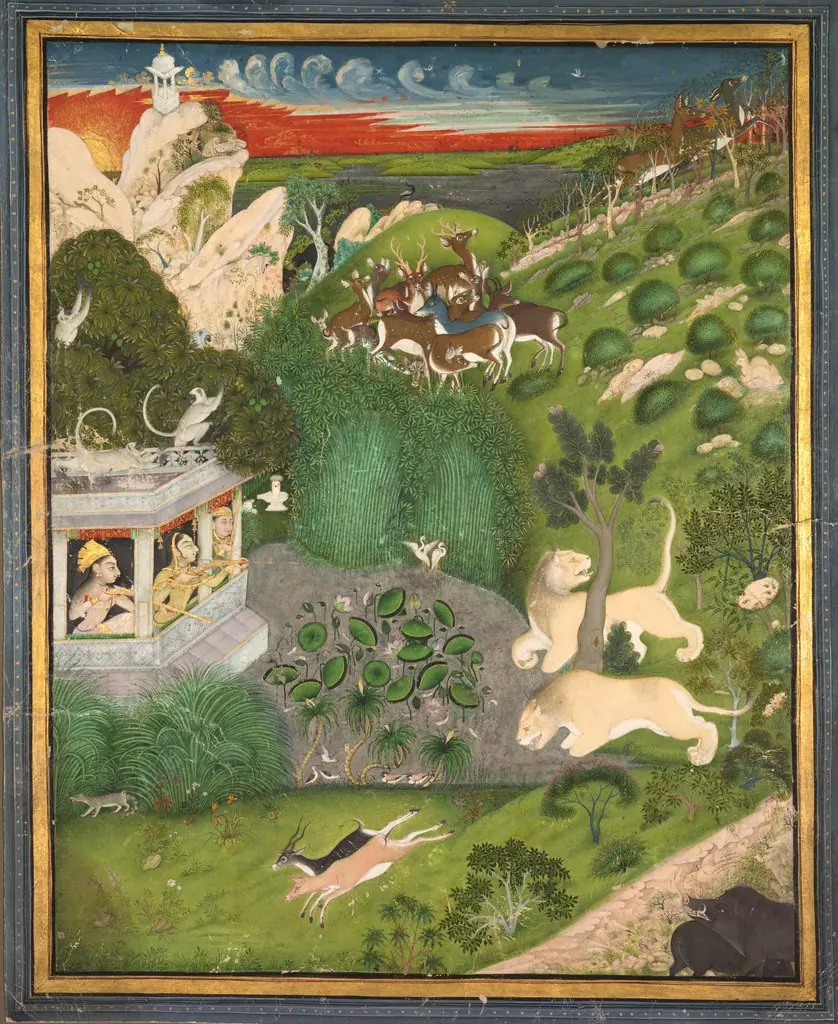 Royal women shooting from a pavilion
 Royal women shooting from a pavilion
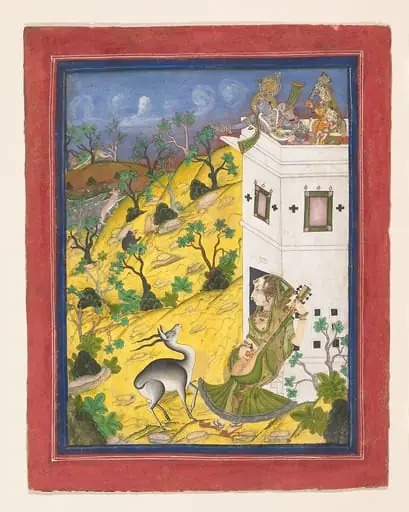 Untitled
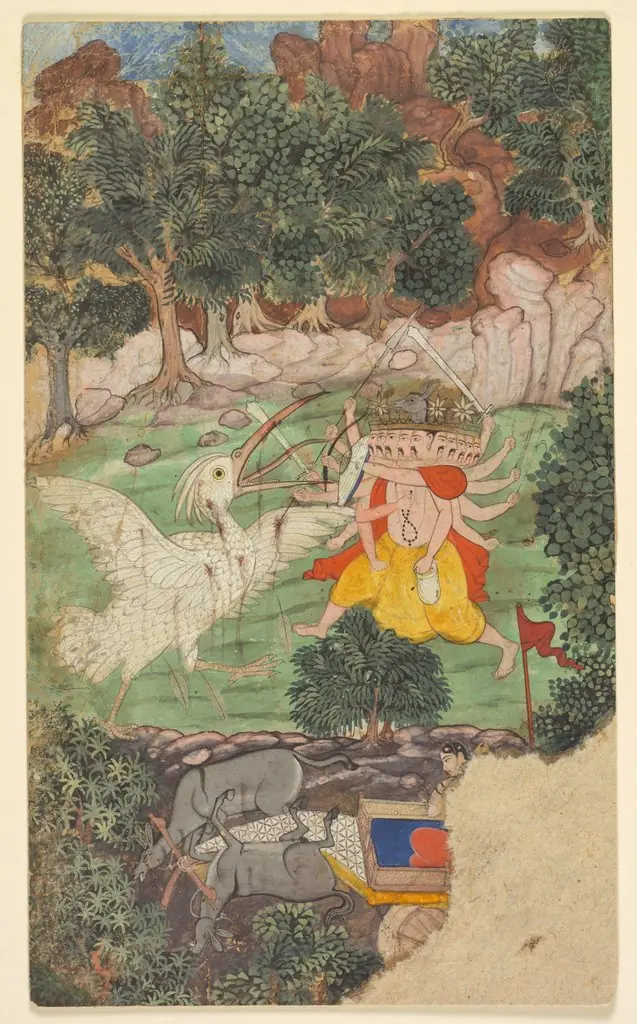 Battle of Ravana and Jatayu, from Chapters 50 and 51 of the Aranya Kanda (Book of the Forest) of Valmiki's Ramayana (Rama’s Journey); folio from the "Burnt" Ramayana
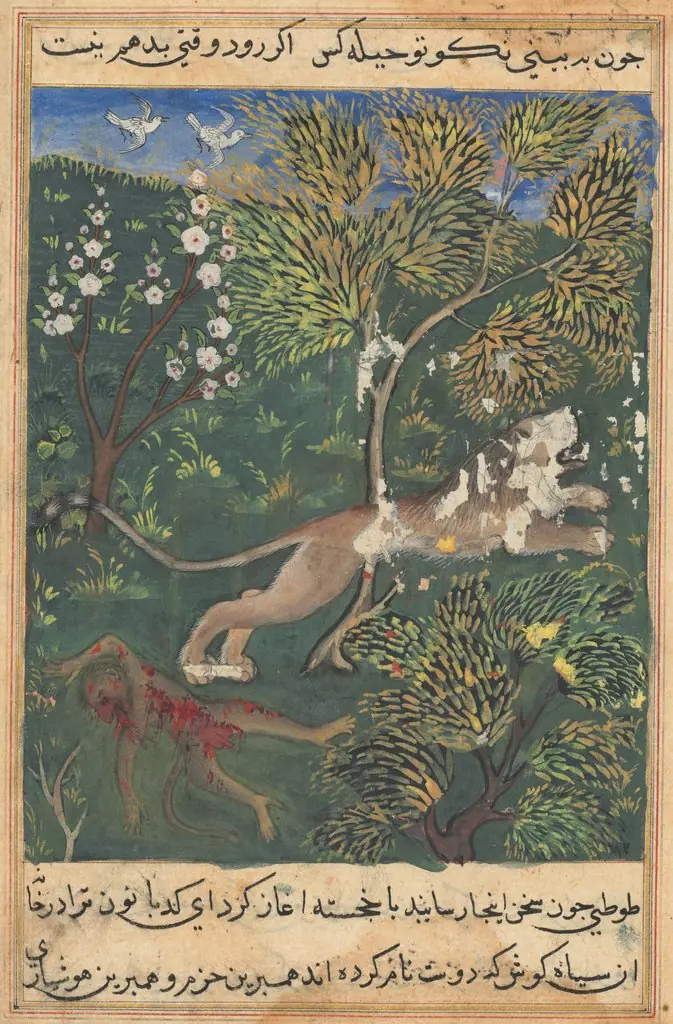 The lion, suspecting treachery on the part of the monkey, slays him and flees, from a Tuti-nama (Tales of a Parrot): Twenty-ninth Night
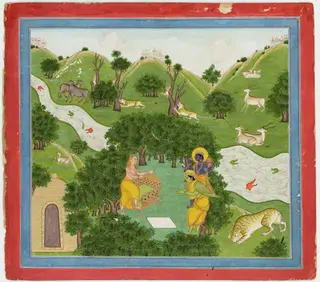 Illustrations to Life of Dhurva Maharaj: #20 God gives Dhurva his throne upon which he can fly anywhere
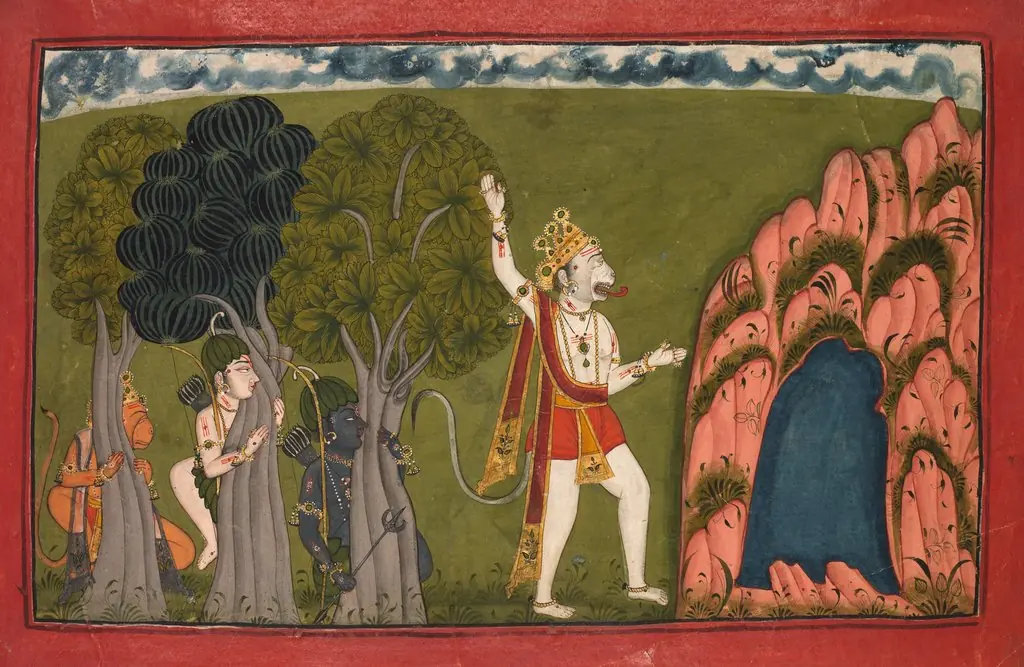 Sugriva challenges his brother Vali, King of the Forest Dwellers, to a duel, folio 10 from the Kishkindha Kanda (Book of Kishkindha) of a Ramayana (Rama’s Journey)
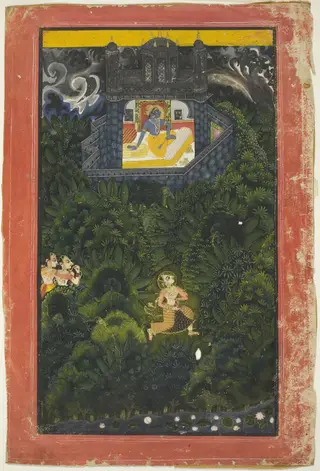 Abhisarika Nayika (Heroine Running to Meet her Lover)
 Basu beheads Namadpush and enters Acre Castle