Artwork
Panel from a Saints' Calendar (painted on both sides)
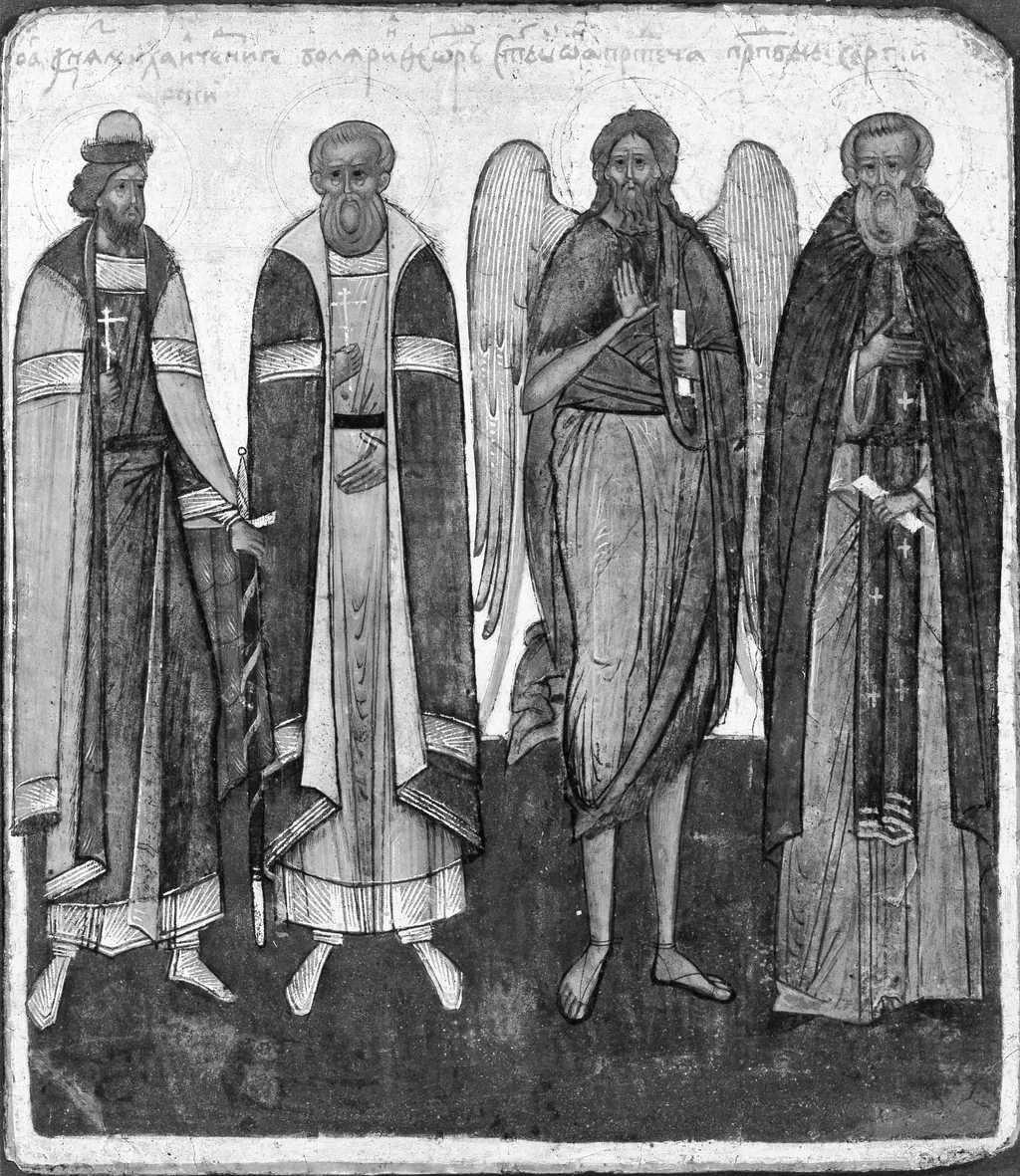
Panel from a Saints' Calendar (painted on both sides) is an unspecified painting. It dates from 1600 and is held in the collection of the Metropolitan Museum of Art. This panel, painted on both sides, presents a religious scene featuring five standing figures.
About this work
Subject & Meaning
The artwork, created around 1600 by an anonymous Russian painter, functions as a panel from a Saints' Calendar, a genre dedicated to religious veneration.
The artwork, created around 1600 by an anonymous Russian painter, functions as a panel from a Saints' Calendar, a genre dedicated to religious veneration. The composition depicts a male saint, consistent with the hagiographic purpose of such calendars which served to commemorate specific holy figures. As a religious painting executed on both sides, the panel likely formed part of a larger liturgical or devotional cycle intended to guide the faithful through the ecclesiastical year.
The subject's representation aligns with the tradition of Russian iconography, where individual saints are portrayed to inspire piety and mark their feast days within the church calendar.
History & Provenance
The panel, painted circa 1600 in Russia, forms part of a double‑sided Saints’ Calendar and was executed by an anonymous Russian master for liturgical use. Its creation reflects the religious art production of the period, with each side depicting a saintly figure. The work remained in private or ecclesiastical hands until it entered the collection of the Metropolitan Museum of Art, where it is now catalogued as a religious painting.
No earlier ownership records are documented, and the panel’s commission is understood to have been tied to a calendar cycle rather than a specific patron.
The panel from a Saints' Calendar (painted on both sides) is housed in the Metropolitan Museum of Art in New York. It is listed as part of the museum’s collection, indicating its official accession within the institution. The work dates to around 1600 and is classified as a religious painting.
No exhibition records are cited in the available documentation, suggesting that the piece has not been featured in publicly documented exhibitions to date.
Overview
This panel, painted on both sides, presents a religious scene featuring five standing figures. Though the original colors have diminished over time, the composition remains discernible, characterized by distinct outlines and touches of gold. The artwork's dual-sided nature suggests it may have served a functional purpose within a larger devotional context, possibly as part of a liturgical calendar.
Technique & Style
The artist employed a stylistic approach common in early religious art, emphasizing symbolic representation over naturalistic depiction. The figures are rendered in a flat manner, lacking cast shadows or the illusion of three-dimensional depth. This technique creates a sense of timelessness and spiritual focus, directing attention to the figures' identities and sacred roles rather than their physical presence in space. Faded hues are complemented by dark outlines and flat gold embellishments.
Context
The artistic conventions observed in this panel reflect a broader tradition in religious painting where the communication of spiritual meaning took precedence over strict realism. By foregoing naturalistic elements like shadows and deep perspective, artists aimed to create images that transcended the earthly realm, inviting contemplation of divine truths. Such works were integral to devotional practices and the visual culture of their era.
Artist & collection

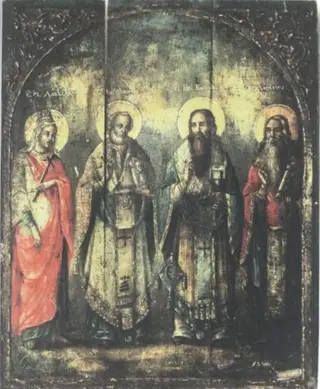
- Sfântul Alexandra, Nicolae, Vasile cel Mare și Haralambie
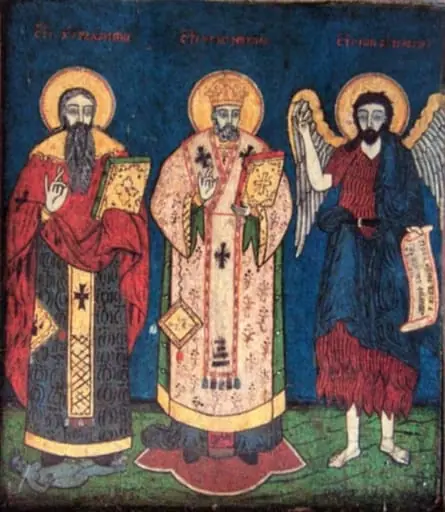 Sfinții Haralambie, Nicolae și Ioan Botezătorul
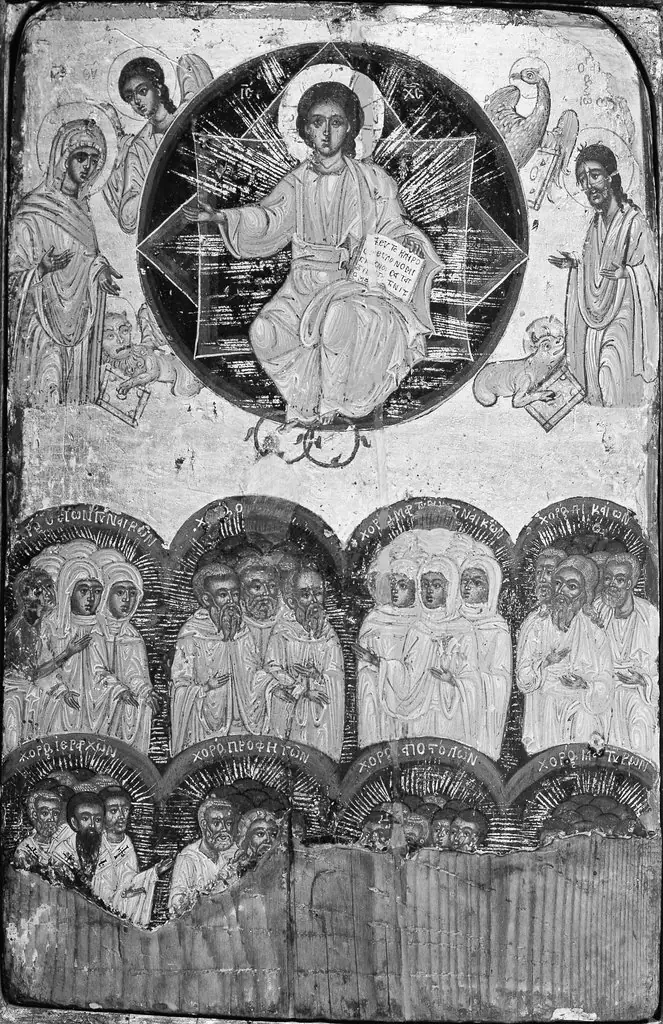 All Saints
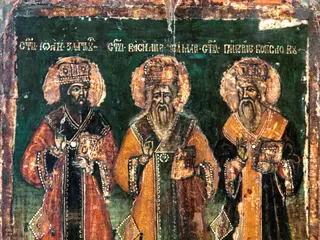 Tema icoanei este "Sfinții trei ierarhi, Vasile, Grigorie, și Ioan". Ordinea din icoană este, de la stânga la dreapta : Ioan Gură de aur(Zlotul), Vasile cel Mare și Grigore Teologul(Bogoslovul).Cei trei sfinți sunt pictați în picioare, Sf. Ioan și Grigorie ușor întorși către Sf Vasile plasat central. Redați în veșminte arhierești, cu însemne episcopale. Pe cap toți poartă mitră împodobită cu pietre scumpe, în mâna stângă țin Evanghelia iar cu dreapta binecuvintează prin atingerea degetului inelar de cel mare.De mâna dreaptă le atârnă bedernița, un veșmânt arhieresc în formă de romb. Reprezentarea celor trei respectă în mare indicațiile Erminiei, ceea ce arată că zugravul o studiase; Doar Sfântul Ioan este redat cu părul și barba negre, ceea ce nu corespunde descrierilor. Veșmintele sunt destul de simple, Sacosurile de culori diferite(roșu cărămiziu, galben ocru, brun închis) au în parte de jos o bordură lată, aurită decorată cu motive geometrice. Peste acestea este așezat omoforul mare, simplu, cu chenar pe margine . La gât poartă câte un engolpion rotund.În partea de jos se vede capătul epitrahilului deasemenea decorat cu motive geometrice și franjuri, așezat peste stihar. Aureolele sunt realizate cu foiță,delimitate de o linie albă, fină. Trăsăturile sunt foarte fine, cu aceent pe detalii, ceea ce denotă un iconar cu experiență și probabil școală. Proporțiile sunt respectate paleta cromatică dominată de culori calde valorate prin contraste cu culorile complementare și nuanțe. Fondul este realizat într-o trecere treptată, de la o culoare mai deschisă în partea de jos la un verde-albastru sus, ceea ce scoate în evidență figurile celor trei. Scrisul este caligrafic, foarte fin și ordonat, realizat cu o linie fină de culoare albă. Chenar dublu, roșu la exterior, auriu la interior. Icoana prezintă crăpături și lacune pe margine.
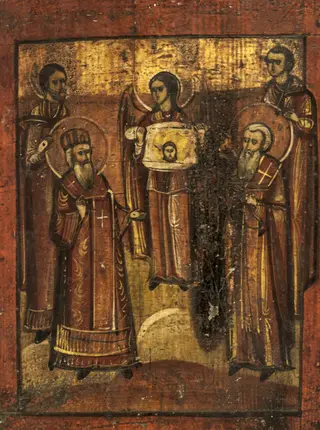 Sfânta Mahramă este, conform sfintei Tradiții, cea mai veche icoană a lui Hristos, nefăcută de mâna omului. Sfântul Ioan Damaschin(filozof, teolog și iconograf din sec VIII) descrie originea acesteia în Dogmatica ortodoxă: Se știe din tradiție că pe când Avgar era regele Edessei, a trimnis un pictor să picteze chipul Domnului, dar din pricină că pictorul nu a putut să -l picteze din cauza luminii strălucitoare a feței, Domnul Însuși , punând haina pe obrazul Lui dumnezeiesc și de viață făcător, s-a imprimat pe haină chipul Lui și astfel a trimis-o lui Avgar, care îl dorea. Deși inscripțiile nu mai ajută la identificarea exactă a momentului ilustrat, icoana ilustrează momentul în care sfânta Mahramă este adusă regelui Avgar. Un înger plasat în centrul compoziției arată mahrama cu chipul lui Iisus înconjurat de nimbul cruciger. De o parte și de alta, plasați simetric, un episcop și un preot în vârstă, binecuvântând, în spatele lor regele, în pandant un personaj fără nimb, toți privind către chipul lui Hristos imprimat pe țesătură. Conform unei legende, chipul lui Hristos s-a imprimat și pe mahrama cu care Veronica i-a șters chipul în timpul patimilor. Compoziția este narativă, echilibrată, chipurile expresive. Cromatica specifică icoanelor de tip krasnushka, tonuri de pământ în combinație cu fondul foiței aurii(fond -1/4 superior). Bordura brun roșcată, lată, delimitat prin linii negre.Icoana prezintă urme de arsură.
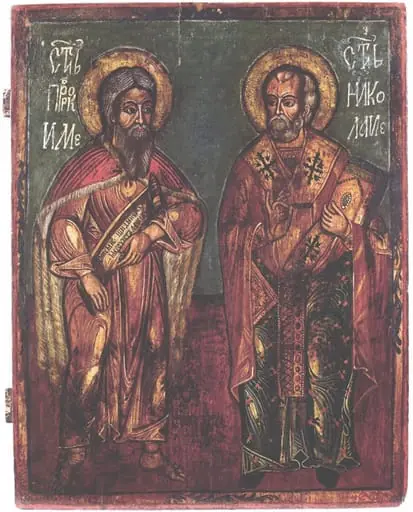 Sfântul Prooroc Ilie și Sfântul Nicolae
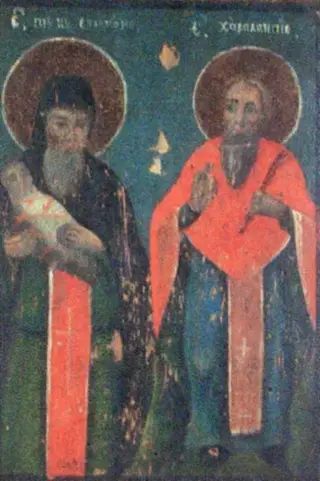 Sfinții Stelian și Haralambie
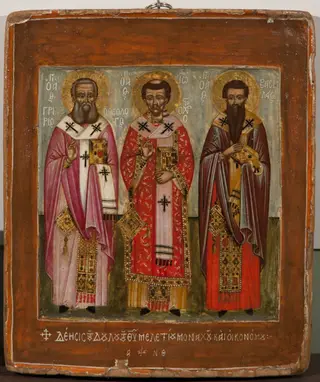 Sf. Trei Ierarhi
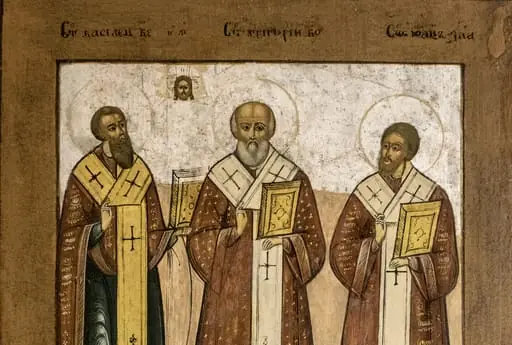 Ordinea din icoană este, de la stânga la dreapta : Vasile cel Mare, Grigore Teologul și Ioan Gură de aur. Cei trei sfinți sunt redați în picioare, central fiind sfântul Grigore, lateral Vasile și Ioan, ușor întorși către acesta. Toți binecuvintează cu dreapta, în stânga țin Evanghelia. Sfântul Griogore este în vârstă, ceilalți doi redați tineri, conform Erminiilor. Sfântul Vasile înveșmântat simplu, stihar albastru, felon purpuriu cu motive discrete, florale, epitrahil galben, ceilalți doi poartă sacos peste stiharul albastru. Toți au capetele descoperite. Pe fondul foiței argintii(1/4 superior) este redat Iisus Hristos- chipul nefăcut de mână de om, sau Sfânta Mahramă. În planul inferior-relief ondulat, benzi de culoare. Cromatica: tonuri de brun, alb(falduri, aureole, iluminarea chipurilor), negru(linia desenului, inscripții), albastru(veșminte), galben tonuri de verde, roșu. (foița metalică).Bordura lată, o înscrie în tipologia icoanelor de krashnuskha.(culoarea a fost modificată în timp), la fel inscripția, respectând canoanele.
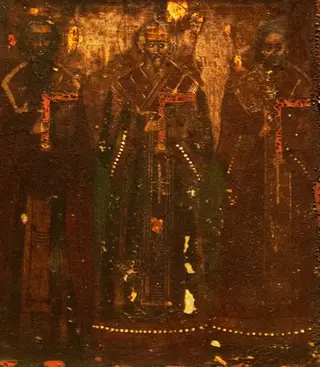 În spațiul dreptunghiular creat prin scobire(rezultă o ramă de 3 cm lățime), sunt pictați, în ax vertical, Sfinții trei ierarhi Vasile, Grigorie și Ioan. Stratul pictural fiind înnegrit, nu se pot identifica exact fiecare din cei trei sfinți. Probabil ca cel din centru să fie Sf. Ioan Gură de Aur, cu părul și barba albe, în stânga fiind sf. Vasile cel Mare iar în dreapta sf. Grigorie Noul Teolog, toți în picioare. Toți trei țin în mîini cartea Sfântă.Veșmintele sunt arhierești, patrafirele au cruci în linii subțiri, doi dintre ei au veșmântul împodobit cu șiruri de puncte albe. Fondul este aurit, aureolele trasate cu linii subțiri, negre, în stilul icoanelor lipovenești. Pe partea de sus a ramei o inscripție în același stil. La mijloc chipul lui Isus și monogramul Acestuia.
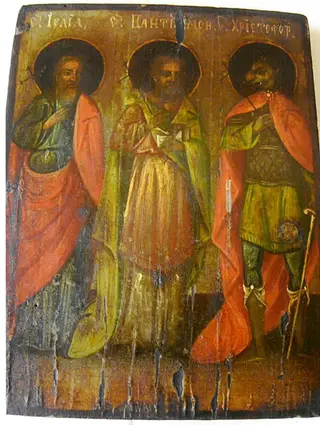 Sfinții Isaia, Pantelimon, Hristofor
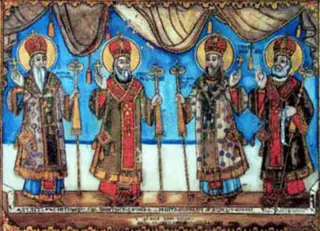 Sfinții Trei Ierarhi și Sfântul Nicolae