Artwork
Pilgrims Travelling to Ise
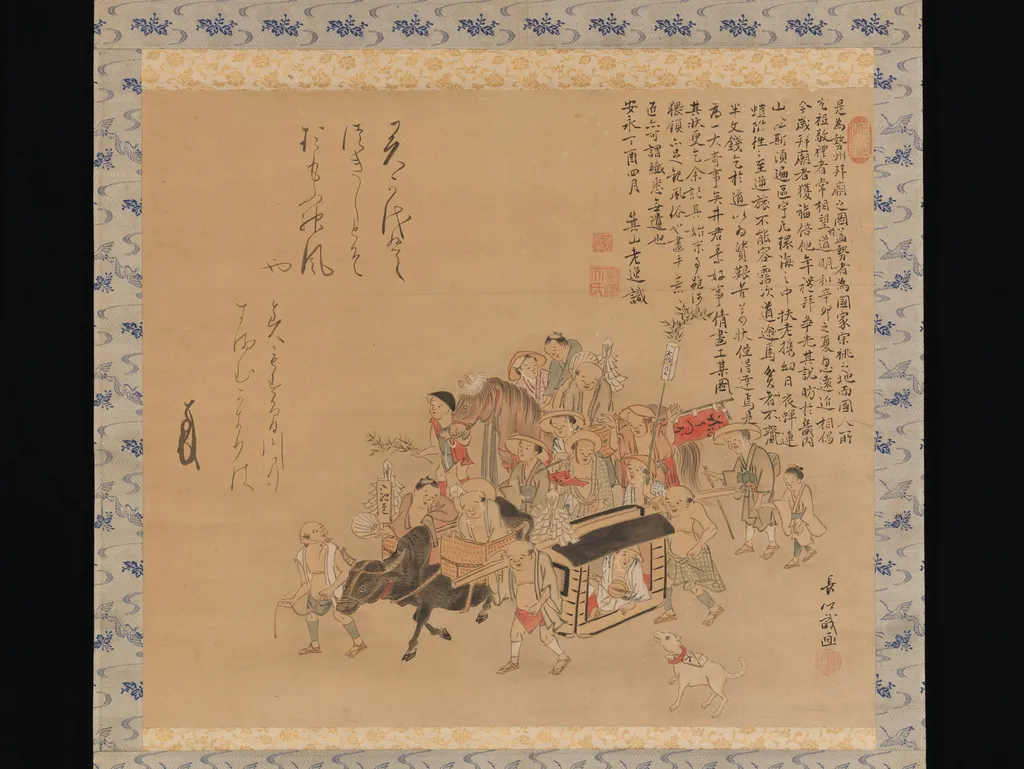
Pilgrims Travelling to Ise is an unspecified painting. It dates from 1749 and is held in the collection of the Metropolitan Museum of Art.
About this work
Subject & Meaning
Travelers are shown accompanied by pack animals, including horses and oxen, with both men and women among the group, and a dog is also present in the scene.
The painting depicts a procession of pilgrims journeying to the Ise Shrines, one of the most sacred sites in Shinto tradition. Travelers are shown accompanied by pack animals, including horses and oxen, with both men and women among the group, and a dog is also present in the scene. The inclusion of these figures and animals reflects the communal character of the pilgrimage, in which lay devotees of varying social backgrounds traveled together to visit the shrines dedicated to the sun goddess Amaterasu.
The pack animals suggest the transport of belongings, offerings, or goods for the journey, while the presence of both sexes indicates that pilgrimage to Ise was a shared devotional practice rather than a solely male undertaking. The work represents the cultural and religious significance of Ise pilgrimage during the mid-eighteenth century, a period when such journeys were a prominent feature of popular religious life in Japan.
History & Provenance
The painting Pilgrims Travelling to Ise was created in 1749 in Japan. While some records attribute the work to the artist Chōgō, other sources list the creator as unknown. The piece depicts a scene featuring men, women, a dog, a horse, and oxen.
Currently, the artwork is held in the collection of the Metropolitan Museum of Art. The specific commission details and the full chain of ownership prior to its arrival at the museum are not detailed in the available records. The work is classified as a painting and remains a significant example of mid-18th-century Japanese art held in a major Western institution.
Pilgrims Travelling to Ise is held in the collection of the Metropolitan Museum of Art. The work, dated 1749, is catalogued within the museum's holdings of Japanese paintings, and its location is recorded as the Metropolitan Museum of Art. No specific accession number, accession date, or detailed exhibition history is documented in the available sources.
Legacy
The 1749 work Pilgrims Travelling to Ise, attributed to an unknown artist and later catalogued as a Japanese narrative painting, entered the collection of the Metropolitan Museum of Art, raising its public profile and scholarly attention; its depiction of a multi‑figure pilgrimage scene with dog, horse, man, oxen and woman has been cited in studies of Edo‑period visual culture, establishing the piece as a reference point for later research on religious travel imagery in Japanese art. The painting’s museum designation has helped preserve its reputation as an exemplar of 18th‑century narrative painting.
Overview
The painting titled "Pilgrims Travelling to Ise" presents a vibrant depiction of a group journeying towards the sacred Ise region. The artwork captures a diverse assembly of individuals, accompanied by animals, all moving in a unified direction. The composition conveys a strong sense of ongoing motion, as if the figures are captured in a fleeting moment before continuing their purposeful trek, imbuing the scene with vitality and forward momentum.
Technique & Style
The figures are depicted in traditional garments, with men frequently wearing hats and carrying various provisions, such as baskets. The background is rendered with a subdued palette and subtle textural details, which serves to emphasize the animated group of travelers. This artistic choice effectively highlights the collective energy and the dynamic movement of the procession, drawing the viewer's attention to the journey itself.
Artist & collection

- Untitled
 Three Visits to a Thatched Cottage
 “Taira no Koremori’s Farewell,” from The Tale of the Heike (Heike monogatari)
 元 忽哥赤 和 佚名 耕稼圖 卷 |Rice Culture, or Sowing and Reaping
 Drinking Festival of the Eight Immortals of the Wine Cup
 明/清 佚名 舊傳王振鵬 養正圖 卷|Family Training
 Landscape
 清 陳字 洗象圖 軸|Washing the White Elephant
 Group Pilgrimage to the Jizo Nun
 Portrait of Shaoyu in the guise of Liu Ling
 Lady Wen-chi's Return to China
 Album of Landscape Paintings Illustrating Old Poems: Children Playing Blindman's Buff in a Garden