Artwork
Portrait of Leopold Méyet (1850–1912) in the uniform of the classical state middle school
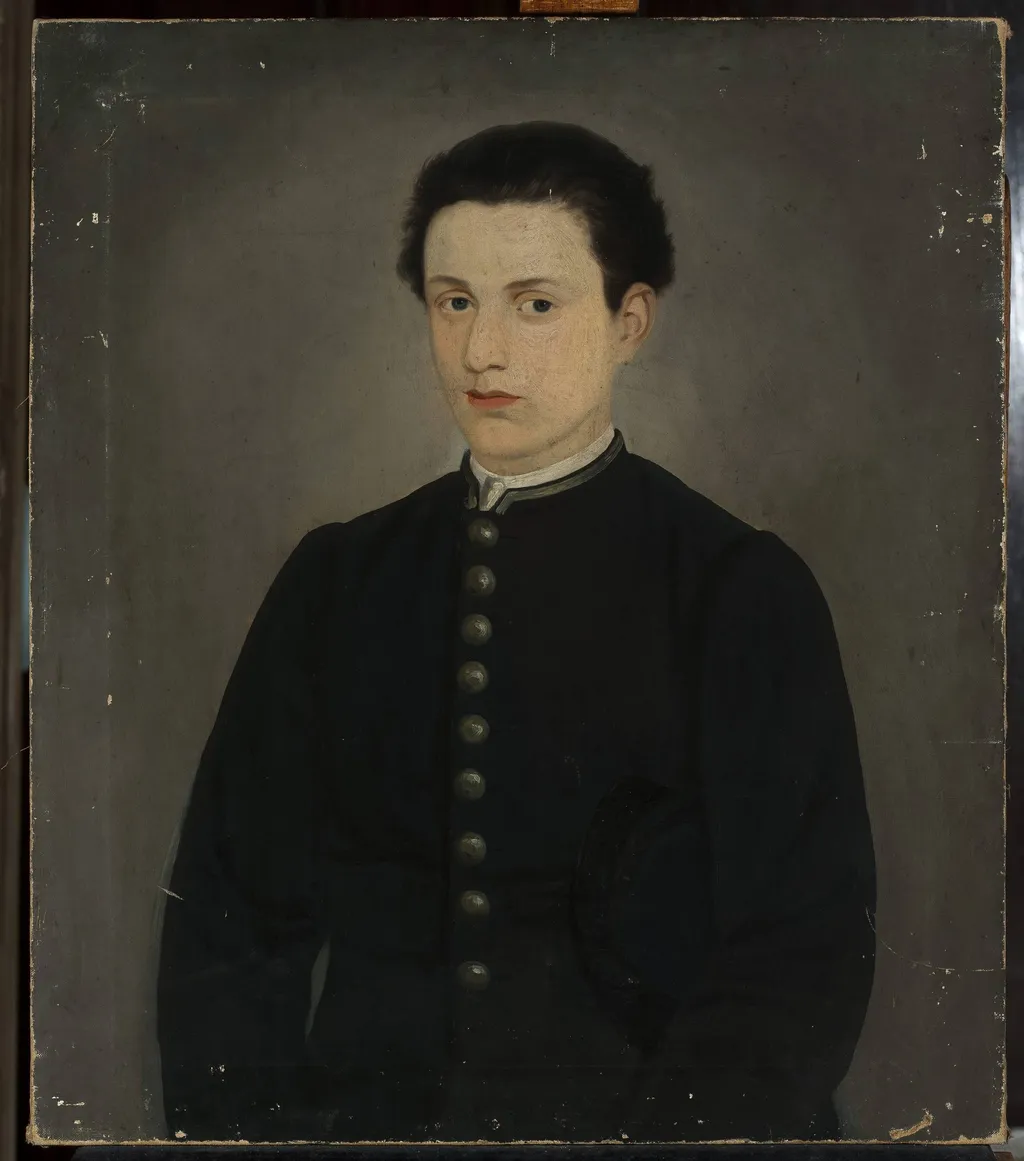
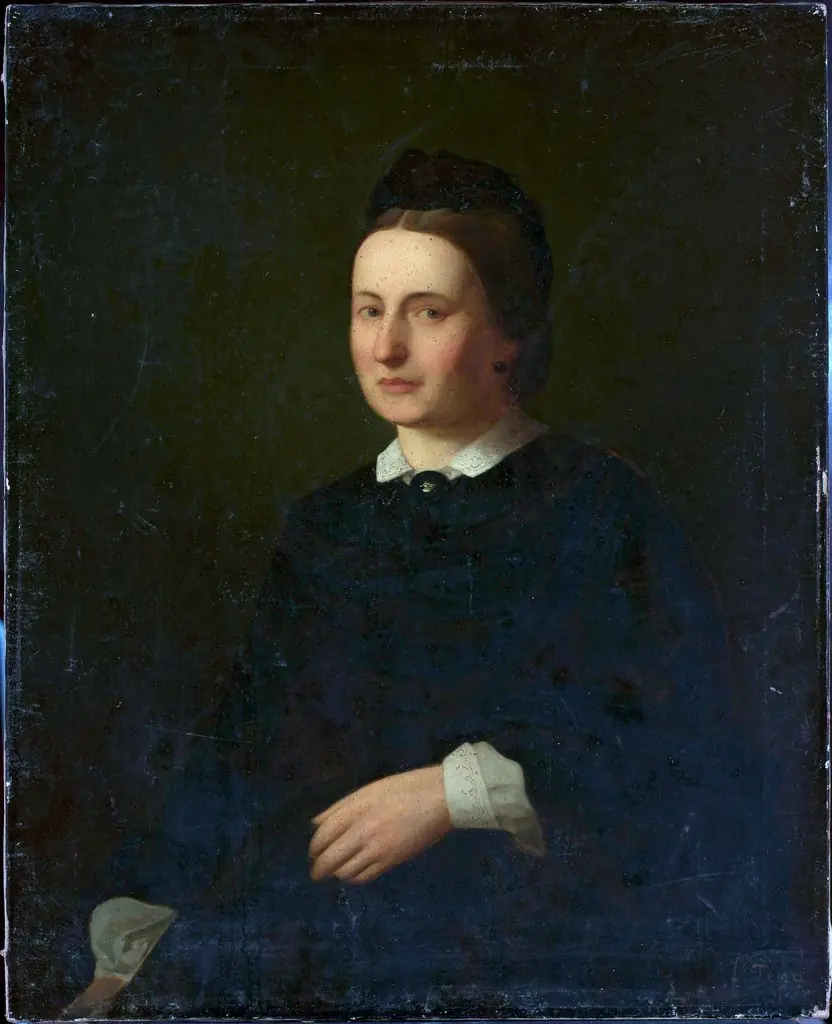
Portrait of Leopold Méyet (1850–1912) in the uniform of the classical state middle school is an oil painting by the Realist artist Unknown. It dates from 1863 and is held in the collection of the National Museum in Warsaw. This oil painting depicts a young man in a formal, dark uniform with a white collar, set against a plain gray background.
About this work
Overview
The Portrait of Leopold Méyet (1850-1912) in the uniform of the classical state middle school is an oil-on-canvas painting dated 1863, executed by an unknown Polish artist. Measuring 73 by 63 centimeters, the work depicts its young subject at approximately thirteen years of age in the formal attire of a classical state middle school, a type of secondary institution in partitioned Poland. The painting is held in the collection of the National Museum in Warsaw, where it is catalogued under the attribution "nieznany malarz polski" (unknown Polish painter). Its significance lies in its value as a document of mid-19th-century Polish educational and social history, as well as in its representative qualities as a portrait from the period of the January Uprising, a moment of intense national struggle. The work exemplifies the conventions of bourgeois portraiture in partitioned Poland while bearing witness to the aspirations of the Polish intelligentsia during a turbulent era.
Technique & Style
The support shows signs of age, including scratches, small losses, and wear particularly along the edges, consistent with its 1863 date and subsequent history.
The painting is executed in oil on canvas with a smooth, controlled technique that prioritizes clarity of form over expressive brushwork. The artist employs a severely restricted palette dominated by blacks, dark grays, and the pale tones of the subject's complexion, with the white collar serving as the principal chromatic accent. Light enters evenly from the left, modeling the facial structure and casting soft shadows on the right side, a conventional arrangement that nonetheless achieves effective three-dimensionality. The brushwork is notably differentiated by area: fine and meticulous in the rendering of the face and the nine metallic buttons, broader and flatter in the treatment of the uniform and the muted gray background. The overall finish is matte, with minimal visible texture, suggesting a preference for the polished surfaces associated with academic portraiture. The composition is deliberately simple and frontal, emphasizing the figure's direct presence. The support shows signs of age, including scratches, small losses, and wear particularly along the edges, consistent with its 1863 date and subsequent history.
History & Provenance
The work is dated to 1863, a year of particular significance in Polish history as the outbreak of the January Uprising against Russian rule. The painting entered the collection of the National Museum in Warsaw, where it remains today. Its accession details and prior ownership chain are not recorded in the available sources. The work has been disseminated through stock photography, with images dated to 10 November 2011 and 17 December 2013 appearing on commercial platforms, suggesting it was photographed for documentation or licensing purposes during this period. No exhibition history is documented in the provided sources. The painting's presence in the National Museum indicates its recognition as a work of historical and artistic interest, though the circumstances of its acquisition remain unspecified.
Context
The portrait occupies a significant place within the broader context of 19th-century Polish portraiture, a field dominated by images of the nobility, the emerging intelligentsia, and military figures. The classical state middle school uniform signals the subject's participation in an educational system that was itself a site of cultural contestation in partitioned Poland, where schooling often served as a vehicle for the preservation of Polish language and national consciousness under foreign rule. The year 1863 places the work in direct temporal proximity to the January Uprising, though no evidence suggests Méyet's personal involvement in that event. The attribution to an unknown Polish painter places the work within a large body of anonymous or poorly documented portraiture from the period, much of which awaits fuller scholarly attention. A conflicting attribution to Stanisław Lentz (1861-1920), a Polish portraitist and professor at the Academy of Fine Arts in Warsaw, appears in some sources, though this seems chronologically implausible given that Lentz was born in 1861 and would have been two years old in 1863. The corpus source and institutional attribution to an unknown artist must be regarded as authoritative.
Legacy
The legacy of the Portrait of Leopold Méyet is primarily documentary and historical rather than art-historical in the conventional sense. As a work by an unidentified artist, it has not shaped stylistic developments or attracted significant critical fortune. Its value lies rather in its function as a visual record of a social type, the educated Polish youth of the 1860s, and in its preservation within the National Museum in Warsaw as part of the collective patrimony of Polish art. The painting has achieved wider visibility through its dissemination on stock photography platforms, where it serves as an accessible image for educational and editorial purposes related to 19th-century Polish history, costume, and education. The figure of Leopold Méyet himself, living from 1850 to 1912, would have witnessed the failed 1863 uprising, the subsequent decades of intensified Russification, and the gradual cultural and political transformations that preceded the restoration of Polish independence in 1918. The portrait thus endures as a fixed image of youth at a moment of national crisis, its subject's long subsequent life adding a poignant temporal dimension to the frozen seriousness of the adolescent face.
Artist & collection









- Portrait of a Man
 Bildnis eines jungen Mannes
 Portrait of Antoni Pleszowski
 Erzherzogin Helene von Österreich
 Portrait of a Lady
 Portrait of a man in a cloak
 Portrait of a lady
 Portrait of Charles van der Meulen, Missionary to Curaçao
 Bavarian Woman, Study
 Portrait of Mrs Van Soom
 Portrait of Paulo Bardti
 Portrait of Antonina Bałutowska née Massalska