Artwork
Saraswati and Ganesh
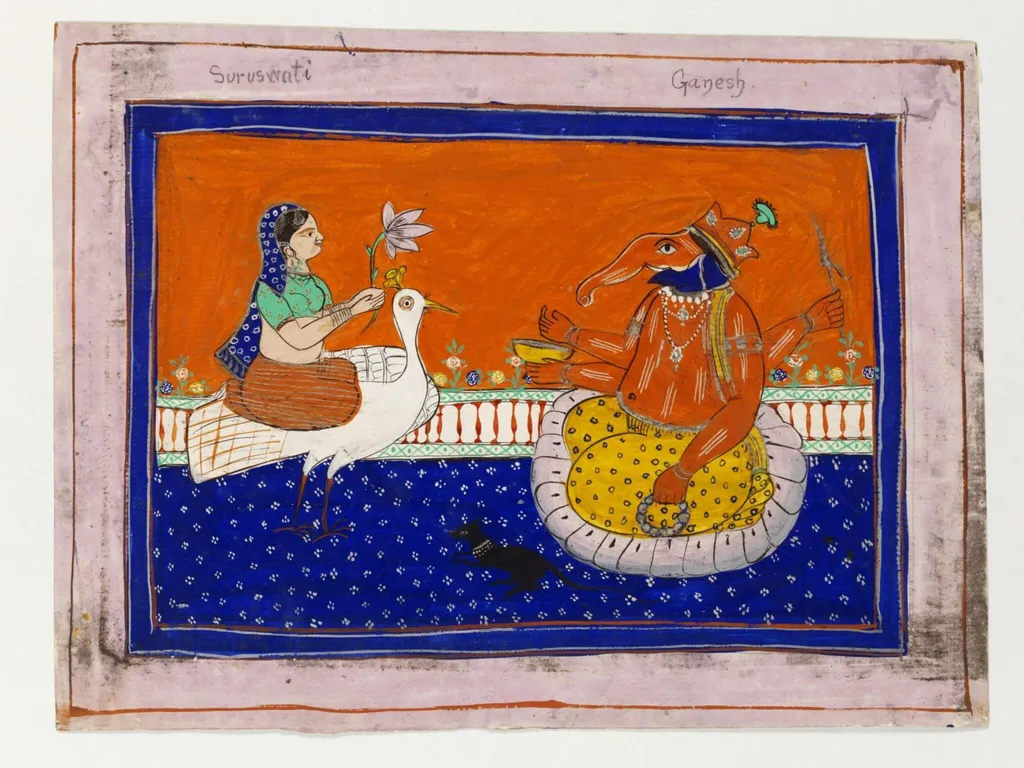
Saraswati and Ganesh is a paint painting by Unknown. It dates from 1850 and is held in the collection of the Victoria and Albert Museum.
About this work
Overview
Executed in a flat, unmodulated style with intense colors, it belongs to a larger album of 196 works assembled by J.
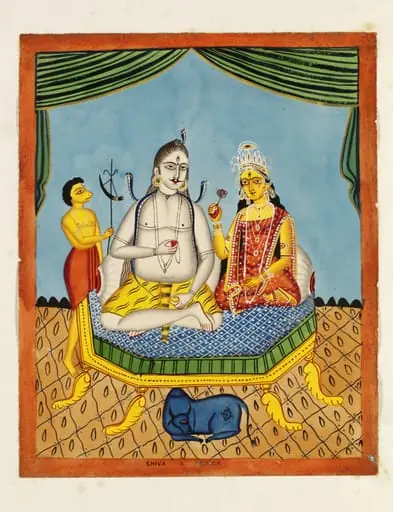
This painting features two Hindu deities, Saraswati and Ganesh, portrayed side by side on a vivid blue platform. Executed in a flat, unmodulated style with intense colors, it belongs to a larger album of 196 works assembled by J. Lockwood Kipling during his time in British India. The absence of perspective and the decorative patterning reflect regional artistic conventions of the period, emphasizing symbolic presence over naturalistic representation.
Subject & Meaning
Saraswati, goddess of knowledge, is depicted with a white bird, likely a swan, her traditional vehicle, and a lotus, symbols of purity and wisdom. Opposite her, Ganesh, the remover of obstacles, is shown with his elephant head, seated cross-legged, holding a staff and accompanied by laddus, his favored offering. Their placement suggests a dialogue between wisdom and auspiciousness, common in devotional imagery meant to invoke both intellectual and spiritual blessings.
Technique & Style
The painting employs bold, unshaded colors, bright blues, oranges, and greens, with no attempt at chiaroscuro or spatial depth. Figures are outlined clearly against a flat orange background and green railing, reinforcing a decorative, two-dimensional aesthetic. The script at the top identifies the deities, indicating the work’s function as a devotional or instructional image, likely produced for private contemplation or ritual use within a household or temple context.
History & Provenance
The painting was collected by J. Lockwood Kipling between 1865 and 1893, during his tenure in British India as an artist and educator. It formed part of a curated album documenting Indian visual culture, now held by the Victoria and Albert Museum. These albums served as ethnographic records, preserving regional styles and iconography that were rapidly changing under colonial influence and modernization.
Context
Created during the late 19th century, this work reflects the persistence of traditional Hindu iconography amid colonial rule. While European techniques were being introduced in urban art schools, rural and artisanal centers continued producing devotional images using time-honored methods. Such paintings were often made for domestic altars or educational settings, reinforcing religious narratives through accessible visual language.
Legacy
As part of Kipling’s collection, the painting contributes to the historical documentation of Indian artistic practices during a period of cultural transition. Its preservation in a major museum ensures continued access for study and public engagement. Though not widely exhibited, it remains a quiet testament to the enduring visual vocabulary of Hindu devotional art in the colonial era.
Artist & collection