Artwork
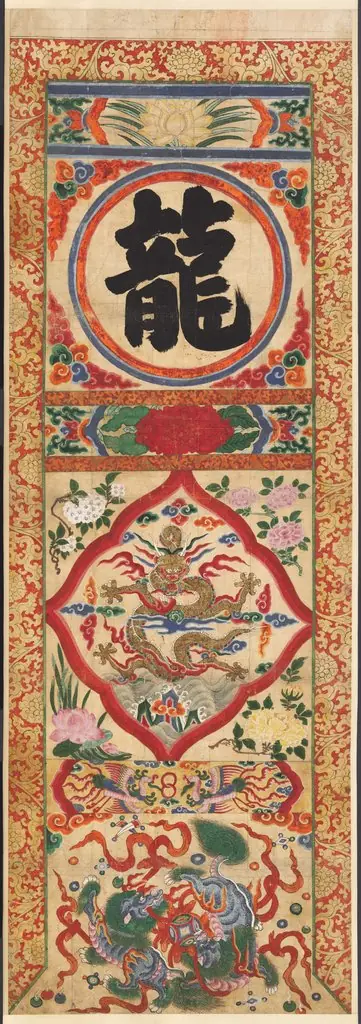
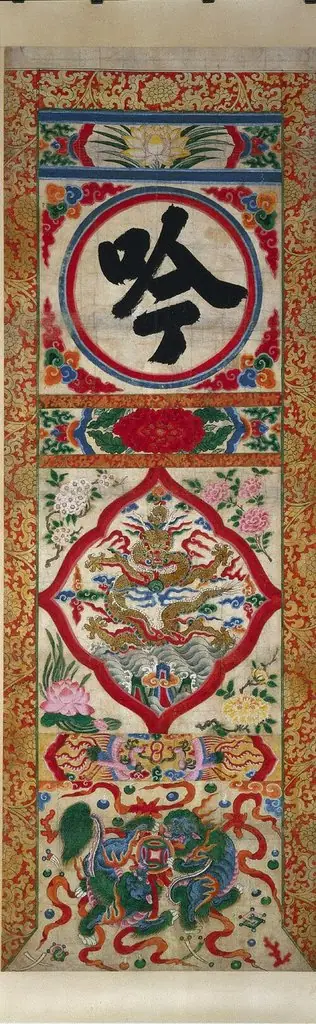
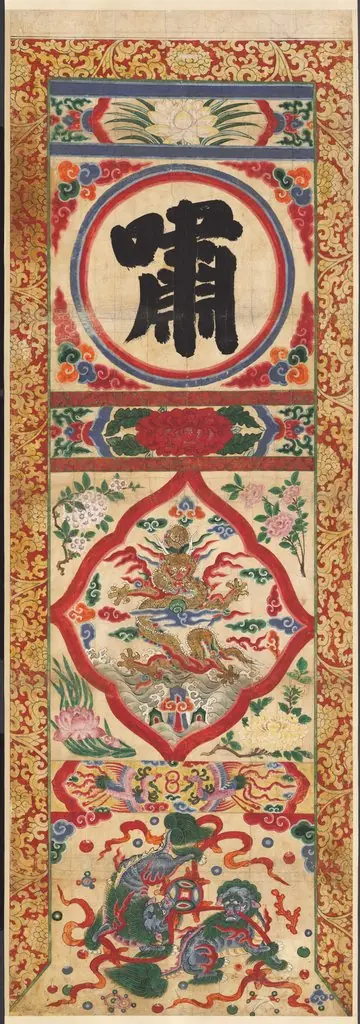
Set of Four Painted Characters
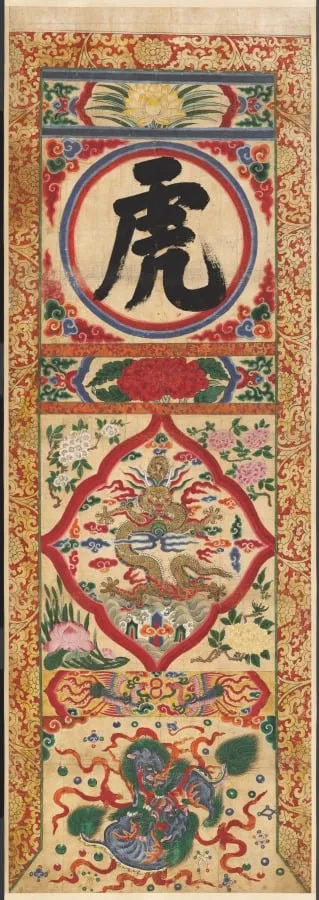
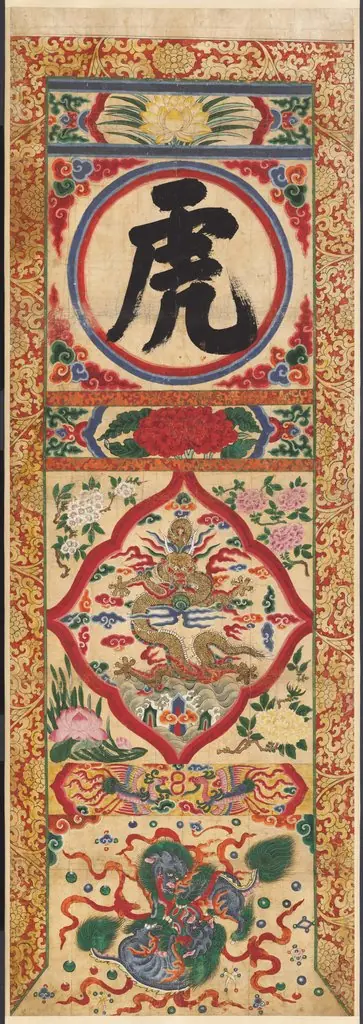
Set of Four Painted Characters is an unspecified painting by the Korean Minhwa artist Unknown. It dates from 1904 and is held in the collection of the Cleveland Museum of Art.
- Accession no.
- 1998.119
About this work
You see four bright scrolls hanging side by side, each showing one big Korean character: a tiger, a dragon, a whistle, and a chant.
These weren’t just art, they were part of outdoor Buddhist rituals, meant to call down good luck. The tiger and dragon stand guard over the west and east, like protectors.
To see more objects like this, look up Korea, Joseon dynasty (1392–1910).
Overview
A set of four painted hanging scrolls from the Joseon dynasty features large, bold Korean characters representing a tiger, dragon, whistle, and recite.
A set of four painted hanging scrolls from the Joseon dynasty features large, bold Korean characters representing a tiger, dragon, whistle, and recite. These scrolls were likely displayed outdoors during Buddhist ceremonies, where their visual presence served a ritual function. Each scroll is individually composed, with vivid pigments and simplified forms, suggesting use in communal spiritual practices rather than private contemplation.
Subject & Meaning
The characters depict symbolic elements tied to protective and ritualistic traditions. The tiger and dragon correspond to western and eastern directional guardians in East Asian cosmology. The whistle and recite likely reference auditory components of Buddhist rites, calls to awaken spirits or invocations through chant.
Together, the four form a symbolic ensemble meant to summon divine favor and ward off misfortune during outdoor ceremonies.
Technique & Style
Each scroll employs a restrained yet expressive brushwork style, with thick ink outlines and flat areas of bright mineral pigments. The characters are rendered in a monumental scale, optimized for visibility from a distance. The composition avoids detail, emphasizing legibility and symbolic clarity. The use of hanging scroll format suggests portability and temporary display, suited for seasonal or event-based rituals.
History & Provenance
These scrolls originate from the Joseon dynasty (1392–1910), a period when Buddhist practices persisted despite state preference for Confucianism. Their survival indicates continued folk or monastic use of ritual objects. Likely produced by itinerant artists or temple artisans, they were not commissioned for elite collections but for practical ceremonial purposes, making their preservation rare.
Context
In Joseon-era Korea, Buddhist rituals often blended with local folk beliefs, especially in rural areas. Outdoor ceremonies involving directional guardians and sonic elements like whistles or chants were common during festivals or times of communal need. These scrolls reflect a syncretic tradition where Buddhist symbolism coexisted with indigenous practices, serving as both spiritual tools and cultural markers.
Legacy
Though not widely documented in official records, such scrolls represent a vital strand of popular religious expression in late premodern Korea. Their existence challenges assumptions that Buddhist art of the period was purely textual or monastic. Today, they offer insight into how spiritual symbols were adapted for accessible, performative rituals beyond temple walls.
Artist & collection









![The Guardian Generals of the Directions (Lokapalas) Dhritarashtra (East) [top] and Virudhaka (South) [bottom], by Unknown](https://artifactworldgallery.com/img/unknown--the-guardian-generals-of-the-directions-lokapalas-dhritarash--26a8da85b3fb4c5a-w320.webp)