Artwork
Sketching from Nature
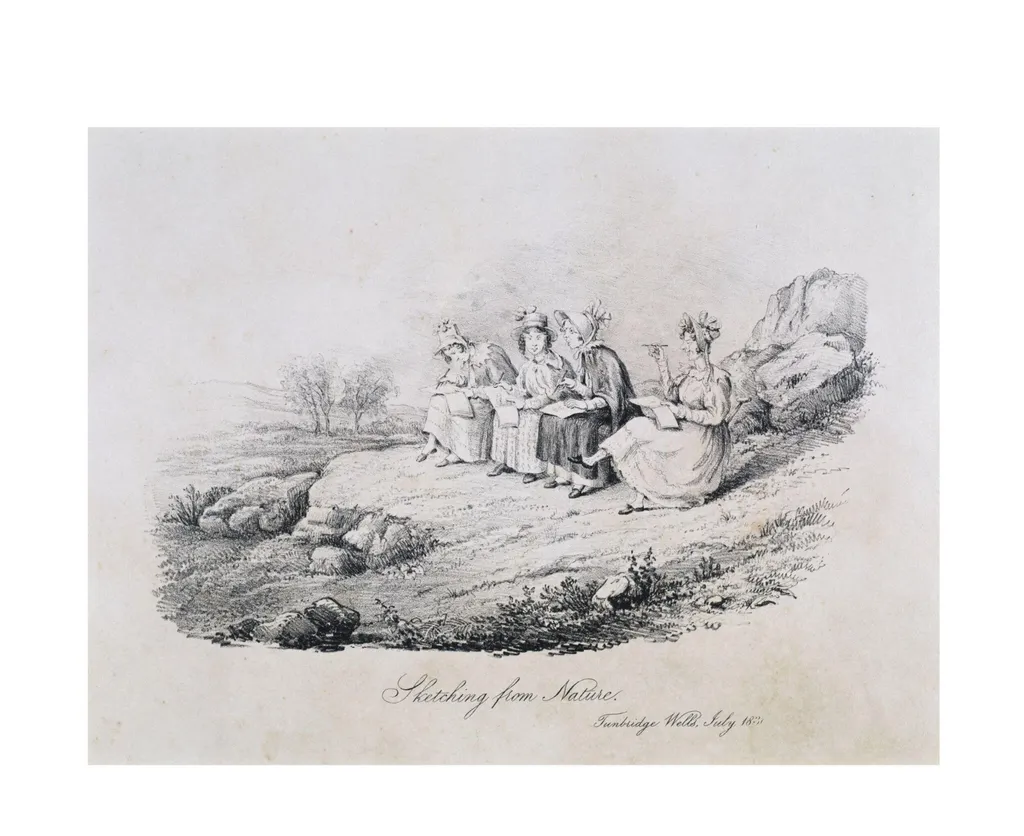
Sketching from Nature is a print by the Romanticist artist Unknown. It dates from 1830 and is held in the collection of the Victoria and Albert Museum. This print depicts four women seated outdoors, each engaged in sketching the landscape.
About this work
Overview
Created as a satirical commentary, it reflects contemporary attitudes toward female amateur artists in the early 1800s.
This print depicts four women seated outdoors, each engaged in sketching the landscape. Created as a satirical commentary, it reflects contemporary attitudes toward female amateur artists in the early 1800s. While drawing was socially encouraged as a refined pastime, this image subtly critiques the superficiality with which some practiced it, highlighting the gap between genteel expectation and artistic seriousness.
Subject & Meaning
The women, dressed in bonnets and arranged in a composed group, are shown copying nature, a common domestic activity for middle- and upper-class women. The scene’s calm demeanor masks its ironic tone: by portraying them as mechanically reproducing scenery without individual expression, the print questions the depth of their engagement, framing their pursuit as performative rather than truly artistic.
Technique & Style
The artist employs clear outlines and restrained tonal variation to emphasize the figures’ uniformity and stillness. Rather than using chiaroscuro for dramatic depth, the work favors flat, even lighting, reinforcing the sense of routine and conformity. The composition is tightly ordered, mirroring the social constraints placed on its subjects, with little sense of movement or personal interpretation in their actions.
History & Provenance
Produced in the early 19th century, the print emerged during a period when female artistic activity was both promoted and limited by societal norms. It likely circulated among middle-class audiences familiar with the conventions of genteel education. Its origin as a satirical print suggests it was intended for private or periodical consumption, targeting those who viewed female sketching as a decorative social habit rather than a serious vocation.
Context
In early 19th-century Britain, watercolor drawing was one of the few acceptable creative outlets for women, taught alongside music and embroidery. While it offered intellectual engagement, it was rarely seen as a path to professional recognition. This print reflects the cultural tension between the encouragement of female creativity and the persistent dismissal of it as trivial, reinforcing gendered boundaries in the arts.
Legacy
The print endures as a document of how artistic practice was gendered in the Victorian era. It captures a moment when women’s engagement with visual culture was both celebrated and condescended to. Today, it serves as a historical lens through which to examine the social frameworks that shaped, and often limited, women’s roles in the visual arts.
Artist & collection









- Rose Maylie and Oliver
 Les présents du berger
 Outside of a Humble Print Shop
 H Beard Print Collection
 The Annual Question - Where Shall We Go?
 A beach scene
 Forest Clearing with an Oak Trunk
 A Cornish View
 Mädel mit Honig und Obst (Girl Selling Honey and Fruit)
 Nurse and Children in the Fields
 The Sunrise Drew Her Thoughts to Europe
 Hüssener, Auguste: Andruckbogen mit drei Gemäldereproduktionen