Artwork
Text, Folio 46 (verso), from a Kalpa-sutra
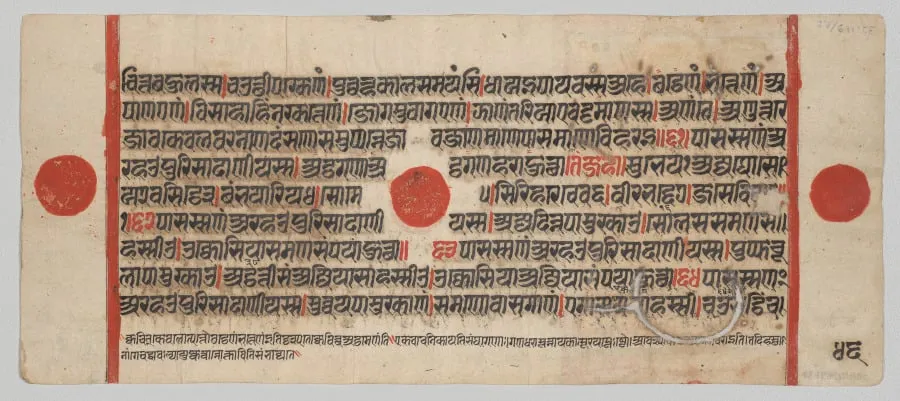
Text, Folio 46 (verso), from a Kalpa-sutra is an unspecified painting by the Mughal Painting artist Unknown. It dates from 1500 and is held in the collection of the Cleveland Museum of Art. The folio illustrates the Jain ascetic Parshva seated in a meditative pose, surrounded by rising waters.
- Accession no.
- 1932.119.46.b
- Credit line
- Edward L. Whittemore Fund
About this work
You see a blue figure standing still in rising water, cobras coiled around him like a living umbrella.
You see a blue figure standing still in rising water, cobras coiled around him like a living umbrella.
This is Parshva, a spiritual teacher from Jain stories. The snakes protected him so he could finish meditating, even as the flood rose to his shoulders. The gold lines on the blue background show the water level, simple but powerful.
To see more paintings like this, look up western india, gujarat, late 15th-early 16th century.
Overview
The folio illustrates the Jain ascetic Parshva seated in a meditative pose, surrounded by rising waters. A cobra with seven hoods forms a protective canopy over his head, while additional serpents coil around him, creating a living umbrella. Gold linear motifs on a blue field suggest the floodwaters reaching his shoulders, emphasizing his steadfastness amid elemental danger.
Subject & Meaning
Parshva, a revered teacher in Jain tradition, is depicted enduring a deluge while maintaining meditation. The serpents, especially the seven‑hooded cobra, symbolize divine protection, allowing him to complete his spiritual practice and attain liberation. The scene conveys the triumph of inner resolve over external adversity, a core theme in Jain narratives of ascetic perseverance.
Technique & Style
Executed in miniature painting, the work employs a limited palette of deep blue and metallic gold. The gold lines convey the water’s surface with a stylized, abstract quality, while the serpents are rendered with fluid, curvilinear forms that contrast with the figure’s stillness. The white lower garment of the ascetic is rendered in flat wash, indicating sectarian affiliation.
History & Provenance
The manuscript originates from western India, specifically Gujarat, and dates to the late 15th or early 16th century. It belongs to a Kalpa‑sutra text used by the Svetambara branch of Jainism, whose monks and nuns traditionally wear white robes. The folio’s provenance reflects the regional artistic conventions of Jain manuscript production during this period.
Context
During the period of its creation, Gujarat was a vibrant centre for Jain patronage, fostering a distinctive manuscript tradition. The depiction of Parshva aligns with Jain hagiographic literature that emphasizes the protective role of nature’s creatures in the spiritual journey of ascetics. Such images served both devotional and didactic functions within monastic communities.
Artist & collection









- Text, Folio 56 (verso), from a Kalpa-sutra
 Text, Folio 55 (verso), from a Kalpa-sutra
 Text, Folio 36 (verso), from a Kalpa-sutra
 Text, Folio 61 (verso), from a Kalpa-sutra
 Text, Folio 50 (recto), from a Kalpa-sutra
 Text, Folio 55 (recto), from a Kalpa-sutra
 Text, Folio 20 (recto), from a Kalpa-sutra
 Text, Folio 45 (verso), from a Kalpa-sutra
 Text, Folio 65 (verso), from a Kalpa-sutra
 Text, Folio 27 (recto), from a Kalpa-sutra
 Text, Folio 59 (recto), from a Kalpa-sutra