Artwork
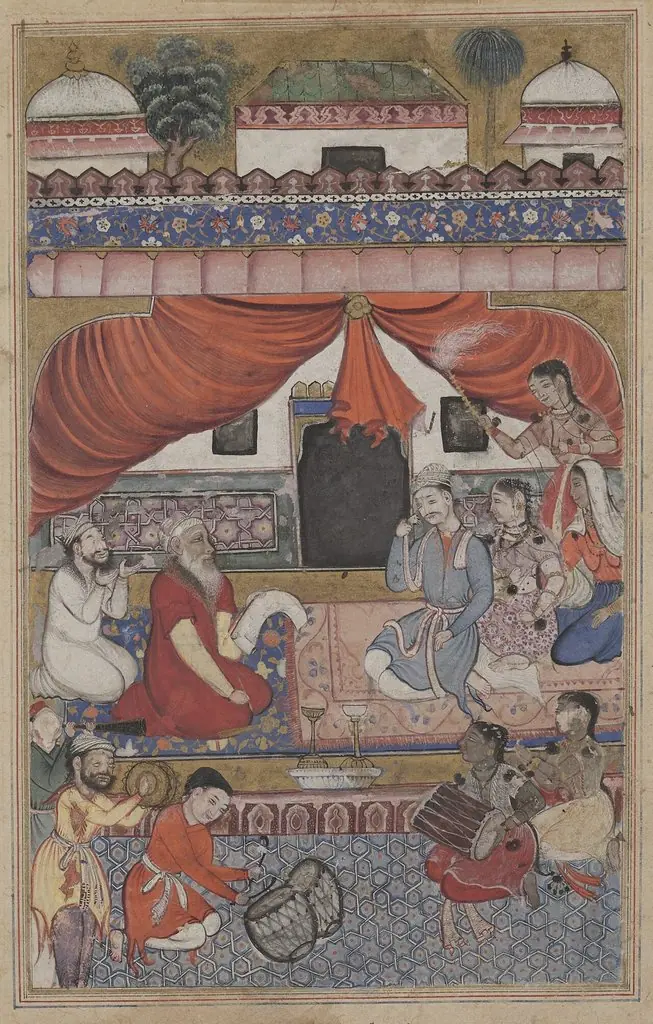
The court of the Raja of Ujjain, from a Tuti-nama (Tales of a Parrot): Forty-sixth Night
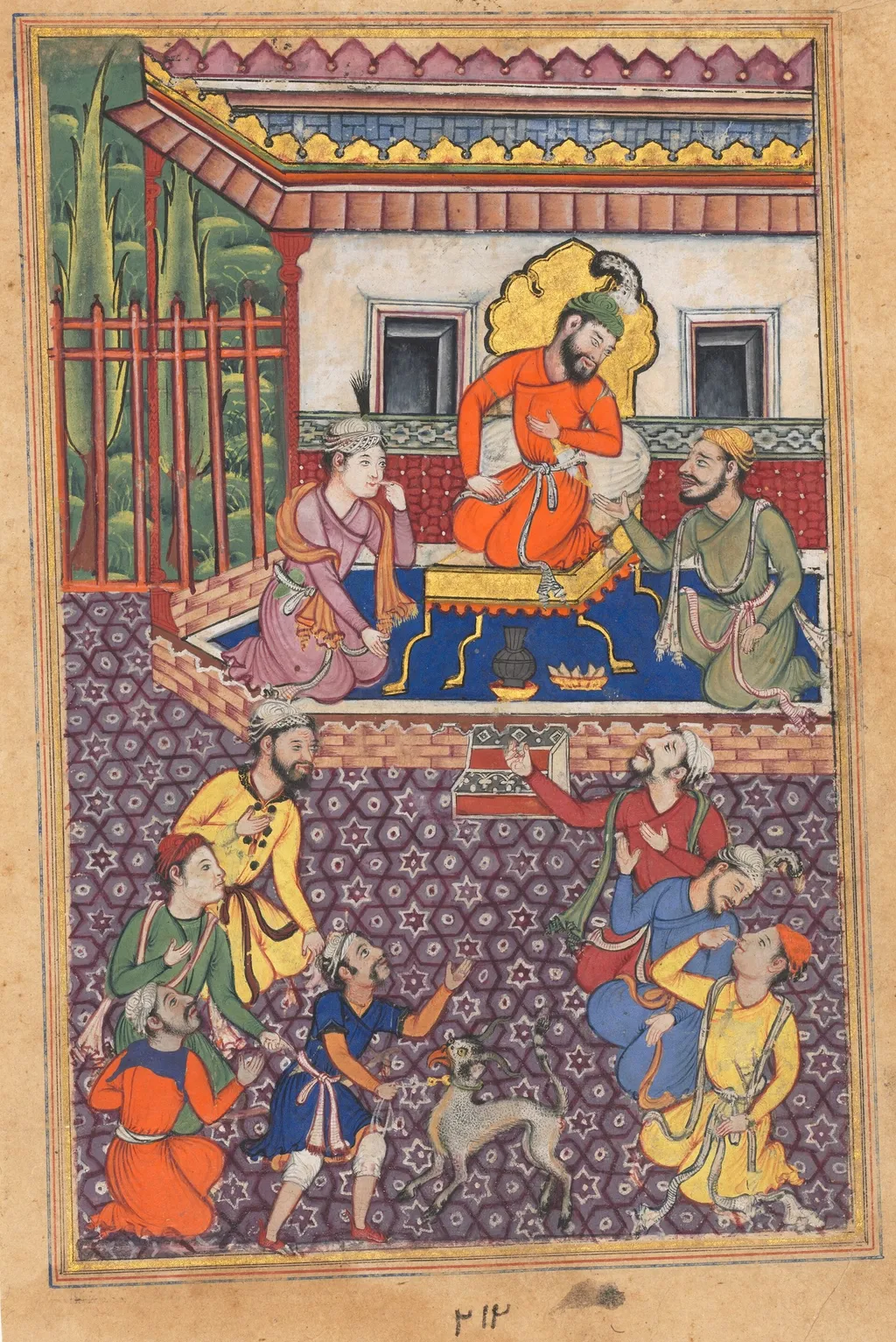
The court of the Raja of Ujjain, from a Tuti-nama (Tales of a Parrot): Forty-sixth Night is an unspecified painting. It dates from 1560 and is held in the collection of the Cleveland Museum of Art. The work is a miniature painting illustrating the forty‑sixth night of a Tuti‑nama, a collection of parrot‑told stories.
About this work
History & Provenance
Its provenance traces from the original royal patronage to the modern museum acquisition, documented in Cleveland Museum of Art records.
The painting was created in 1560 in Mughal India as part of a dispersed Tuti-nama manuscript commissioned for the court of the Raja of Ujjain, a work attributed to an unknown Mughal artist. It entered the collection of the Cleveland Museum of Art, where it remains on view as item 1962.279.291.b.
The manuscript’s folio, catalogued as the Forty-sixth Night scene, illustrates a royal court scene and reflects the stylistic conventions of early Mughal book painting. Its provenance traces from the original royal patronage to the modern museum acquisition, documented in Cleveland Museum of Art records.
The work’s creation history is situated within the broader tradition of 16th‑century Persianate illustration that traveled across the Indian subcontinent, linking elite manuscript culture with later museum collecting practices.
The painting The court of the Raja of Ujjain, from a Tuti-nama (Tales of a Parrot): Forty-sixth Night is held in the collection of the Cleveland Museum of Art in Cleveland, Ohio. The work, created in 1560 within the Mughal Empire, is cataloged under the accession number 1962.279.291.b. While the specific artist remains unidentified, the museum maintains the piece as part of its permanent holdings. No specific exhibition history is provided in the available records.
Overview
The work is a miniature painting illustrating the forty‑sixth night of a Tuti‑nama, a collection of parrot‑told stories. It depicts an interior court scene rendered in vivid pigments, with a central figure seated on a raised dais holding an infant, surrounded by attendants and onlookers.
Subject & Meaning
The central man, clothed in a red robe and crowned with a golden headdress, is presented as a ruler, likely the Raja of Ujjain, emphasizing his authority through the halo‑like light surrounding him. The infant he cradles suggests a dynastic or ceremonial moment, while the surrounding figures convey the pageantry of courtly life.
Technique & Style
Executed in the traditional Indian miniature tradition, the painting employs fine brushwork to delineate intricate costumes, patterned flooring and a lattice window. Bright, saturated colors, reds, purples, greens, contrast against a flat gold background, while delicate line work defines facial expressions and textile folds.
Context
Court scenes such as this were commonly used to visualize stories of royal virtue and moral instruction. The inclusion of a parrot narrator reflects the literary device of the Tuti‑nama, where a talking bird recounts tales that blend folklore with ethical lessons, situating the artwork within a broader tradition of didactic illustration.
Artist & collection

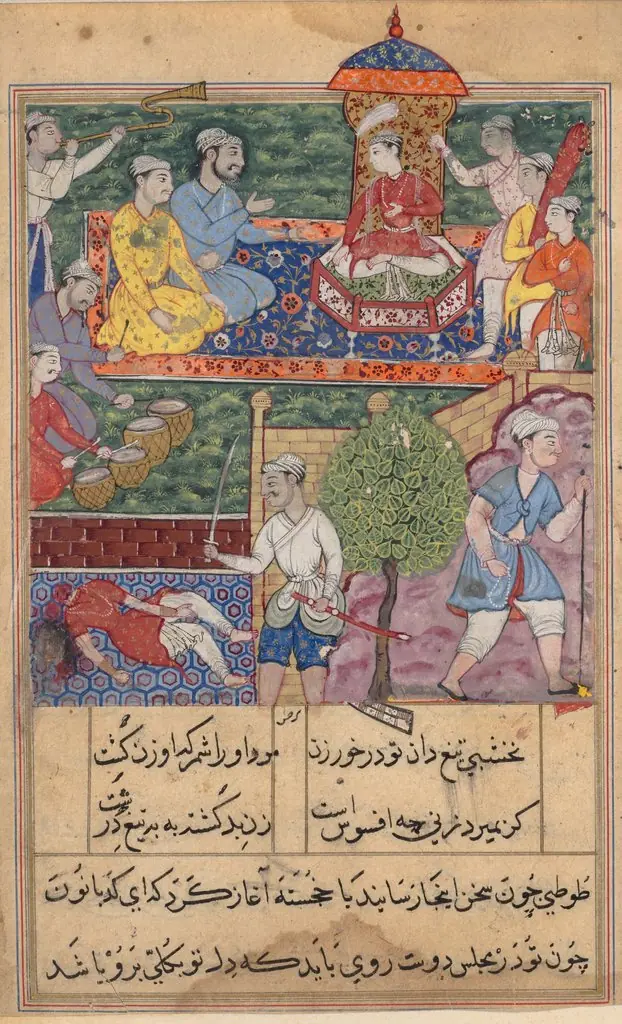 Page from Tales of a Parrot (Tuti-nama): text page
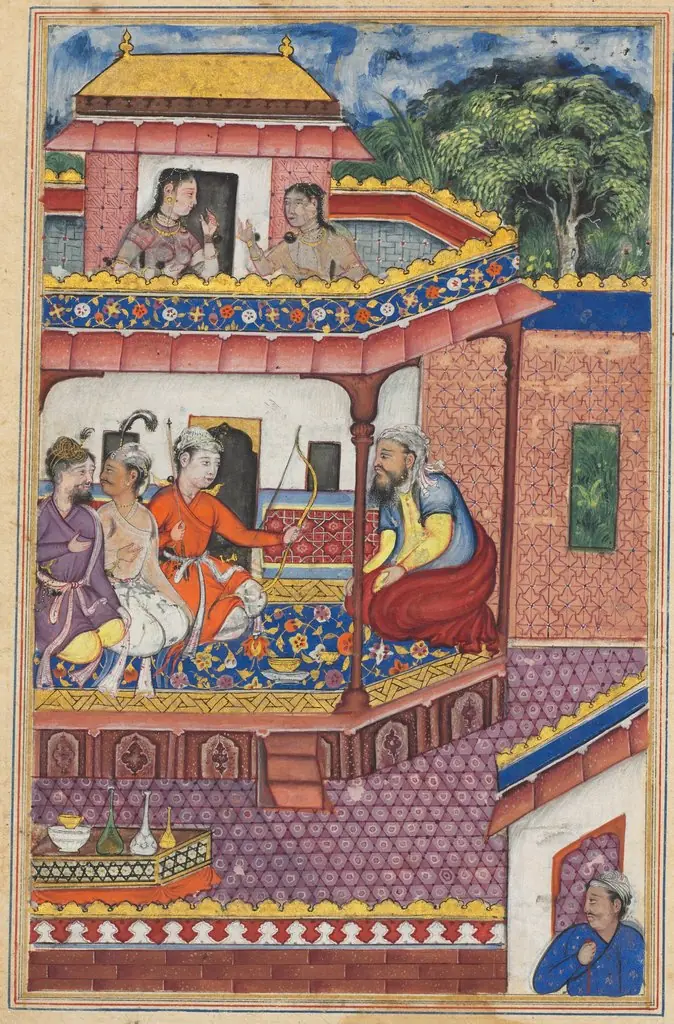 The three young men present themselves as suitors for the hand of Zuhra, the daughter of the merchant of Kabul, from a Tuti-nama (Tales of a Parrot): Thirty-fourth Night
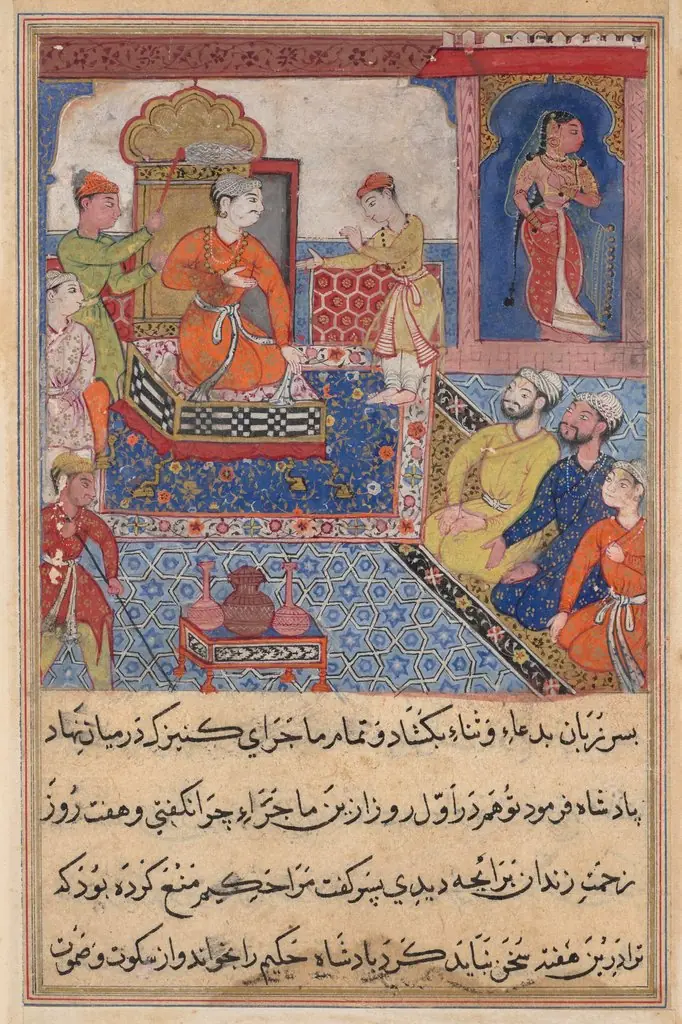 Page from Tales of a Parrot (Tuti-nama): text page
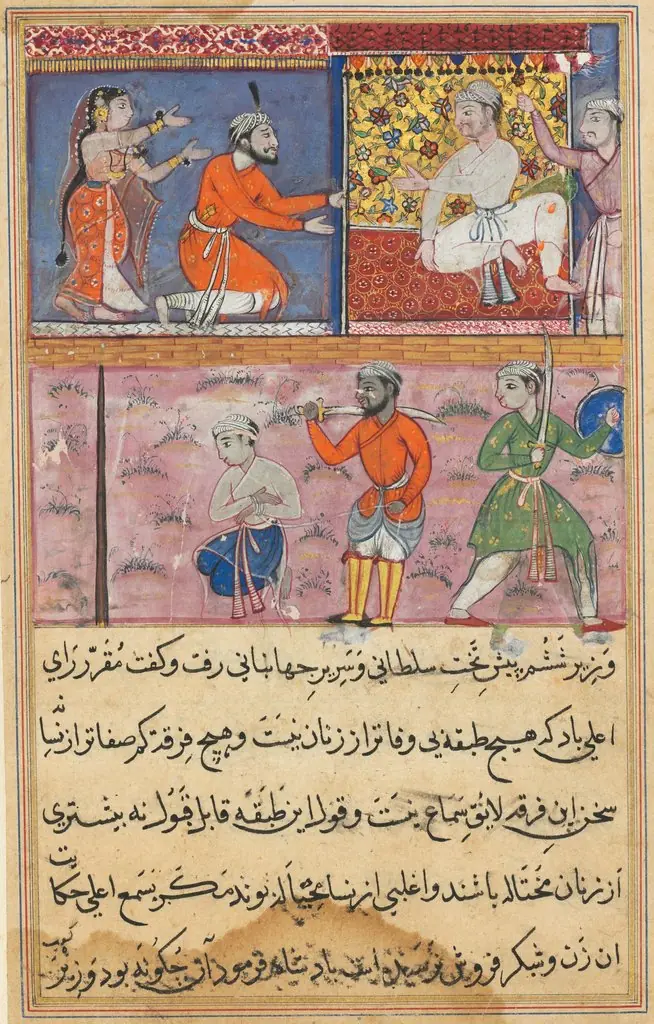 The prince sent back to the place of execution for the sixth time, from a Tuti-nama (Tales of a Parrot): Eighth Night
 The merchant returns bringing a young slave who is really the son of the princess of Rum, now married to the king, from a Tuti-nama (Tales of a Parrot): Fiftieth Night
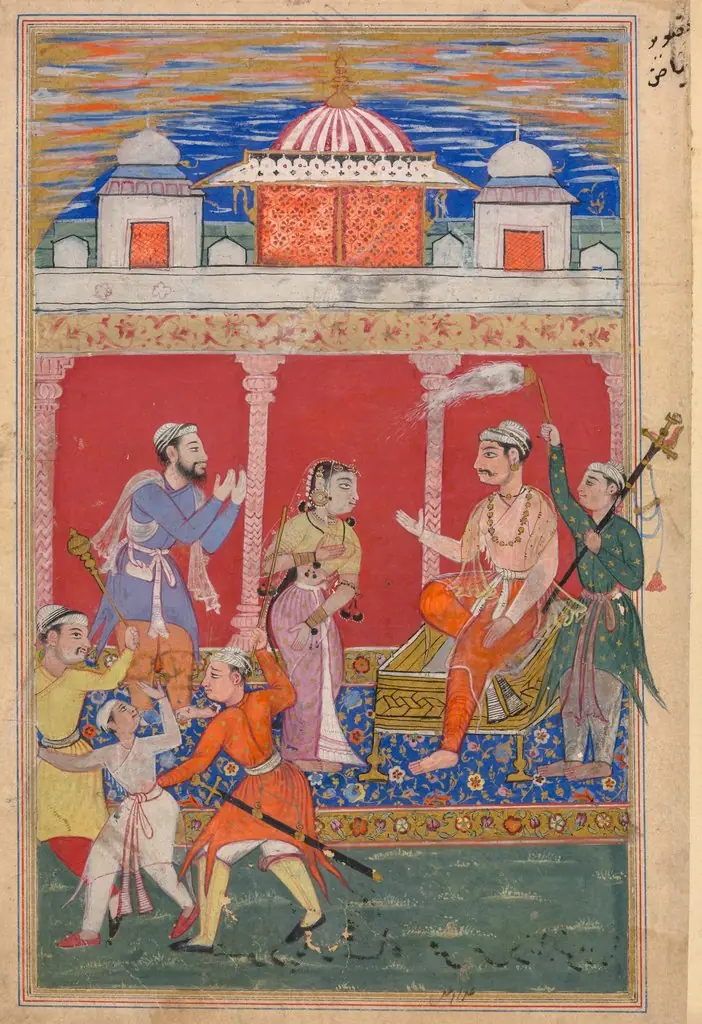 Page from Tales of a Parrot (Tuti-nama): text page
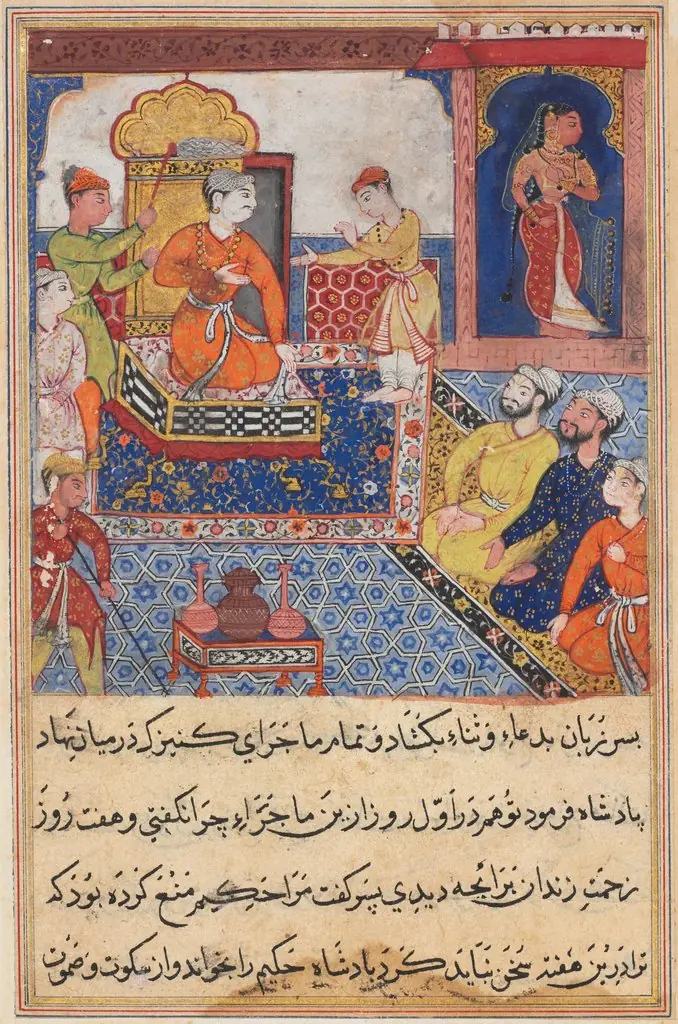 The young prince recounts his experiences to his father, the king, from a Tuti-nama (Tales of a Parrot): Eighth Night
- The court of the Raja of Ujjain, from a Tuti-nama (Tales of a Parrot): Forty-sixth Night
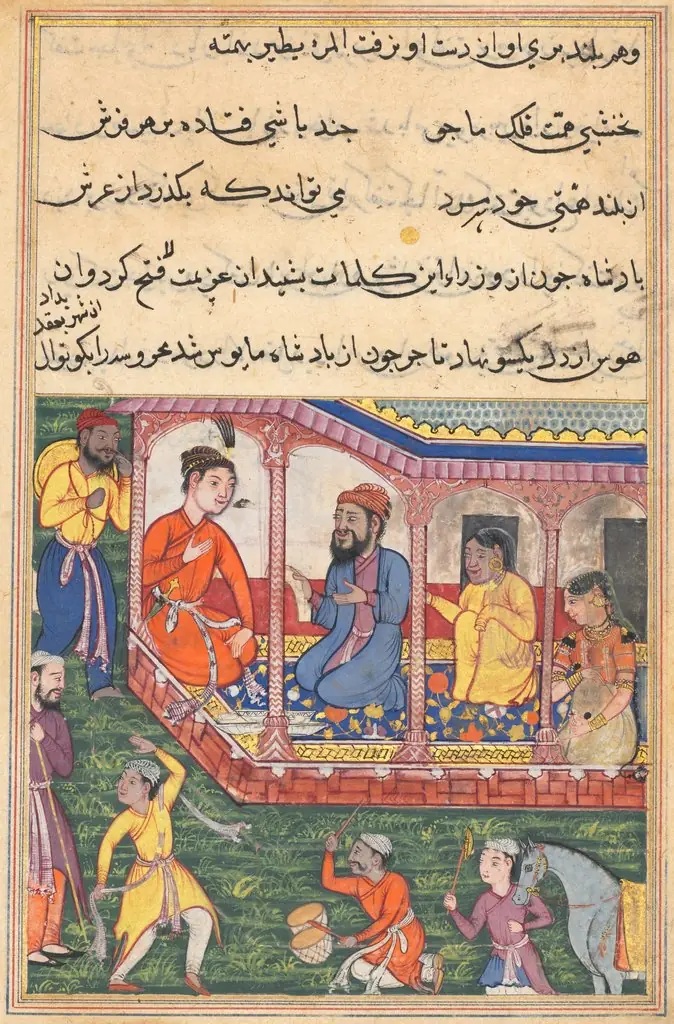 Mahrusa’s marriage to the prefect of the city, from a Tuti-nama (Tales of a Parrot): Thirty-sixth Night
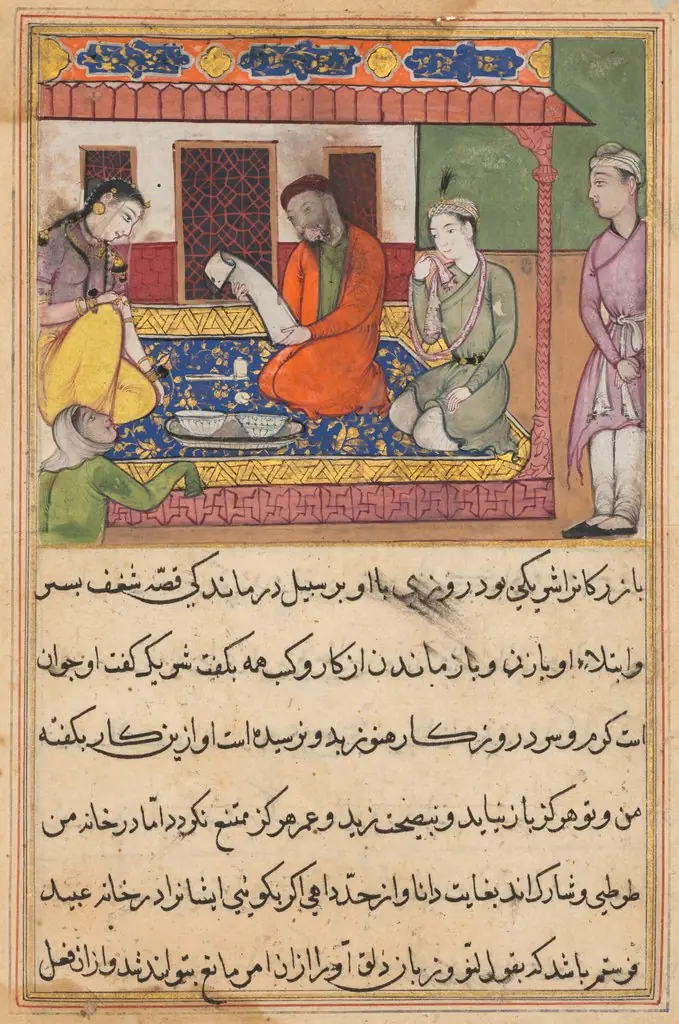 The marriage of ‘Ubaid, son of a merchant of Tirmiz, from a Tuti-nama (Tales of a Parrot): Forty-second Night
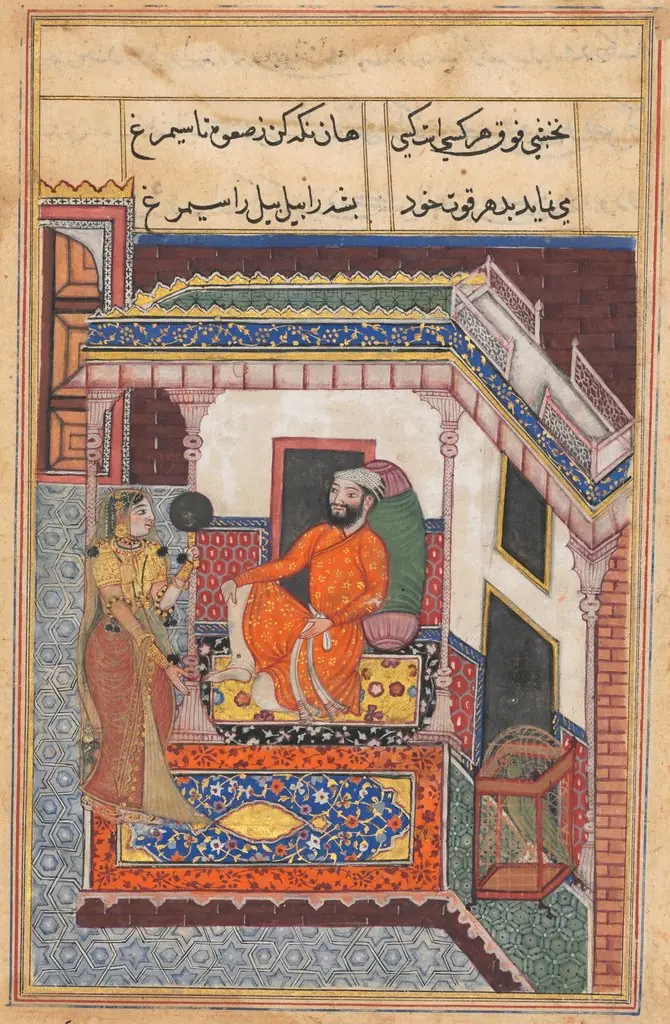 The parrot laughs on hearing the Raja of Ujjain’s wife admire her beauty in a mirror, from a Tuti-nama (Tales of a Parrot: Forty-sixth Night
 Preparation for the marriage of Mahmuda to the Young Vizier, from a Tuti-nama (Tales of a Parrot): Thirty-third Night