Artwork
The Eleven Principal Disciples (Ganadharas) of Mahavira, Folio 57 (verso), from a Kalpa-sutra
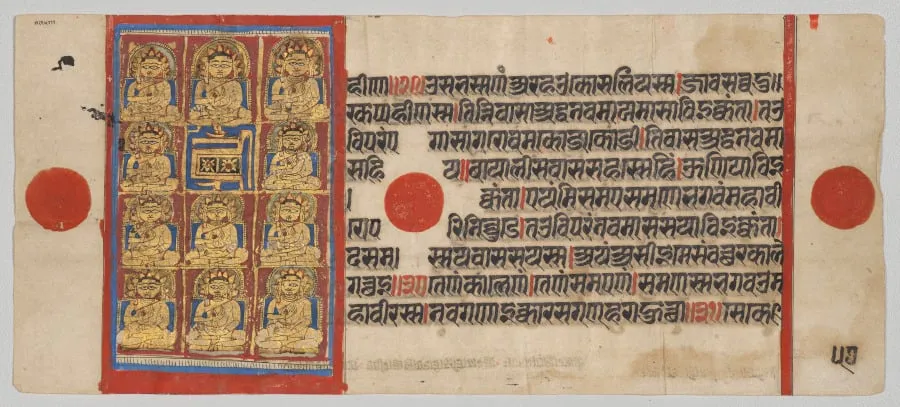
The Eleven Principal Disciples (Ganadharas) of Mahavira, Folio 57 (verso), from a Kalpa-sutra is an unspecified painting by the Indian Miniature artist Unknown. It dates from 1488 and is held in the collection of the Cleveland Museum of Art. This folio originates from a manuscript of the Kalpa-sutra, a sacred Jain text detailing the lives of Tirthankaras and their disciples.
- Accession no.
- 1932.119.57.b
- Credit line
- Edward L. Whittemore Fund
About this work
Overview
Painted in the western Indian tradition, likely Gujarat, it illustrates the eleven principal disciples of Mahavira, arranged in orderly rows.
This folio originates from a manuscript of the Kalpa-sutra, a sacred Jain text detailing the lives of Tirthankaras and their disciples. Painted in the western Indian tradition, likely Gujarat, it illustrates the eleven principal disciples of Mahavira, arranged in orderly rows. Their uniform appearance and meditative posture reflect doctrinal emphasis on spiritual equality among the enlightened. The composition serves both devotional and didactic functions within monastic practice.
Subject & Meaning
The eleven disciples, known as Ganadharas, are depicted identically to signify their shared attainment of spiritual insight and their role as transmitters of Mahavira’s teachings. Each figure assumes the same meditative pose, left hand resting in the lap, right hand raised in the gesture of instruction, emphasizing unity of wisdom rather than individual identity. Their shaved heads and elongated earlobes mark them as renunciants, while their white robes align with the Shvetambara sect’s practices.
Technique & Style
Executed in fine brushwork with mineral pigments, the figures are rendered with restrained detail, prioritizing symbolic clarity over individualization. The background remains unadorned, focusing attention on the disciplined rows of monks. Above them, a central grid holds stylized sacred syllables, om and hrim, intertwined with delicate floral motifs, serving as visual mantras to aid contemplation during ritual recitation.
History & Provenance
The folio is part of a larger illuminated manuscript tradition from Gujarat, dating to the late medieval period, likely the 15th or 16th century. Such manuscripts were commissioned by wealthy lay patrons or monastic communities for use in religious ceremonies and study. Its survival suggests careful preservation within a Jain religious context, where textual and visual devotion were deeply intertwined.
Context
In Jain cosmology, the Ganadharas were the first generation of disciples entrusted with preserving Mahavira’s oral teachings. Their uniform depiction reflects the Jain principle that enlightenment transcends personal distinction. The inclusion of sacred syllables and floral patterns aligns with broader Indian devotional practices, where visual elements function as aids to meditation and spiritual focus within ritual settings.
Legacy
This folio exemplifies the enduring Jain artistic tradition of using repetition and symbolism to convey doctrinal truths. Its stylistic consistency with other western Indian manuscripts highlights regional conventions in religious illustration. Today, it remains a key reference for understanding how Jain communities visualized spiritual authority and the transmission of sacred knowledge through centuries.
Artist & collection









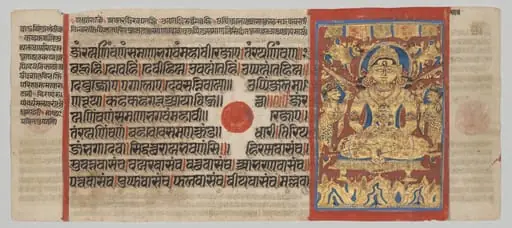
- Ritual Bath of Mahavira, Folio 31 (recto), from a Kalpa-sutra
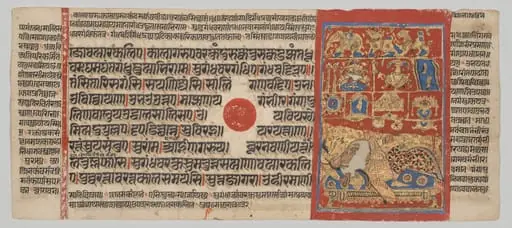 The Fourteen Dreams of Queen Trishala, folio 14 (recto), from a Kalpa-sutra
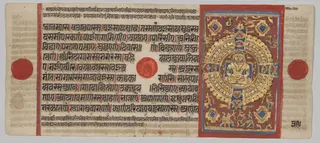 Mahavira's Omniscience and First Teaching (Samavasarana), Folio 39 (verso), from a Kalpa-sutra
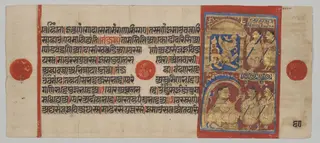 The Lion's Cave with Sthulabhadra and His Sisters, Folio 60 (verso), from a Kalpa-sutra
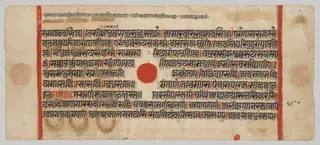 Text, Folio 57 (recto), from a Kalpa-sutra
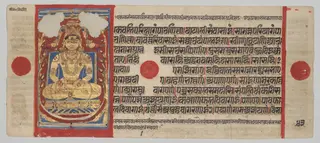 Mahavira in the Realm of Liberation (Nirvana), Folio 43 (verso), from a Kalpa-sutra