Artwork
Ritual Bath of Mahavira, Folio 31 (recto), from a Kalpa-sutra
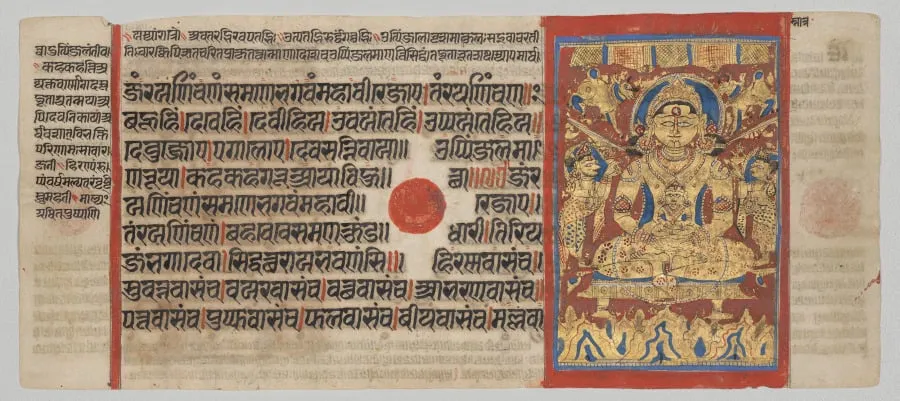
Ritual Bath of Mahavira, Folio 31 (recto), from a Kalpa-sutra is an unspecified painting by the Indian Miniature artist Unknown. It dates from 1488 and is held in the collection of the Cleveland Museum of Art. The painting depicts the ceremonial first bathing of Mahavira, the founder of Jainism.
- Accession no.
- 1932.119.31.a
- Credit line
- Edward L. Whittemore Fund
About this work
You see a bright blue god holding a baby while two priests pour milk from golden jars.
You see a bright blue god holding a baby while two priests pour milk from golden jars. Below them, jagged white mountains rise like teeth. Two white cows float above the scene.
This is a Jain ritual: the first bath of Mahavira, the religion’s founder. The milk washes away birth impurities. The painting comes from a book of Jain rules, made in Gujarat around 1500. No one knows who painted it.
To see more art like this, look up western india, gujarat.
Overview
The painting depicts the ceremonial first bathing of Mahavira, the founder of Jainism. Central to the scene is Indra, the celestial king, cradling the infant Mahavira on his lap while two priests attend him. Above, two cows hover, signifying the presence of milk, the substance used for the ritual purification.
Subject & Meaning
In Jain tradition, the initial bath of Mahavira is performed with milk to cleanse the newborn of all impurities associated with birth. The presence of Indra underscores divine endorsement of Mahavira’s spiritual mission, while the cows, symbols of purity, reinforce the sanctity of the milk used in the rite.
Technique & Style
Executed in vivid pigments, the work features a bright blue figure for Indra contrasted with golden vessels held by the priests. The jagged white peaks at the lower edge suggest Mount Meru, rendered in a stylized, almost tooth‑like manner. The composition balances celestial and earthly realms through floating elements and a clear, linear arrangement.
History & Provenance
Created as a folio in a Kalpa‑sutra manuscript, the piece originates from Gujarat around the early sixteenth century. The manuscript records Jain ritual law, and this particular illustration serves a didactic purpose. The artist’s identity remains unknown, a common circumstance for devotional works of the period.
Context
The Kalpa‑sutra is a key Jain text that codifies rites, biographies, and ethical precepts. This illustration would have accompanied the textual description of Mahavira’s birth rituals, providing visual guidance for monastic instruction and lay devotion in western India.
Legacy
As a representative example of Jain manuscript art, the folio illustrates the integration of religious narrative with regional artistic conventions of Gujarat. Its preservation offers insight into the visual language used to convey doctrinal concepts and ritual practices within Jain communities.
Artist & collection









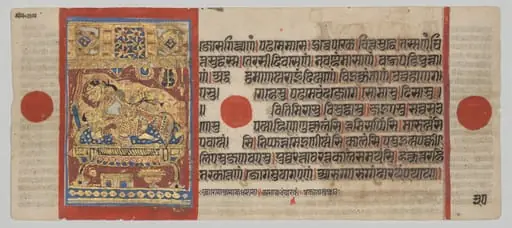
- Birth of Mahavira, folio 30 (verso), from a Kalpa-sutra
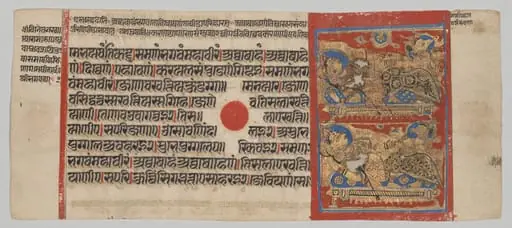 Transfer of the Embryo of Mahavira, Folio 12 (recto), from a Kalpa-sutra
 Mahavira's Initiation Tonsure, Folio 37 (verso), from a Kalpa-sutra
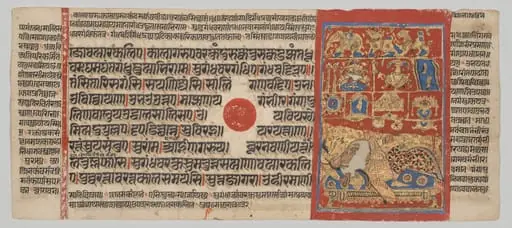 The Fourteen Dreams of Queen Trishala, folio 14 (recto), from a Kalpa-sutra
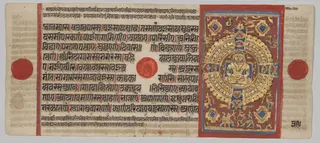 Mahavira's Omniscience and First Teaching (Samavasarana), Folio 39 (verso), from a Kalpa-sutra
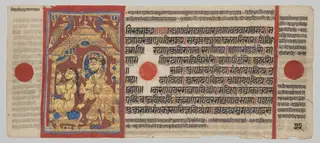 King Siddhartha's Morning Bath, Folio 22 (verso), from a Kalpa-sutra
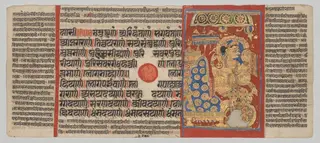 Indra Venerates the Embryo of Mahavira, Folio 7 (recto), from a Kalpa-sutra
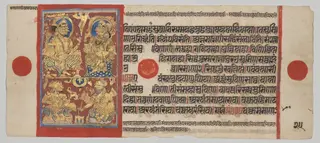 King Siddhartha and Queen Trishala with the Dream Interpreters, Folio 25 (verso), from a Kalpa-sutra
 Text, Folio 37 (recto), from a Kalpa-sutra
 Text, Folio 31 (verso), from a Kalpa-sutra