Artwork
The Lion's Cave with Sthulabhadra and His Sisters, Folio 60 (verso), from a Kalpa-sutra
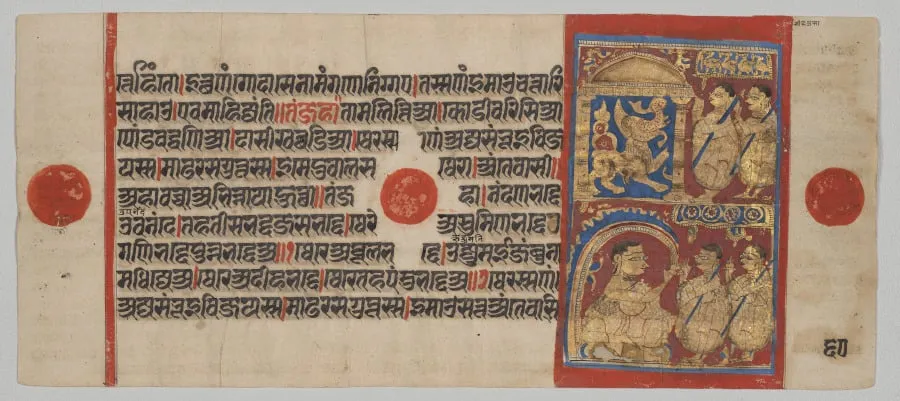
The Lion's Cave with Sthulabhadra and His Sisters, Folio 60 (verso), from a Kalpa-sutra is an unspecified painting by the Indian Miniature artist Unknown. It dates from 1450 and is held in the collection of the Cleveland Museum of Art.
- Accession no.
- 1932.119.60.b
- Credit line
- Edward L. Whittemore Fund
About this work
Overview
The folio, part of a Kalpa‑sutra manuscript, opens to a vivid illustration portraying a Jain monk who has assumed a hybrid form, a lion’s head and a serpent’s tail, while seated inside a cavern. Two female disciples, dressed in white, stand nearby, visibly alarmed, and a senior monk appears in the lower left, delivering a reprimand.
Subject & Meaning
The scene visualizes a narrative absent from the main text, which merely lists the monk Sthulabhadra and his sisters among notable teachers. According to later commentaries, the monk displayed his supernatural abilities to his visiting sisters, prompting their fear and the elder monk’s admonishment for excessive pride. The image thus serves as a moral reminder of humility in spiritual practice.
Technique & Style
Executed with a palette dominated by bright reds and greens, the painting employs bold outlines and flat areas of colour typical of western Indian manuscript art. The figures are rendered in a stylized manner, with the lion‑headed monk’s features exaggerated to emphasize his animal transformation, while the nuns are depicted in simple, serene white garments.
History & Provenance
The folio belongs to a Jain Kalpa‑sutra codex, likely produced in Gujarat, a region known for its manuscript illumination during the medieval period. The work’s precise date and artist remain unidentified, but its inclusion in a religious text suggests it was created for monastic use and circulated among Jain scholarly communities.
Context
Jain visual culture often incorporates didactic scenes that complement textual teachings. By illustrating an anecdote found only in exegetical literature, the painting bridges the gap between scripture and oral tradition, reinforcing ethical lessons about the dangers of ostentatious displays of spiritual power.
Artist & collection









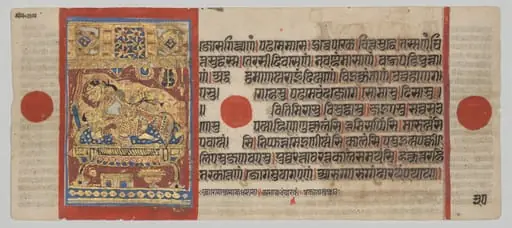 Birth of Mahavira, folio 30 (verso), from a Kalpa-sutra
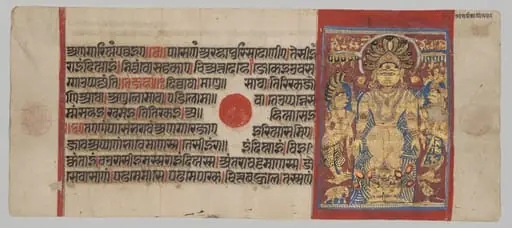 Parshva Undergoes Physical Trials, Folio 46 (recto), from a Kalpa-sutra
 King Siddhartha's Morning Bath, Folio 22 (verso), from a Kalpa-sutra
 King Siddhartha and Queen Trishala with the Dream Interpreters, Folio 25 (verso), from a Kalpa-sutra
 Indra Commands Harinaigameshin to Transfer the Embryo of Mahavira, Folio 9 (verso), from a Kalpa-sutra
 Transfer of the Embryo of Mahavira, Folio 12 (recto), from a Kalpa-sutra