Artwork
The Fountain of Life
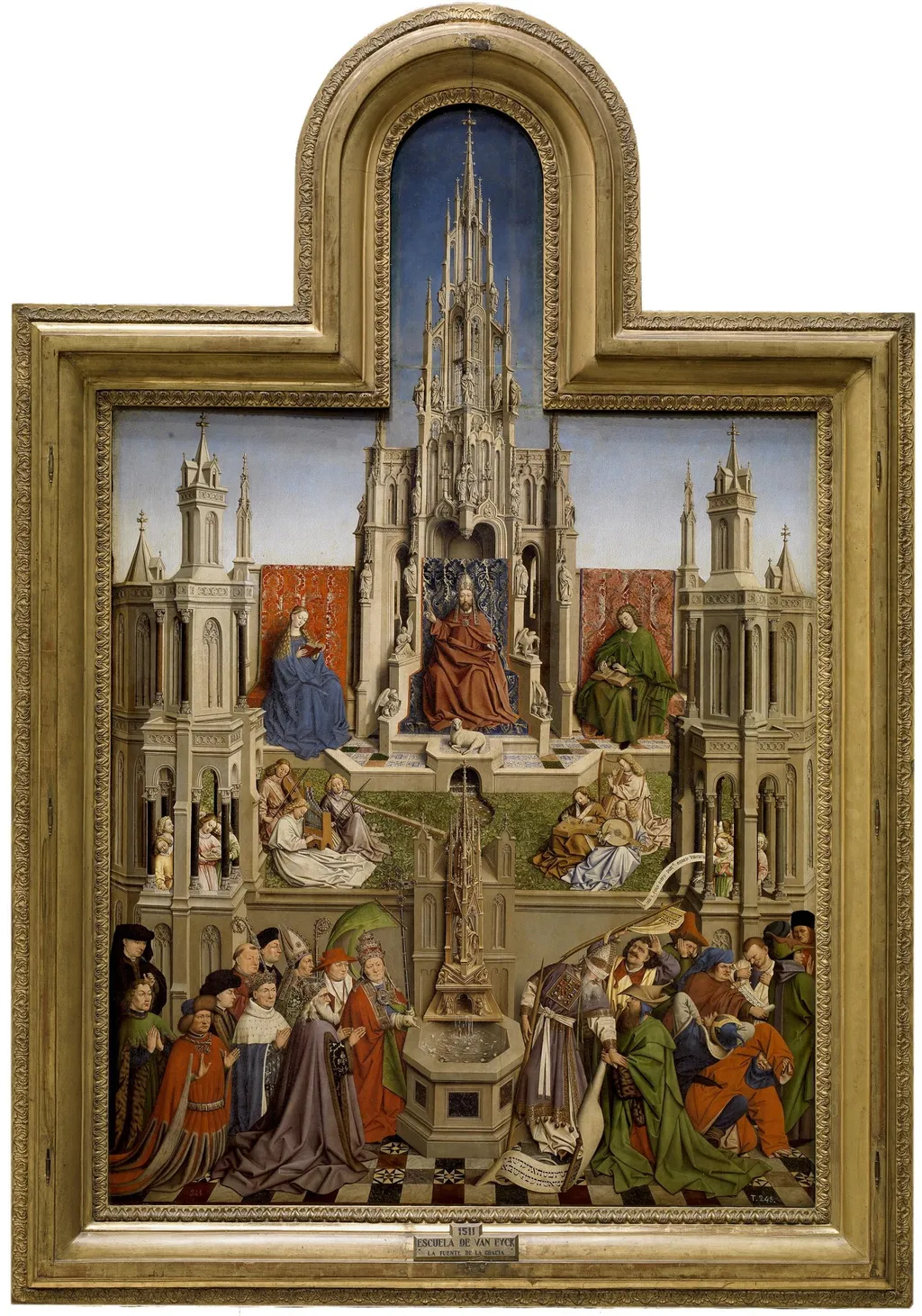
The Fountain of Life is an unspecified painting. It dates from 1440 and is held in the collection of the Museo del Prado.
About this work
Subject & Meaning
The upper level depicts a Deësis: God the Father enthroned within an elaborate Gothic structure, flanked by the Virgin Mary reading a red book and St.
The painting is organized into three horizontal terraces representing the divine, the heavenly, and the earthly realms. The upper level depicts a Deësis: God the Father enthroned within an elaborate Gothic structure, flanked by the Virgin Mary reading a red book and St. John the Evangelist writing in a sacred text. The Lamb of God sits on a pedestal before the throne, and from beneath it flows a stream of water symbolizing grace and the rite of baptism.
The middle terrace shows musical angels in white robes seated on grass, accompanied by singing choirs in flanking towers. Instruments include a harp, a viol, a lute, a portative organ, and a marine trumpet. An angel holds a phylactery inscribed with a verse from the Song of Songs: "A fountain of gardens, a well of living waters."
The lower level stages the Triumph of the Church over the Synagogue. Christians, led by a Pope, emperor, and princes, stand serene in prayer on God's right, while Jews, led by a blindfolded high priest and a rabbi holding a Torah scroll, appear chaotic and despairing. The Hebrew inscriptions on their banners and scrolls are largely nonsensical, serving only as identifying markers.
The central Gothic fountain, fed by the water from above, unites the composition as a symbol of baptism and the Eucharist, embodying the grace that illuminates the triumphant Church and blinds the Synagogue.
Technique & Style
The Fountain of Life is an oil painting executed on an oak panel. Dendrochronological analysis indicates the timber was felled around 1418, supporting a creation date circa 1432, though some sources suggest a range between 1440 and 1450. The work measures 181 cm in height and 119 cm in width.
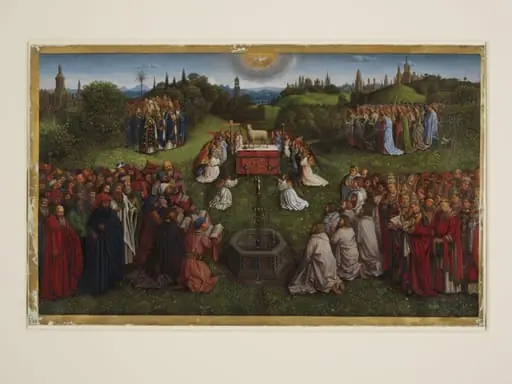
Stylistically, the composition adheres to Early Netherlandish conventions, closely resembling passages of the Ghent Altarpiece through its detailed rendering of fabrics, illusionistic architectural reliefs, and precise botanical elements. The painting is organized into three distinct horizontal terraces featuring a Deësis scene, musical angels, and a symbolic confrontation between the Church and the Synagogue. While the border suffered damage during its removal from a monastery wall in 1838, the panel remains in generally good condition following a major restoration completed prior to its exhibition in 2018.
History & Provenance
The painting was likely executed in the Netherlands within Jan van Eyck's workshop between 1428 and 1432, though earlier scholarship suggested dates as late as 1450. Dendrochronological analysis indicates the oak panel's tree was felled around 1418, supporting a creation date shortly after 1428. While some theories propose Van Eyck painted it during a diplomatic mission to the Iberian Peninsula, technical evidence favors production in Flanders, possibly for a Spanish commission.
The work's first documented appearance occurs in the Libro becerro of the Monastery of the Parral near Segovia, recorded as a gift from King Henry IV of Castile in 1454, the year his reign began. The king may have inherited the piece from his father, John II. Fixed to the sacristy wall, the painting remained there until 1838, when secularization led to its removal, causing some border loss.
It was subsequently transferred to the Museo de la Trinidad in Madrid before entering the Museo del Prado collection in 1870.
The painting is currently held by the Museo del Prado in Madrid, having been transferred there in 1870 from the Museo de la Trinidad. Prior to its arrival in Madrid, the work resided at the Monastery of the Parral near Segovia, where it was recorded in the 1454 Libro becerro as a gift from King Henry IV of Castile. It remained fixed to the monastery's vestry wall until secularization in 1838 forced its removal and subsequent relocation to the Trinidade monastery.
The Prado acquired the piece formally in 1870, though it had been photographed by Jean Laurent in 1859. In terms of exhibitions, the work was the subject of a major temporary display following extensive restoration during the 2018–2019 season. It was also featured in a 2003 exhibition dedicated to its critical re-evaluation.
Context
The Fountain of Life is a central work of Early Netherlandish painting, stylistically linked to Jan van Eyck and his brother Hubert, though it remains unsigned and the subject of ongoing attribution debates. While some scholars have proposed Jan van Eyck himself as the creator, possibly during a diplomatic mission to the Iberian Peninsula, technical analysis and dendrochronology suggest the panel was executed in the Netherlands, likely in van Eyck’s workshop, between the late 1420s and 1440. The work closely echoes passages from the 1432 Ghent Altarpiece, reinforcing its place within the Van Eyckian tradition.
Art historians such as Josua Bruyn and Susan Jones have attributed it to a follower or posthumous workshop production, whereas Otto Pächt argued for an original composition by van Eyck later copied by his atelier. The painting’s iconography, depicting the triumph of the Church over the Synagogue, resonated strongly in 15th-century Spain, where it was gifted by King Henry IV of Castile to the Monastery of Parral in 1454. Its enduring influence is evidenced by numerous copies, including a 16th-century version by Cristóbal de Velasco.
Legacy
The Fountain of Life exerted a lasting influence on religious art in Spain and beyond, particularly through its symbolic program of triumphing the Church over the Synagogue, a theme that resonated in 15th‑century Iberia where large Jewish communities existed. The work’s complex iconography, depicting a Deësis in the upper terrace, musical angels on the middle terrace, and a contested allegorical battle on the lower terrace, has been widely cited in scholarship as a visual articulation of baptismal and Eucharistic grace, with flowing water symbolising divine grace that blinds the Synagogue. Its legacy is evident in numerous copies, including a 16th‑century version by Cristóbal de Velasco now in the Allen Memorial Art Museum, and in its prominent display at the Museo del Prado, where it was featured in a 2018‑2019 special exhibition after extensive restoration.
The painting’s attribution to Jan van Eyck’s workshop, its dendrochronologically dated support (felled before 1422, painted c. 1432), and its documented provenance from Henry IV’s gift in 1454 to the Monastery of the Parral have shaped its reputation as a key example of Early Netherlandish painting in Spain.
Overview
The work known as The Fountain of Life, also referred to as The Fountain of Grace and the Triumph of the Church over the Synagogue, is an oil painting on panel dating to around 1432. It has spent most of its existence in Spain and is now held by the Museo del Prado, where it was recently included in a dedicated exhibition.
Artist & collection

- The Dream of Pope Sergius
 The Le Cellier Altarpiece
 The mystic marriage of St. Catherine
 The Fifteen Mysteries and the Virgin of the Rosary
![Diptych from the Winterfeld family foundation right wing: Maria lactans and Christ as Vir Dolorum [Man of Sorrows] (upper area), Ecce Homo (lower area); reverse: Mocking (upper area), flagella](https://artifactworldgallery.com/img/diptych-from-the-winterfeld-family-foundation-right-wing-mar--eacf0a5482d27bb1-w320.webp) Diptych from the Winterfeld family foundation right wing: Maria lactans and Christ as Vir Dolorum [Man of Sorrows] (upper area), Ecce Homo (lower area); reverse: Mocking (upper area), flagella
Diptych from the Winterfeld family foundation right wing: Maria lactans and Christ as Vir Dolorum [Man of Sorrows] (upper area), Ecce Homo (lower area); reverse: Mocking (upper area), flagella St Anne Altarpiece
 Altarpiece of Archbishop Sancho de Rojas
 Copy of a detail of the Ghent Altarpiece, Adoration of the Lamb, by Hubert and Jan van Eyck in the church of St Bavon, Ghent.
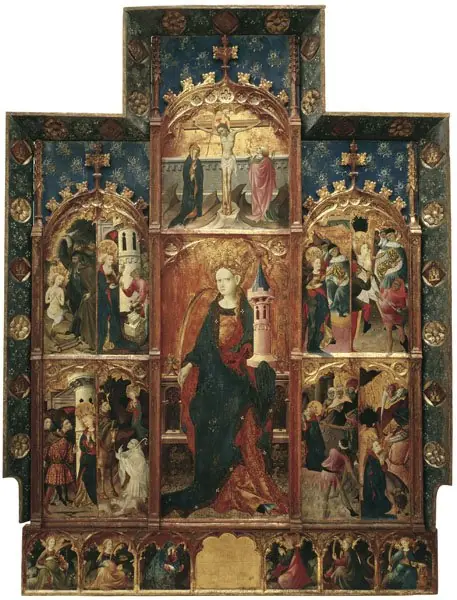 Altarpiece of Saint Barbara
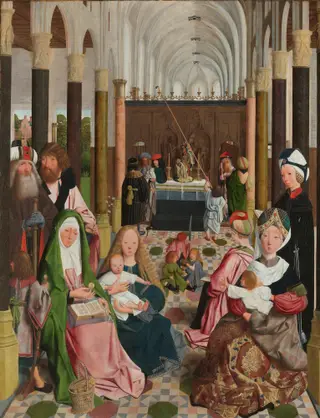 The Holy Kinship
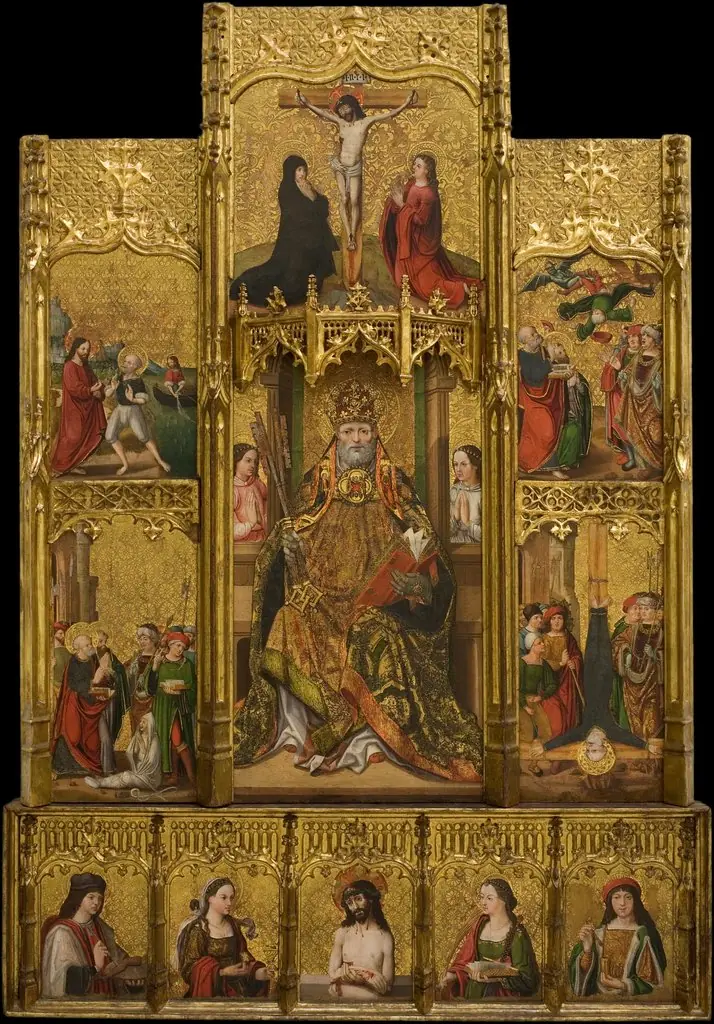 Altarpiece of Saint Peter
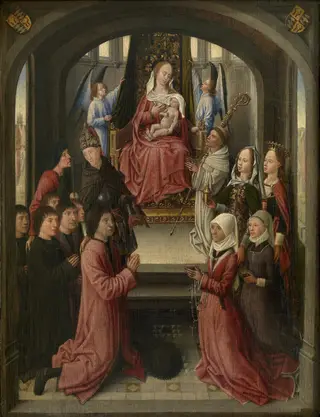 Lactatio of Saint Bernard of Clairvaux with Donors