Artwork
The Temptation of St Anthony
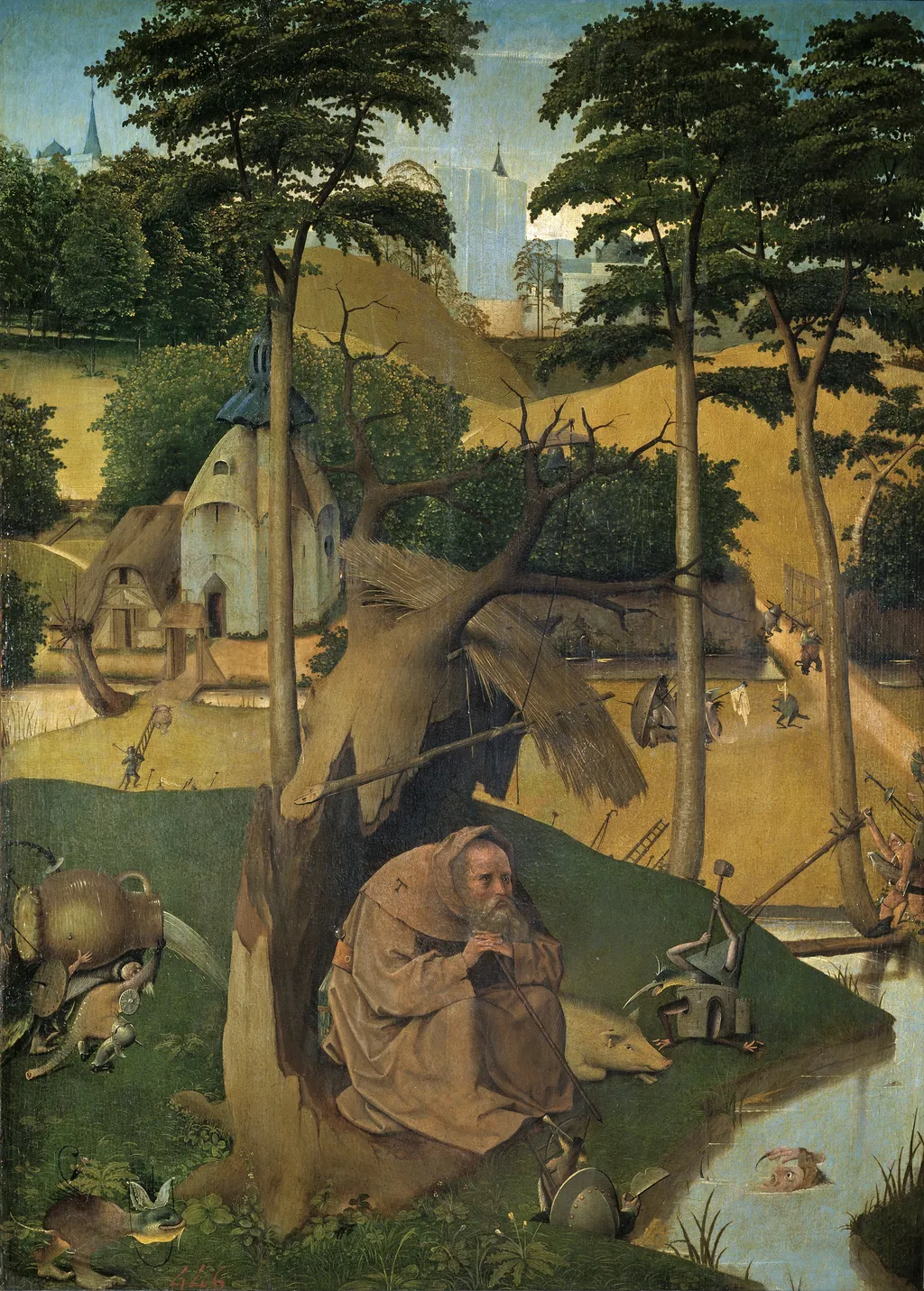
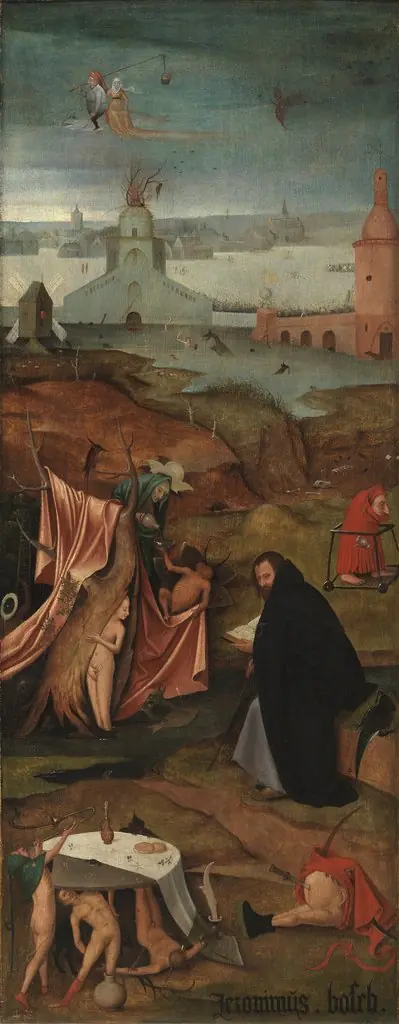
The Temptation of St Anthony is an oil painting by the Northern Renaissance artist Unknown. It dates from 1510 and is held in the collection of the Museo del Prado. The oil on canvas titled The Temptation of St.
About this work
Subject & Meaning
The composition emphasizes the saint's spiritual victory and inner peace, reflecting mystical writings by Ruysbroeck regarding devotion and harmony.
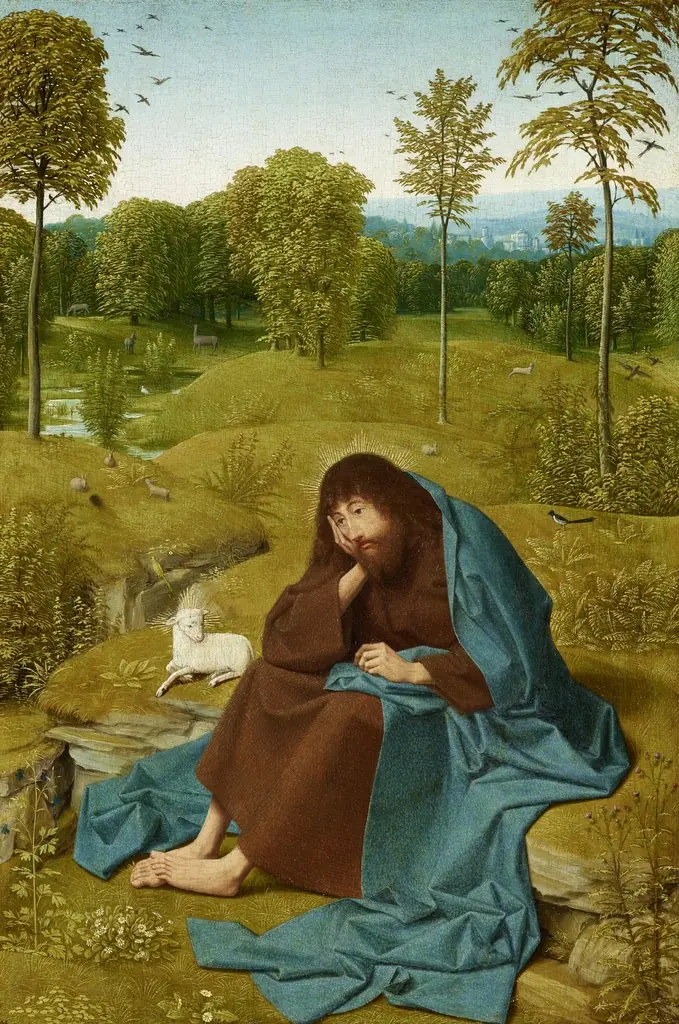
The painting depicts Saint Anthony the Great enduring his legendary temptations in the Egyptian desert, inspired by the Golden Legend and Athanasius of Alexandria. The saint is shown meditating calmly near a hollow tree or dry stump, wearing a dark brown habit marked with the Greek letter 'tau' and accompanied by a pig, his traditional attribute symbolizing protection against ergotism. Unlike more chaotic interpretations of the subject, this work presents a serene atmosphere where demonic creatures appear as harmless goblins or caricatures rather than terrifying monsters. These hybrid figures, including those wielding broken knives or scales, attempt to distract the saint but fail to disrupt his contemplative state. The composition emphasizes the saint's spiritual victory and inner peace, reflecting mystical writings by Ruysbroeck regarding devotion and harmony. Traditional symbols such as the pig with a bell, a prayer book at the saint's belt, and a bell hanging in the tree further identify the figure and his ascetic life.
Technique & Style
The work is executed in oil paint on a wooden panel, measuring 73 cm in height and 52.5 cm in width. Originally framed with a semi-circular arch, the painting retains its four unpainted edges, suggesting it may have functioned as a wing rather than a fragment. Stylistically, the piece diverges from the artist's typical compositions through a closed, low viewpoint and a limited palette dominated by yellow and green tones, notably lacking red. The vegetation in the foreground is rendered with unusual precision compared to the artist's usual broader strokes. The demonic figures, typically chaotic in the artist's other works, appear here as static, goblin-like creatures that do not disrupt the serene atmosphere. The landscape is organized into terraced layers with green and yellowish hues fading into soft blues at the horizon, featuring distant towers and a city visible through a narrow opening.
History & Provenance
The painting is attributed to Hieronymus Bosch or a follower and is dated to circa 1500-1525. It entered the collection of the Escorial monastery, likely sent there by Philip II of Spain in 1574. The work is first documented in 1912 at the Museo del Prado, Madrid, where it remains in the Royal Collection. The panel’s creation history is uncertain; dendrochronology suggests a terminus post quem of about 1468, but scholars generally place it among Bosch’s late works. The attribution has been questioned, with the Bosch Research and Conservation Project concluding in 2016 that it is by a follower rather than Bosch himself. The work is held in the Museo del Prado, Madrid, with accession details recorded by the museum. It is first documented in the Royal Collections after being sent to the Monastery of El Escorial by Philip II of Spain in 1574. It entered the Prado’s holdings from the Royal Collection, where it remained unrecorded in earlier Escorial inventories. The painting was exhibited in 2016 as part of the traveling presentation *Jheronimus Bosch, Visions of Genius* organized by the Noordbrabants Museum, Bois-le-Duc. The Prado subsequently withdrew the work from loan following the Bosch Research and Conservation Project’s announcement of doubts regarding its attribution to Bosch.
Context
The Temptation of St. Anthony (c. 1500-1516) occupies a contested position within the corpus of Hieronymus Bosch, with its authorship remaining a primary subject of modern scholarship. While historically attributed to the Early Netherlandish master, the Bosch Research and Conservation Project (BRCP) concluded in 2016 that the work was likely executed by a follower, citing stylistic deviations in composition and technique. Consequently, the Museo del Prado withdrew the painting from the 2016 'Visions of Genius' exhibition, reflecting the institutional impact of this re-evaluation. Art historians contrast the work's serene, meditative atmosphere with the chaotic energy of Bosch's authenticated Triptych of the Temptation of St. Anthony in Lisbon. Scholars suggest the painting reflects mystical influences, such as the writings of Ruysbroeck, and demonstrates a unique, calmer interpretation of the saint's solitude that distinguishes it from the artist's other known depictions of the subject.
Legacy
The painting known as The Temptation of St Anthony, also called Le Petit saint Antoine, has been understood in modern scholarship as a late work of disputed authorship that came to influence how later artists approached the theme of saintly temptation. Early records place the panel in the Escorial monastery, where Philip II of Spain is believed to have sent it in 1574, and it entered the Royal Collection before being installed in the Museo del Prado, where it remains on public view. Contemporary critics and the Bosch Research and Conservation Project have questioned the attribution to Hieronymus Bosch, arguing instead that a follower likely executed the work in the early sixteenth century; this uncertainty has shaped both scholarly debate and museum display policies, notably the Prado’s decision to withhold the piece from a 2016 Bosch exhibition. Stylistically, the work departs from Bosch’s earlier, more chaotic depictions of the saint by presenting a tranquil, meditative St. Anthony amid a sunlit landscape, with traditional attributes such as the tau habit, a pig, and a prayer book rendered in a palette dominated by yellow and green. The demons that once threatened the saint are rendered as benign, almost playful goblins, reinforcing a calmer narrative of temptation. These visual choices have been cited as evidence of a shift toward introspective spirituality in early‑modern art and have inspired later interpretations of Bosch’s influence on the visual language of religious dissent and mysticism.
Artist & collection