Artwork
Untitled
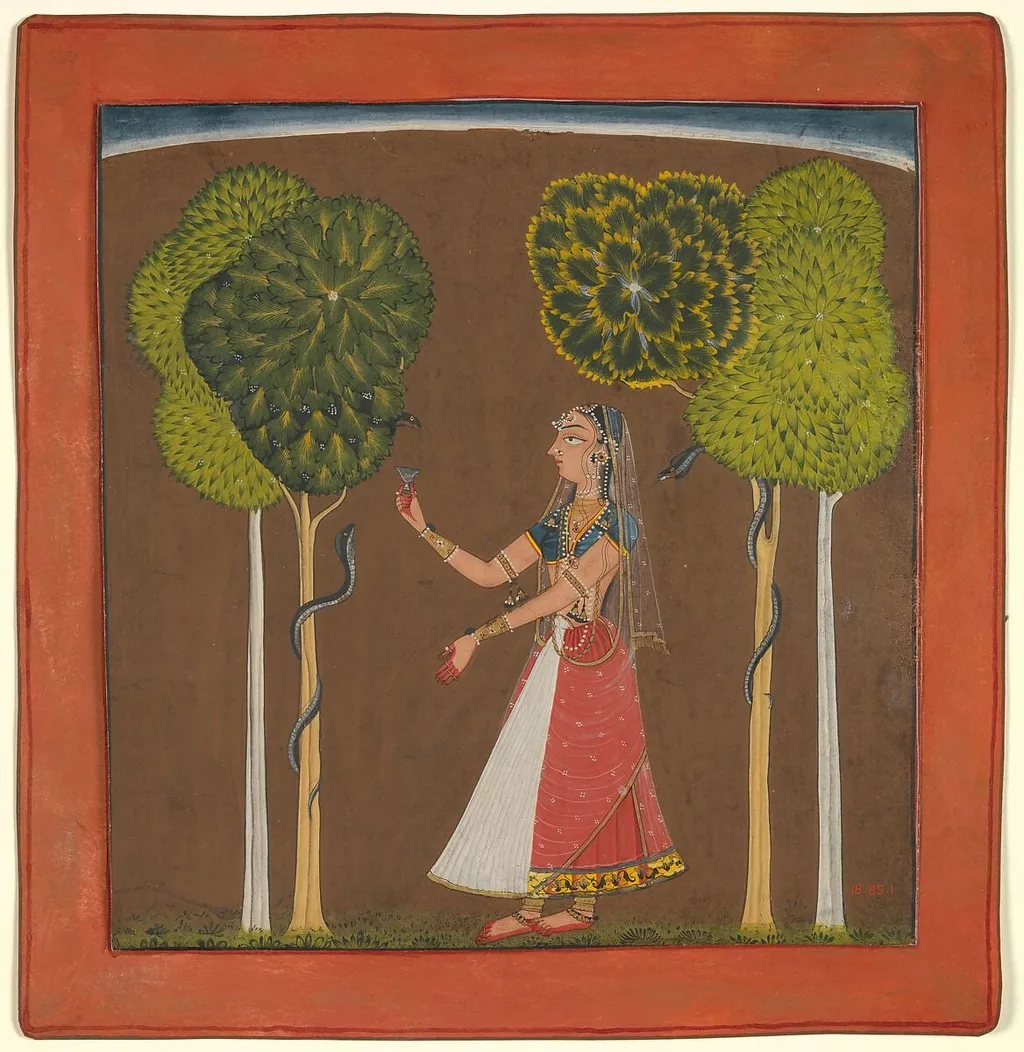
Untitled is a watercolor painting. It dates from 1705 and is held in the collection of the Metropolitan Museum of Art.
About this work
Subject & Meaning
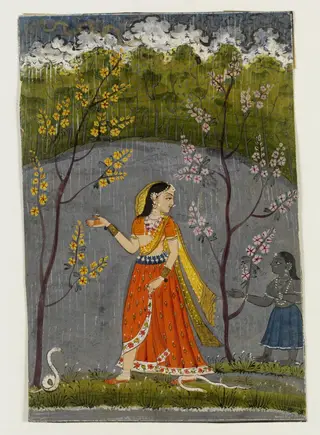
In this context, the woman represents Eve, while the snake and the tree symbolize the serpent and the Tree of Knowledge within the Garden of Eden narrative.
Created in 1705 in India, this anonymous work is classified as a religious painting that visually narrates a specific biblical or mythological episode through its central figures. The composition depicts a woman standing near a tree, accompanied by a snake, elements that collectively establish the iconography of the Fall of Man. In this context, the woman represents Eve, while the snake and the tree symbolize the serpent and the Tree of Knowledge within the Garden of Eden narrative.
The use of ink and opaque watercolor on paper serves to render these symbolic figures, grounding the artwork's meaning in the traditional religious story of temptation and the loss of innocence. The Metropolitan Museum of Art holds the work, which relies on these specific visual motifs to convey its spiritual and didactic significance.
History & Provenance
Created in 1705, the work titled Untitled is an anonymous painting executed in ink and opaque watercolor on paper. Produced in India, the piece depicts a woman, a tree, and a snake within a religious genre context. While the specific artist remains unknown and no commissioning details are recorded in available records, the work's creation is firmly dated to the early eighteenth century.
The painting eventually entered the collection of the Metropolitan Museum of Art, where it is currently held. Its provenance prior to this institutional acquisition is not detailed in the provided sources, though its origin is established as Indian. The work stands as a significant example of anonymous religious painting from that period and region.
The work titled Untitled, dated 1705, is part of the collection of the Metropolitan Museum of Art in New York, where it is catalogued without an explicit accession number; the museum's records do not disclose a specific inventory identifier. The painting, executed in ink and opaque watercolor on paper, depicts a snake, a tree, and a woman, matching the description in the source. No exhibition record is documented for this piece in the available references, indicating that its public display history has not been publicly noted.
Context
The untitled work, dated 1705, is classified as a religious painting executed in ink and opaque watercolor on paper and is attributed to an anonymous Indian artist. Its iconography includes a snake, a tree, and a woman, motifs that align with contemporary South Asian religious narratives. The painting entered the collection of the Metropolitan Museum of Art, where it remains on view, and scholars reference it as an example of early 18th‑century anonymous devotional art from India.
Because the creator’s identity is unknown, the piece is discussed primarily in terms of its stylistic placement within regional religious art and its contribution to understanding artistic anonymity in that period.
Overview
This untitled painting, rendered in ink and opaque watercolor on paper, originates from a small kingdom in the western Himalayas. It portrays a woman standing beneath a tree, holding a snake in each hand. The artwork is characterized by its bold lines and flat, vibrant application of deep greens, reds, and blues, creating a visually striking composition.
Technique & Style
The painting exhibits a direct and expressive visual language. Artists utilized strong, clear lines to define forms, complemented by the flat application of opaque watercolors. Colors such as deep greens, reds, and blues are presented as distinct patches, eschewing shadows to create a sense of directness and vitality. This stylistic choice emphasizes shape and color over three-dimensional illusion.
Artist & collection

 Abhisarika Nayika
 Untitled
 Untitled
 The Heroine Who Waits Anxiously for Her Absent Lover: Utka Nayika
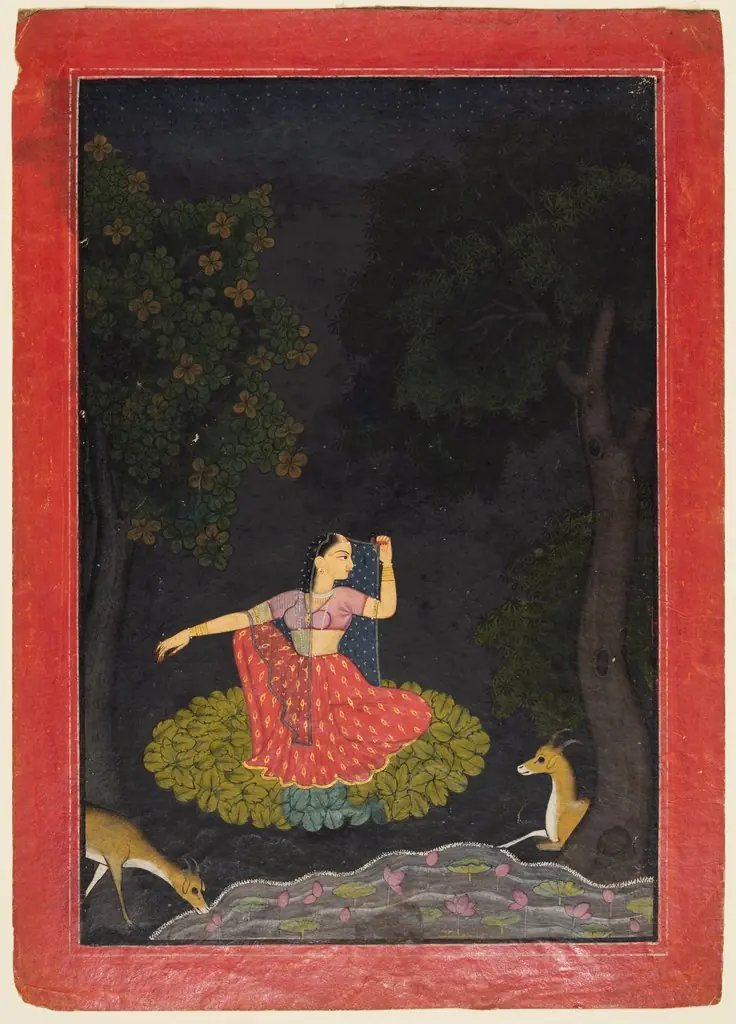 A Heroine Waiting for Her Paramour: Vasakasajja Nayika, from a Nurpur Rasikapriya
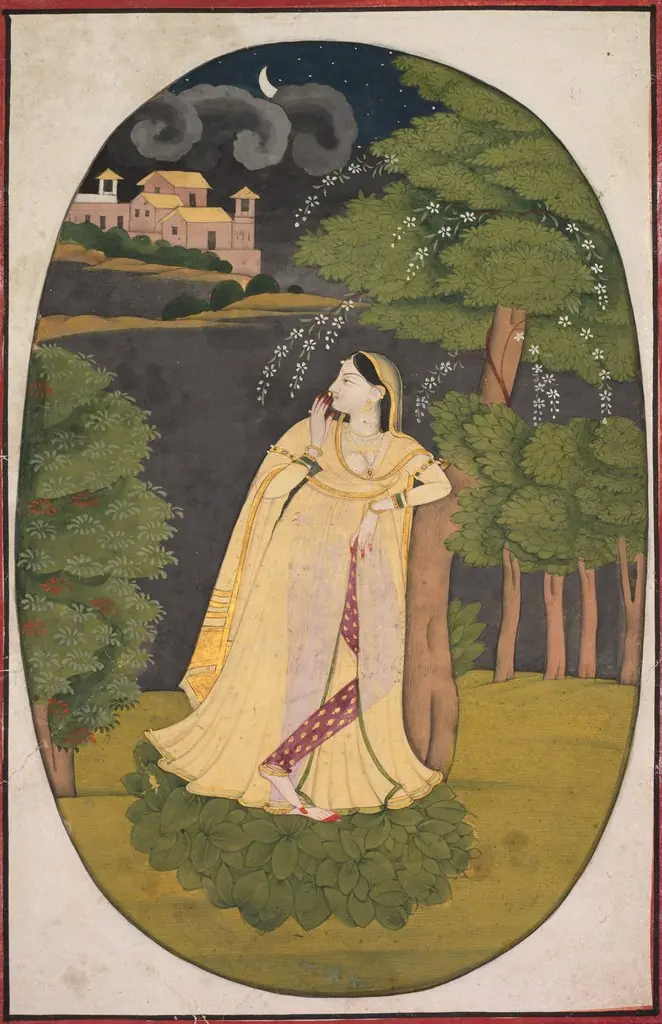 The Heroine Who Waits Anxiously for Her Absent Lover (Utka Nayika)
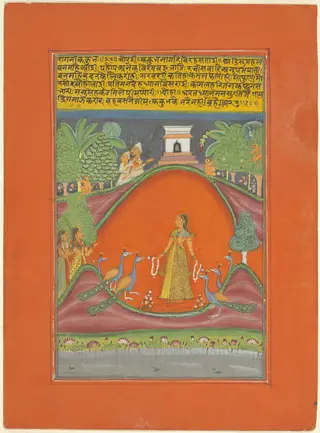 Ragini Kakubha, Page from a Jaipur Ragamala Set
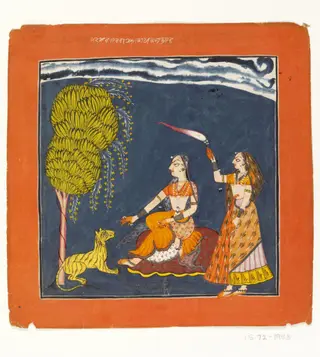 Patamanjari Ragini
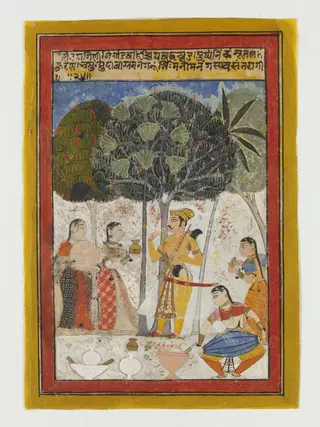 Vasant Ragini
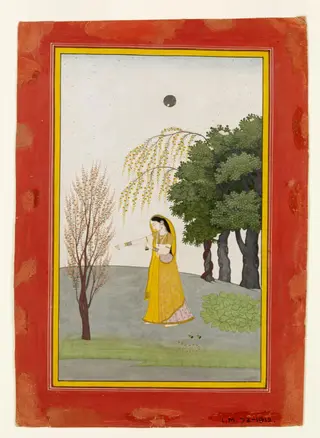 Vipralabdha Nayika
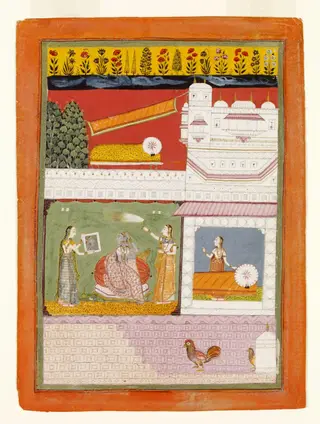 Vilaval Ragini
- Untitled