Artwork
Hurricane, Bahamas
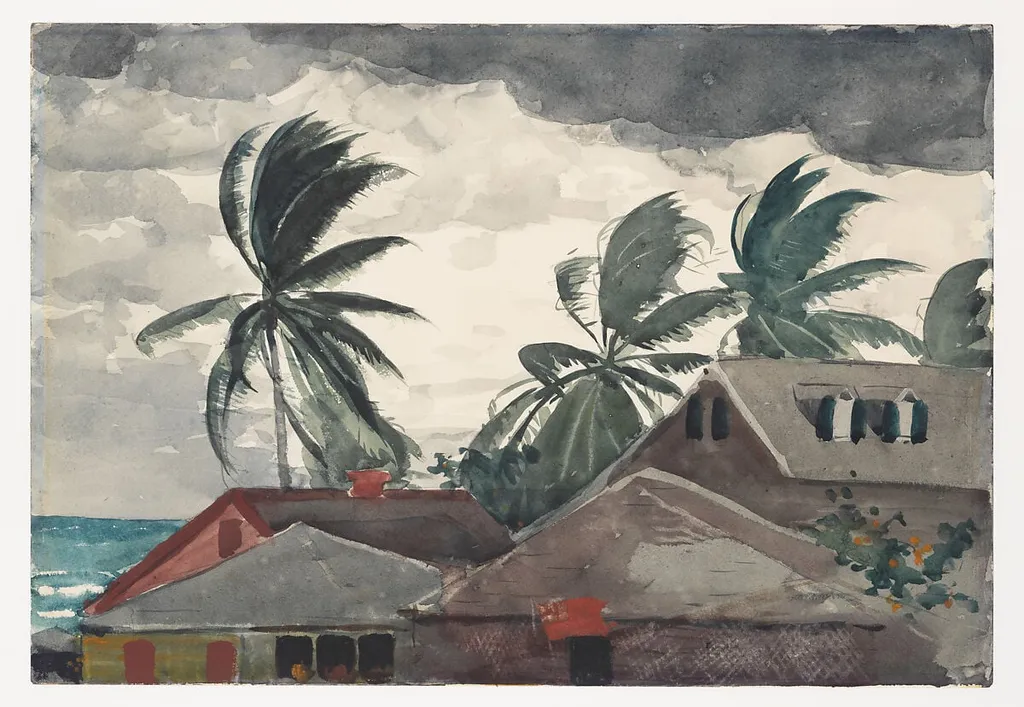
Hurricane, Bahamas is a watercolor work on paper by the American Impressionist artist Winslow Homer. It dates from 1898 and is held in the collection of the Metropolitan Museum of Art.
About this work
Subject & Meaning
These visual elements convey both the imminent danger and the dynamic forces of nature, suggesting how the hurricane reshapes the environment.
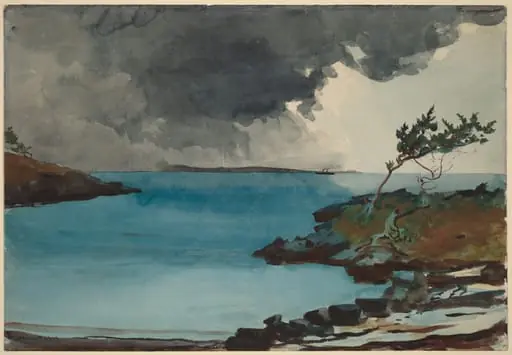
The watercolor titled Hurricane, Bahamas, painted by Winslow Homer in 1898, portrays a stark landscape in which a modest house stands beside a solitary tree beneath a turbulent sky.
The composition includes a dense cloud formation and visible signs of wind, together forming an iconography of an approaching hurricane that emphasizes the raw power of the storm over a vulnerable Bahamian setting. These visual elements convey both the imminent danger and the dynamic forces of nature, suggesting how the hurricane reshapes the environment.
Technique & Style
The work is executed in watercolor with graphite accents on off-white wove paper, a support typical of Homer's late 19th-century landscapes. The sheet, measuring roughly 36.7 × 53.5 cm, has a relatively smooth surface that allows layered washes and fine linear detail. Formal qualities include a dynamic composition of swirling clouds, a precarious house, and bending trees that convey the force of an approaching hurricane, rendered through vigorous brushwork and stark contrast.
History & Provenance
Hurricane, Bahamas is a watercolor on paper created in 1898 by the American artist Winslow Homer. The work, measuring 36.7 × 53.5 cm, was produced during Homer's stay in the Bahamas and reflects his interest in tropical weather. It is held in the collection of the Metropolitan Museum of Art, where it is classified under The American Wing's landscape holdings.
The painting's provenance is limited to its creation in 1898 and subsequent acquisition by the museum, with no recorded earlier owners, accession number, or exhibition history in the available sources.
Overview
Winslow Homer's Hurricane, Bahamas, created in 1898, captures a dramatic natural event through watercolor and graphite on paper. The composition portrays a powerful storm, characterized by turbulent, wind-swept clouds, a house, and a resilient tree. This work exemplifies Homer's ongoing engagement with the forces of nature, particularly marine environments, for which he became widely recognized in American art.
Context
Winslow Homer established himself as a prominent figure in 19th-century American art, recognized for his contributions as both a landscape painter and an illustrator. His artistic output frequently explored marine subjects, depicting the sea and coastal life with a distinctive intensity. Hurricane, Bahamas fits within this broader interest, reflecting his consistent exploration of the relationship between humanity and the formidable power of the ocean and its weather systems.
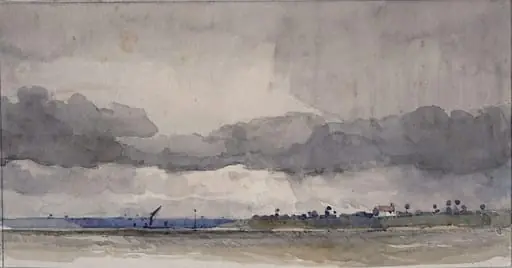
![Storm on a N.African [?] coast](https://artifactworldgallery.com/img/j-h-stokes--storm-on-a-n-african-coast--fa8cd201d0f18573-w320.webp)
Artist & collection
Artist
Winslow Homer (February 24, 1836 – September 29, 1910) was an American landscape painter and illustrator, best known for his marine subjects.