Artwork
The Veteran in a New Field
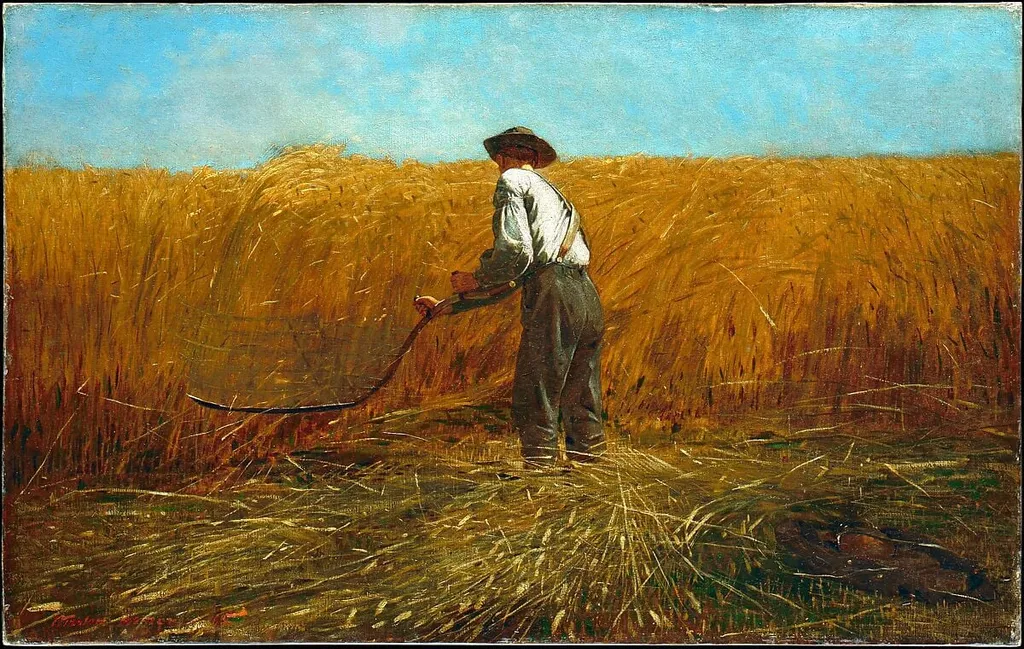
The Veteran in a New Field is an oil painting by the Impressionist artist Winslow Homer. It dates from 1865 and is held in the collection of the Metropolitan Museum of Art.
- Accession no.
- 67.187.131
- Credit line
- Bequest of Miss Adelaide Milton de Groot (1876-1967), 1967
About this work
Subject & Meaning
Biblical allusions further deepen the meaning, referencing Isaiah's call to beat swords into plowshares as the veteran swaps weapons for farming tools.
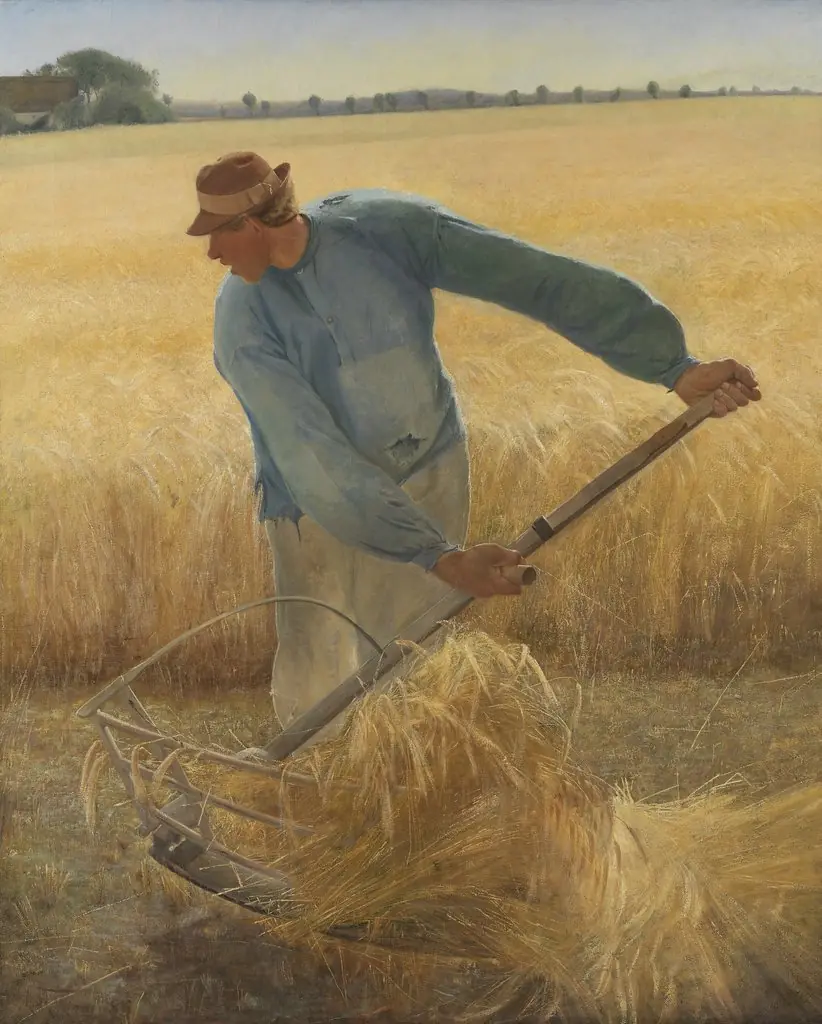
Winslow Homer's 1865 painting depicts a lone farmer harvesting wheat with a scythe, identified as a former Union soldier by the discarded military jacket and canteen in the foreground. By presenting the figure from behind, the artist universalizes the subject as any returning serviceman transitioning from war to civilian life. The imagery carries heavy symbolic weight; the scythe evokes the Grim Reaper, linking the agricultural harvest to the massive loss of life during the Civil War, while wheat historically associated with mortality reinforces the theme.
Biblical allusions further deepen the meaning, referencing Isaiah's call to beat swords into plowshares as the veteran swaps weapons for farming tools. Scholars interpret the work as both an elegy for Abraham Lincoln and a complex commentary on postwar society, balancing hope for national rebirth against the haunting melancholy of a soldier forever marked by conflict.
Technique & Style
The painting is executed in oil on canvas, a medium typical of Homer's mature practice. Its support is a single, unprimed linen canvas, left visible in places to contribute to the work's tactile, unvarnished surface. The handling is restrained and broadly brushed, with minimal linear detail and a muted, earth-toned palette dominated by ochres, umbers, and soft greens that evoke both field and aftermath.
The composition is deliberately simplified, centering on a Rückenfigur whose anonymity invites universal identification. A single scythe, rendered with broad, fluid strokes, anchors the foreground and carries symbolic weight as both farming tool and metaphor for death. The absence of elaborate modeling underscores the painting's stark, emblematic quality, while the open field recedes in shallow space to focus attention on the veteran's solitary labor.
History & Provenance
Winslow Homer completed The Veteran in a New Field in 1865, the final year of the American Civil War. The oil-on-canvas work depicts a former Union soldier harvesting wheat, a subject reflecting the artist's return to civilian life and his previous coverage of the conflict. The painting was donated to the Metropolitan Museum of Art by Adelaide Milton de Groot, where it remains part of the collection today. No specific commission details or intermediate ownership records are provided in the available sources.
The Veteran in a New Field is housed in the Metropolitan Museum of Art in New York. Its accession number is 67.187.131, assigned when Adelaide Milton de Groot donated the work to the museum. The painting has been part of the Met's permanent collection since the donation and is regularly shown in gallery installations of American art from the Civil War era, though no separate traveling exhibition records are documented in the sources.
Context
Completed in 1865, The Veteran in a New Field serves as a transitional work in Winslow Homer's career, marking a shift toward symbolic depth while addressing the immediate aftermath of the American Civil War. Art historians frequently interpret the painting as an allegory for postwar American society, where the solitary figure represents the return of Union soldiers to civilian life. The composition employs biblical allusions, specifically Isaiah 2:4, to suggest the transformation of weapons into farming tools, while the scythe evokes the Grim Reaper to link the harvest with the war's massive casualties.
Scholars such as Nancy Rash have further theorized the piece functions as an elegy for Abraham Lincoln, whose assassination occurred the same year the work was finished. Critics initially questioned the painting's agricultural accuracy, yet modern analysis views this simplification as a deliberate choice to emphasize themes of national rebirth, melancholy, and the enduring psychological impact of war on the individual.
Legacy
Since its donation by Adelaide Milton de Groot to the Metropolitan Museum of Art in 1967, The Veteran in a New Field has been recognized as a pivotal work in Winslow Homer's oeuvre and in American art of the Civil War era. Art historians frequently cite it as a transitional painting that crystallizes Homer's shift from reportage to symbolic reflection on war's aftermath, emphasizing its stark composition and layered biblical allusions. Interpretations of the scythe as both farming tool and emblem of death have cemented the work's reputation as a meditation on mortality and national renewal, shaping readings of postwar American identity in visual culture.
Its continued display at the Metropolitan Museum of Art anchors its legacy as a canonical image of Civil War commemoration.
Overview
Winslow Homer's The Veteran in a New Field, an oil on canvas completed in 1865, captures a pivotal moment in American history. Painted at the conclusion of the Civil War, it presents a solitary figure engaged in agricultural labor. The work is widely understood as a commentary on the nation's transition from conflict to peace, reflecting on the reintegration of soldiers into civilian life and the enduring impact of the recent war.
Artist & collection
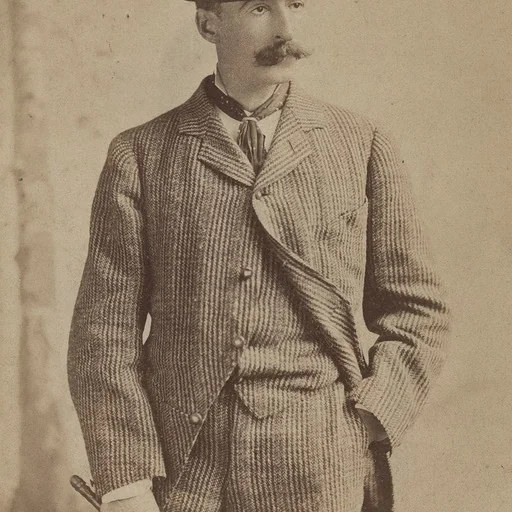
Artist
Winslow Homer (February 24, 1836 – September 29, 1910) was an American landscape painter and illustrator, best known for his marine subjects.