Artwork
Waiting for the Stage
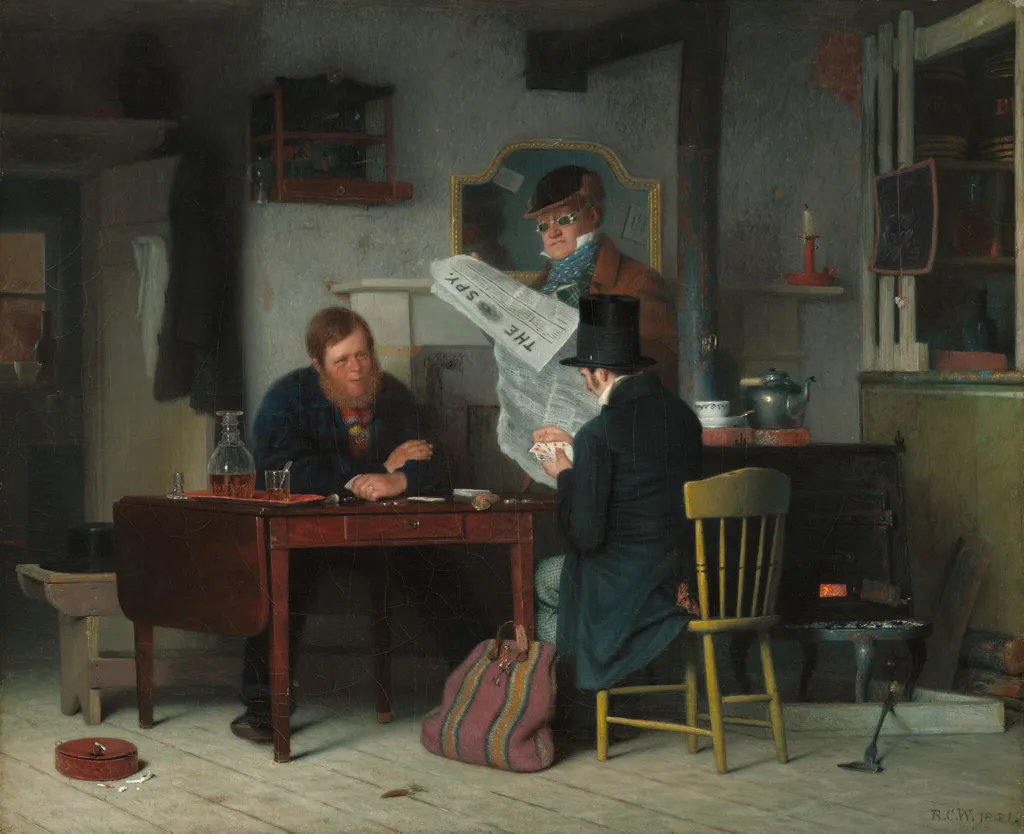
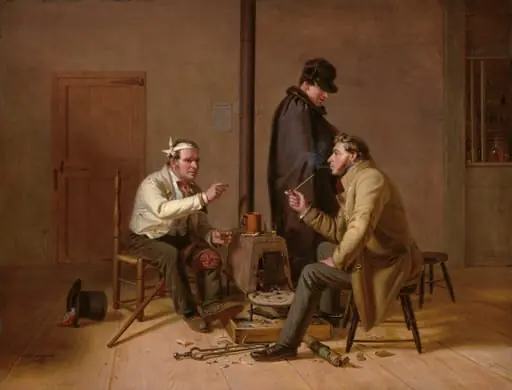
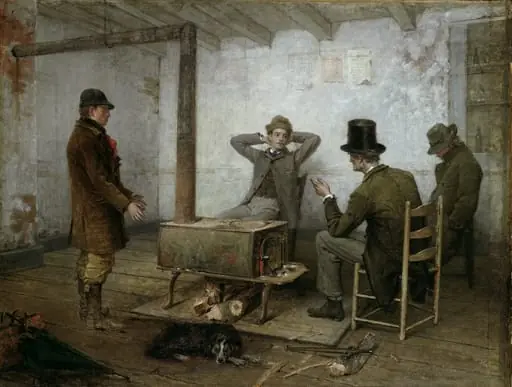
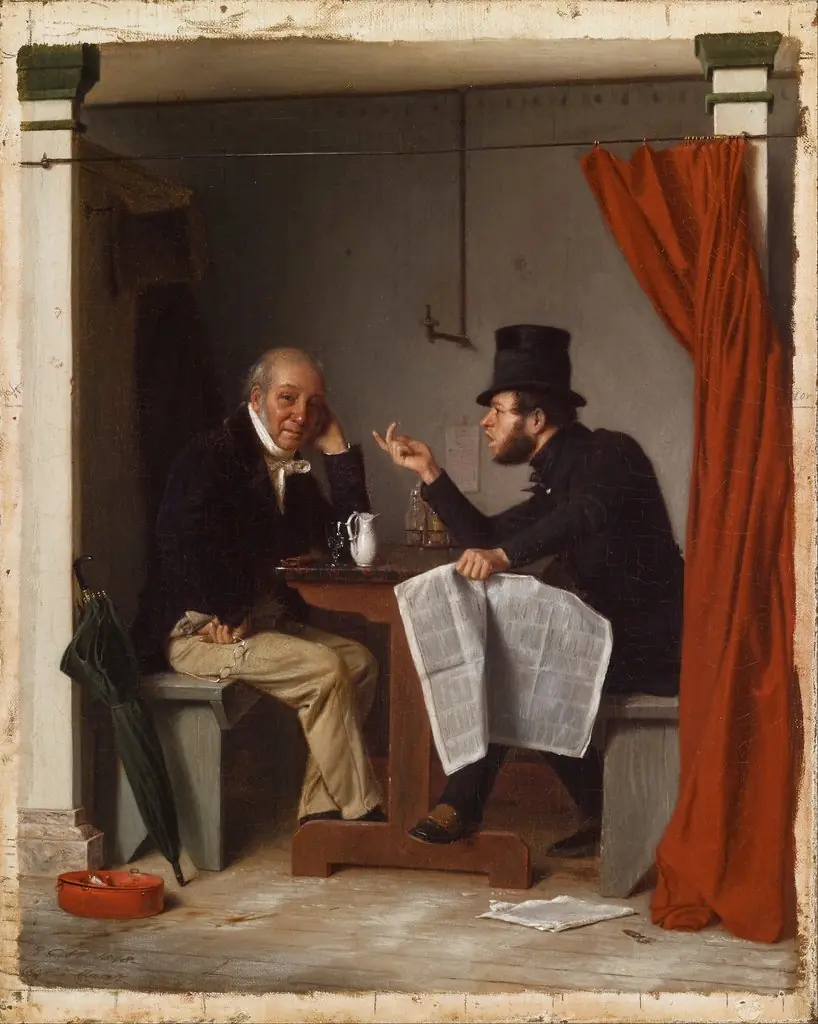
Waiting for the Stage is an oil painting by the Hudson River School artist Richard Caton Woodville. It dates from 1851 and is held in the collection of the National Gallery of Art.
- Inscription
- Inscribed:lower right: R.C.W. 1851. / Paris
About this work
Subject & Meaning
The painting depicts three men in a modest stagecoach tavern, two playing cards for money while the third appears to read a newspaper.
The painting depicts three men in a modest stagecoach tavern, two playing cards for money while the third appears to read a newspaper. Close inspection reveals that the newspaper’s title, The Spy, and the figure’s peculiar green-lens spectacles are visual cues. These elements signal that the ostensible reader is a conspirator collaborating with the well-dressed traveler to cheat the card game.
The scene critiques social trust and deception in mid-nineteenth-century travel culture, using the tavern’s plain stove, scattered pipes, and spittoon to evoke everyday settings where strangers’ intentions are opaque. The mirrored frame behind the spy’s head further implicates the viewer, turning the act of looking into complicity with the deception.
Technique & Style
The painting is executed in oil on canvas, a genre scene that records three figures inside a modest tavern. Woodville combines the narrative realism of the Düsseldorf school with a humorous, psychologically nuanced approach, using precise brushwork to render textures such as the iron stove, the spilled brandy, and the green‑tinted spectacles of the standing observer. A strategically placed mirror frames the mysterious figure, while the newspaper titled “The Spy” reveals his role as a covert observer of the card players.
The composition relies on careful spatial arrangement, chiaroscuro lighting, and subtle symbolic details that together create a vivid, story‑like tableau.
History & Provenance
Waiting for the Stage was painted in Paris in 1851 by American genre painter Richard Caton Woodville, who worked under private instruction of Karl Ferdinand Sohn and was influenced by Johann Peter Hasenclever of the Düsseldorf school. The oil on canvas measures 38.1 cm by 46 cm and depicts three men in a modest tavern, two playing cards and a third reading a newspaper that reveals his role as a spy. The work entered the artist’s family, passed to Samuel P. Avery Jr., then to Lucius Tuckerman in 1867, and subsequently descended through several relatives until a private collection held it by 1959.
The Corcoran Gallery of Art acquired the painting in October 1960, and in 2014 it was transferred to the National Gallery of Art.
The work is presently in the National Gallery of Art, Washington, D.C., where it entered the collection in 2014 after being held by the Corcoran Gallery of Art since October 1960. Its ownership traces back to the artist, then to Samuel P. Avery Jr., Lucius Tuckerman (purchased 1867), and subsequent descendants until a private collector held it until 1959. The Corcoran acquired the painting in 1960, adding it to its American genre‑painting holdings, and it remained on view there before the transfer to the National Gallery. No specific accession number is recorded in the documented provenance.
Context
The painting Waiting for the Stage (1851) by Richard Caton Woodville exemplifies genre scenes of the Düsseldorf school, blending humor and social critique. It entered private collections, was sold to the Corcoran Gallery in 1960, and later to the National Gallery of Art in 2014, tracing a clear provenance. Scholarship highlights its narrative detail, the spy figure identified through a newspaper titled "The Spy," and its connection to Woodville’s study under Johann Peter Hasenclever, linking it to broader antebellum American visual culture. Reception has emphasized its technical precision, psychological depth, and role in documenting 19th‑century tavern life.
Legacy
After its creation in Paris in 1851, Waiting for the Stage entered American collections and became a touchstone for antebellum genre painting. Its layered narrative and optical tricks, especially the revelation of the "spy" through the mirrored frame and newspaper headline, were widely discussed in art-historical literature, particularly in studies of the Düsseldorf School’s influence on American realism. The painting’s compositional devices and social critique informed later genre traditions, including works that probe hidden motives within domestic and tavern interiors.
Its canonical presence in the National Gallery of Art’s holdings has anchored sustained scholarly attention, reinforcing its status as a key example of mid-nineteenth-century narrative realism.
Overview
Richard Caton Woodville completed Waiting for the Stage in 1851, rendering this genre scene in oil on canvas. The painting captures a moment of anticipation, presenting three men within an interior space. This work exemplifies Woodville's focus on narrative scenes from daily life, a common theme in mid-19th century American art.
Own this work as a print
Artist & collection