Artwork
元 吳鎮 老松圖 軸|Crooked Pine
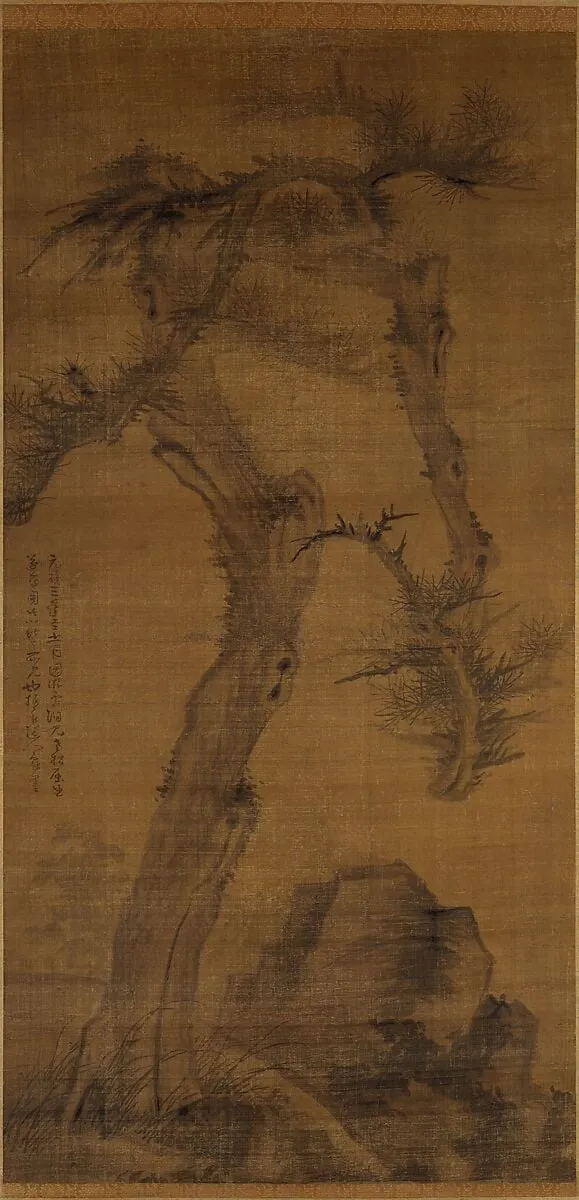
元 吳鎮 老松圖 軸|Crooked Pine is an ink painting by the Yuan dynasty literati painting artist Wu Zhen. It dates from 1335 and is held in the collection of the Metropolitan Museum of Art.
About this work
Here, one old pine gets the whole stage, its branches reach like fingers, its bark looks rough enough to touch.
You see a single pine tree, twisted and gnarled, rising from a rocky slope in black ink on silk.
Wu Zhen painted this in 1335, when most artists filled scrolls with crowds of trees and mountains. Here, one old pine gets the whole stage, its branches reach like fingers, its bark looks rough enough to touch. The emptiness around it isn’t empty; it lets the tree breathe.
If you like how ink can feel alive, look up the technique called cross-hatching.
Technique & Style
The work is executed as a hanging scroll in ink on silk, dated 1335. Its composition centers on a gnarled pine rendered with abbreviated, textured strokes to convey age and resilience. Fine, dry brushwork outlines the trunk and branches, while diluted ink washes model volume and recession.
The foliage is indicated by clustered, hook-like dots and short dabs, a manner associated with Wu Zhen's mature style. The overall handling balances controlled linearity with atmospheric modulation, typical of Yuan literati ink painting on silk.
History & Provenance
The hanging scroll titled Crooked Pine was created by the Yuan dynasty artist Wu Zhen in 1335. Executed in ink on silk, this work depicts a gnarled pine and is believed to have originated in China. It is held by the Metropolitan Museum of Art in New York, recorded in the museum's collection under accession number 1973.120.5. No specific commission details or a detailed chain of prior ownership are provided in the available records.
Overview
Wu Zhen’s hanging scroll, dated 1335, presents a solitary pine rendered in ink on silk. The composition is dominated by a lone, twisted tree that rises from a rugged slope, its gnarled trunk and spreading branches occupying the entire visual field.
Subject & Meaning
The work focuses exclusively on an aged pine, a traditional symbol of resilience and longevity in Chinese art. By isolating the tree against a minimal background, the artist emphasizes its endurance and the quiet dignity of solitary nature.
Context
In an era when many scrolls filled the scene with multiple trees and mountains, Wu Zhen’s choice to isolate a single pine marks a contemplative shift toward personal expression and the exploration of negative space within Chinese ink painting.
Artist & collection



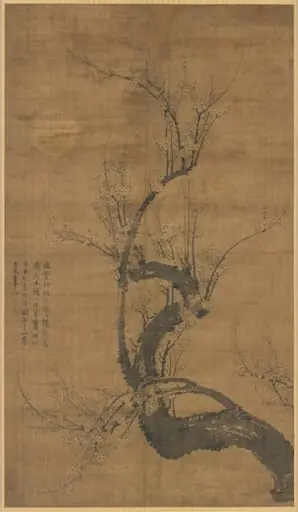 A Prunus in the Moonlight
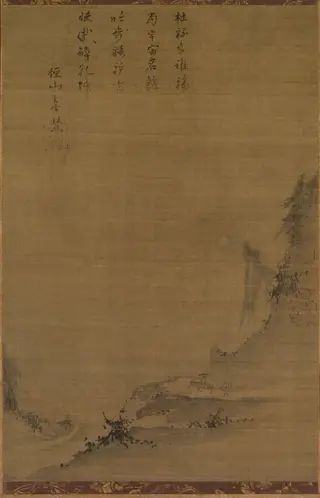 Mountain Landscape in Moonlight
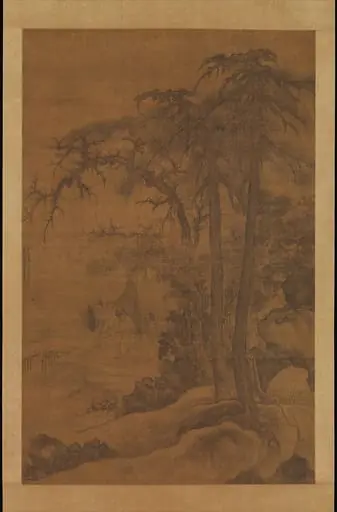 元 唐棣 松溪歸漁圖 軸|Returning Fishermen
 清 佚名 倣王翬 倣李公麟草堂圖 軸|Landscape in the Style of Li Gonglin
 Frosted Branches and Dwarf Bamboo, in the Style of Su Shi
 A Wintry Forest
 明 鍾禮 觀瀑圖 軸|Li Bai gazing at the waterfall on Mount Lu
 Mountain Market, Clear with Rising Mist
 같은 해에 태어난 관리들의 친목 모임 조선|同庚契會圖 朝鮮|Gathering of government officials
 南宋 佚名 賞梅圖 軸|Scholar admiring plum blossoms