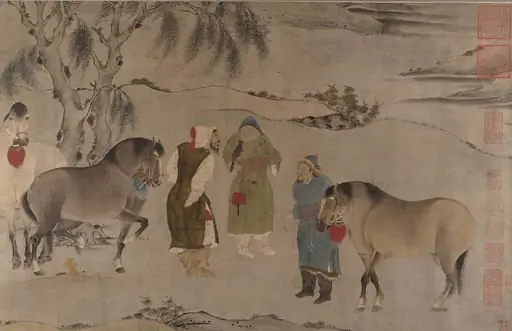
Artwork
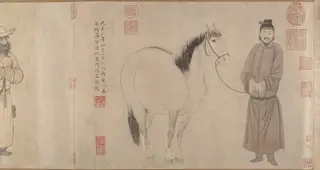
明/清 佚名 舊傳趙孟頫 相馬圖 卷|Judging a Horse
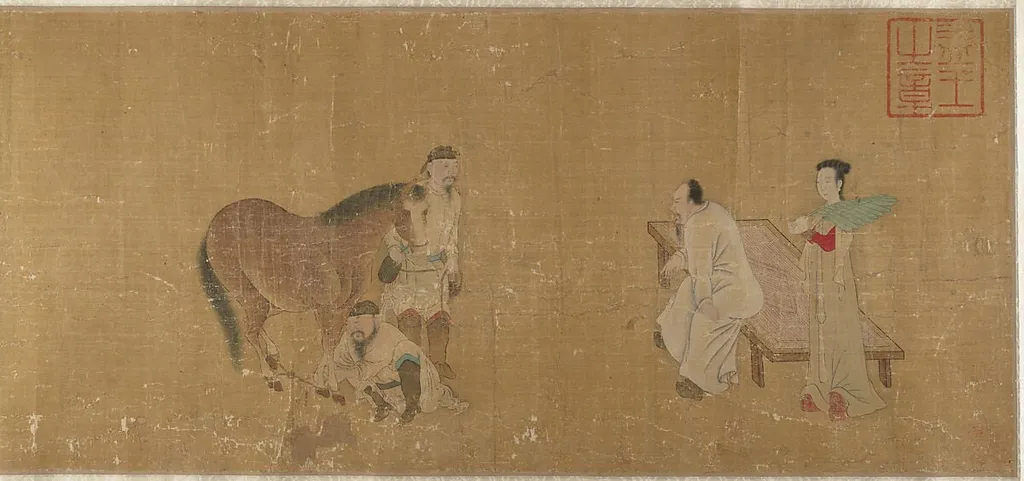
明/清 佚名 舊傳趙孟頫 相馬圖 卷|Judging a Horse is an ink painting by the Ming dynasty painting artist Zhao Mengfu. It is held in the collection of the Metropolitan Museum of Art. This handscroll, titled Judging a Horse, is an anonymous painting from the Ming or Qing dynasty.
About this work
Subject & Meaning
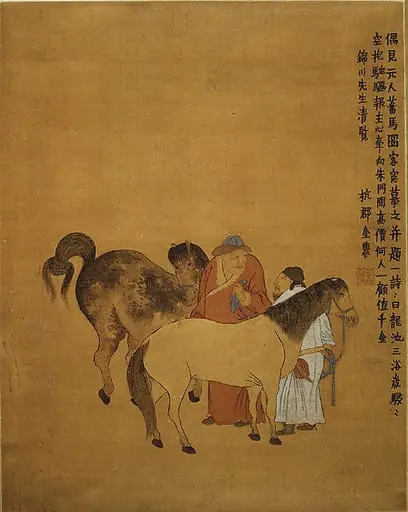
The handscroll portrays a moment in which a horse is being assessed by a man and a woman, as indicated by the title Judging a Horse and the depicted figures of horse, man, and woman. The composition centers on the animal, with the two observers positioned to examine its form and demeanor, suggesting an act of evaluation rather than a narrative scene. This focus on the horse’s qualities invites consideration of the animal’s symbolic associations with vigor, status, and proper selection within Chinese visual tradition, while the presence of both male and female figures may imply a shared or communal judgment.
Technique & Style
The work is a handscroll painted in ink and polychrome pigments on silk, measuring roughly 30.
The work is a handscroll painted in ink and polychrome pigments on silk, measuring roughly 30.5 cm in height and 102.9 cm in width, produced in China in 1639 (1,2). Its support is silk, typical of elite Ming‑Qing handscrolls, and the composition follows a narrative sequence in which a scholar evaluates a horse while a woman observes, rendered with controlled brushwork and subtle color washes that emphasize line and movement (1,2). The stylistic approach reflects the scholarly painting tradition associated with Zhao Mengfu, employing restrained ink outlines and layered color to convey texture and spatial depth (1,2). The current physical condition of the scroll is not documented in the available records (1,2).
History & Provenance
The handscroll titled Judging a Horse, traditionally attributed to Zhao Mengfu but executed by an anonymous artist in 1639, is held in the collection of the Metropolitan Museum of Art. The work, classified as a genre scene depicting horses and figures, measures 30.5 cm in height and 102.9 cm in width. While the source material confirms its location within the museum's holdings and provides its physical dimensions and date of creation, no specific inventory or accession number is cited in the available records.
Furthermore, the provided sources do not contain details regarding any past or future exhibitions featuring this specific scroll.
Context
The handscroll, executed in ink and color on silk and dated 1639, belongs to the horse‑painting genre and depicts a horse together with a man and a woman. Its style is linked to the tradition of Zhao Mengfu, whose legacy persisted into the Ming‑Qing period and informed later scholarly interpretations of the work as a continuation of that lineage. The piece is part of the Metropolitan Museum of Art collection, documented as a Chinese painting of anonymous authorship, and its dimensions and provenance are recorded in museum records.
Art historians regard it as an important example for studying the transmission of Song‑Yuan horse imagery into later Chinese art, underscoring its relevance in both Chinese and Western scholarship.
Legacy
The handscroll Judging a Horse, dated 1639 and attributed to an anonymous follower of Zhao Mengfu, entered the Metropolitan Museum of Art collection and is documented as a key example of Qing‑era horse painting. Its composition, depicting a horse alongside a man and woman, helped revive the Song‑Ming tradition of equine portraiture and influenced later East Asian works that emphasized dynamic animal movement and narrative detail. Scholars cite the piece as a benchmark for the anonymous school’s role in preserving Zhao Mengfu’s stylistic legacy, shaping subsequent artistic approaches to horse subjects in Chinese and Japanese painting.
The work’s provenance and display at the Met have reinforced its reputation as a pivotal reference for studies of later Chinese art.
Overview
This handscroll, titled Judging a Horse, is an anonymous painting from the Ming or Qing dynasty. Executed with ink and color on silk, it presents a detailed genre scene. The artwork depicts two figures engaged in the careful examination of a horse, a common subject in Chinese art that highlights the animal's importance and the connoisseurship involved in its assessment.
Artist & collection

Artist
Zhao Mengfu (Chinese: 趙孟頫; pinyin: Zhào Mèngfǔ; Wade–Giles: Chao Meng-fu; courtesy name Zi'ang (子昂); pseudonyms Songxue (松雪, "Pine Snow"), Oubo (鷗波, "Gull Waves"), and Shuijing-gong Dao-ren (水精宮道人, "Master of the Water…