The Renaissance period is usually told as a triumph of ideas. Humanism, the recovery of antiquity, a new confidence in the dignity of the human body. That account is true and it is incomplete. The claim of this essay is narrower and more physical: the style we now recognize as Renaissance was made with the hands before it was thought through with the head. It was built out of gypsum and animal glue, ground pigment suspended in walnut and linseed oil, ruled vanishing lines and cartoons pricked with a pin. Method came first. The famous calm followed from it.
Read the period through its materials and the standard sequence reorganizes itself. Linear perspective was a drafting procedure before it became a philosophy of space. The move from egg tempera to oil was a change in what paint could be asked to do, not a change of belief. The poised symmetry that the Tate defines as the High Renaissance, reached in the short window from about 1500 to 1530 in Leonardo, Michelangelo and Raphael, was the visible payoff of a workshop economy that had spent a century sharpening its instruments. The argument here is that you cannot separate the look of a Raphael Madonna from the prepared ground beneath it, the underdrawing inside it, and the apprentices who mixed its blues. Style, in this period, is a record of procedure.
The panel before the picture
Almost everything that reads as Renaissance luminosity begins with surfaces the viewer never sees. A fifteenth-century Italian panel painting started as seasoned poplar, planed and joined, then sealed with size and coated with gesso: gypsum or chalk bound in dilute glue, brushed on in many thin layers and scraped down to an ivory smoothness harder than the wood itself. This ground was not neutral. Its brilliance is what let thin paint glow, because light passed through the color, struck the white below, and came back to the eye. The picture's later radiance was loaded into it before the first figure was drawn.
The Getty Conservation Institute's survey of historical methods shows how literally these recipes were followed across the period, from ground preparation to binders to the layered application of glazes, a chain of operations each painter inherited rather than invented. That inheritance matters. The Getty's documentation of studio practice makes plain that a Renaissance master was a manager of a process, not a lone genius improvising on a blank field. The blank field had already been engineered. North of the Alps, where painters worked on oak rather than poplar, the same logic held with different timber, and the smoother, denser northern grounds suited the microscopic detail that Flemish oil technique would push to its limit.
Perspective as a tool, not a theory
Single-point perspective is the period's signature, and it is easy to mystify. In the workshop it was a construction kit. The painter fixed a horizon, chose a vanishing point, and ran orthogonals back to it so that floor tiles, ceiling coffers and the edges of buildings all converged on the same spot. Foreshortening, the rate at which receding intervals shrink, could be set with a ruler and a simple geometric scheme. Once the cartoon was drawn at full scale, its outlines were pricked and pounced, dusting charcoal through the holes onto the prepared ground, or incised directly with a stylus. Many Renaissance panels still carry those incised lines under raking light. The illusion of deep, measured space was a manual transfer.
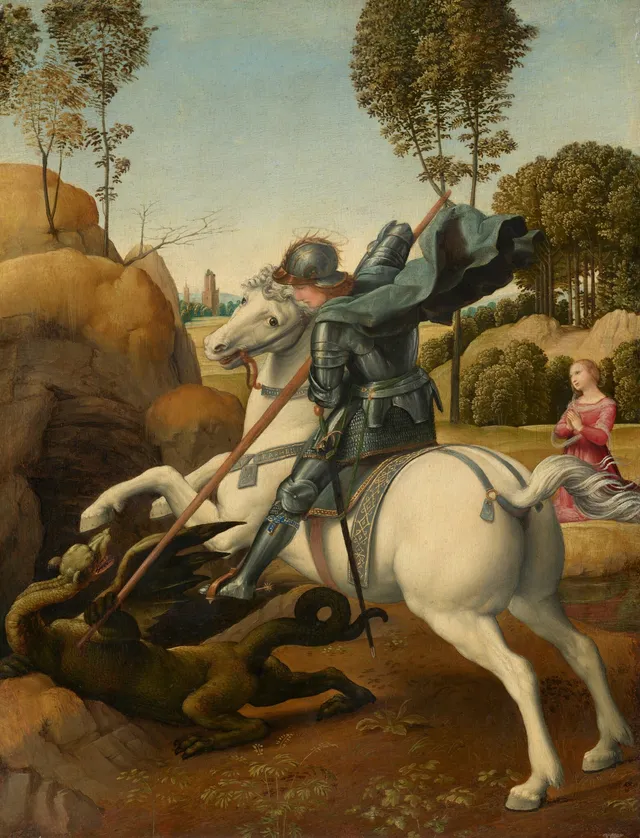
What makes the great pictures great is the disobedience inside the method. A painter who could build a flawless box learned exactly when to bend it. Look at Raphael's small panel of Saint George and the Dragon. The action is compressed into a shallow stage, the horse wheeling, the lance already snapped, and Raphael lets the diagonal of the spear and the twist of the horse's neck do the spatial work that a deep architectural recession would do elsewhere. The rules are there to be broken on purpose. That is the difference between a draftsman and Raphael, whose ninety-odd works in this archive let you watch the system become second nature.
Looking at The Harvesters
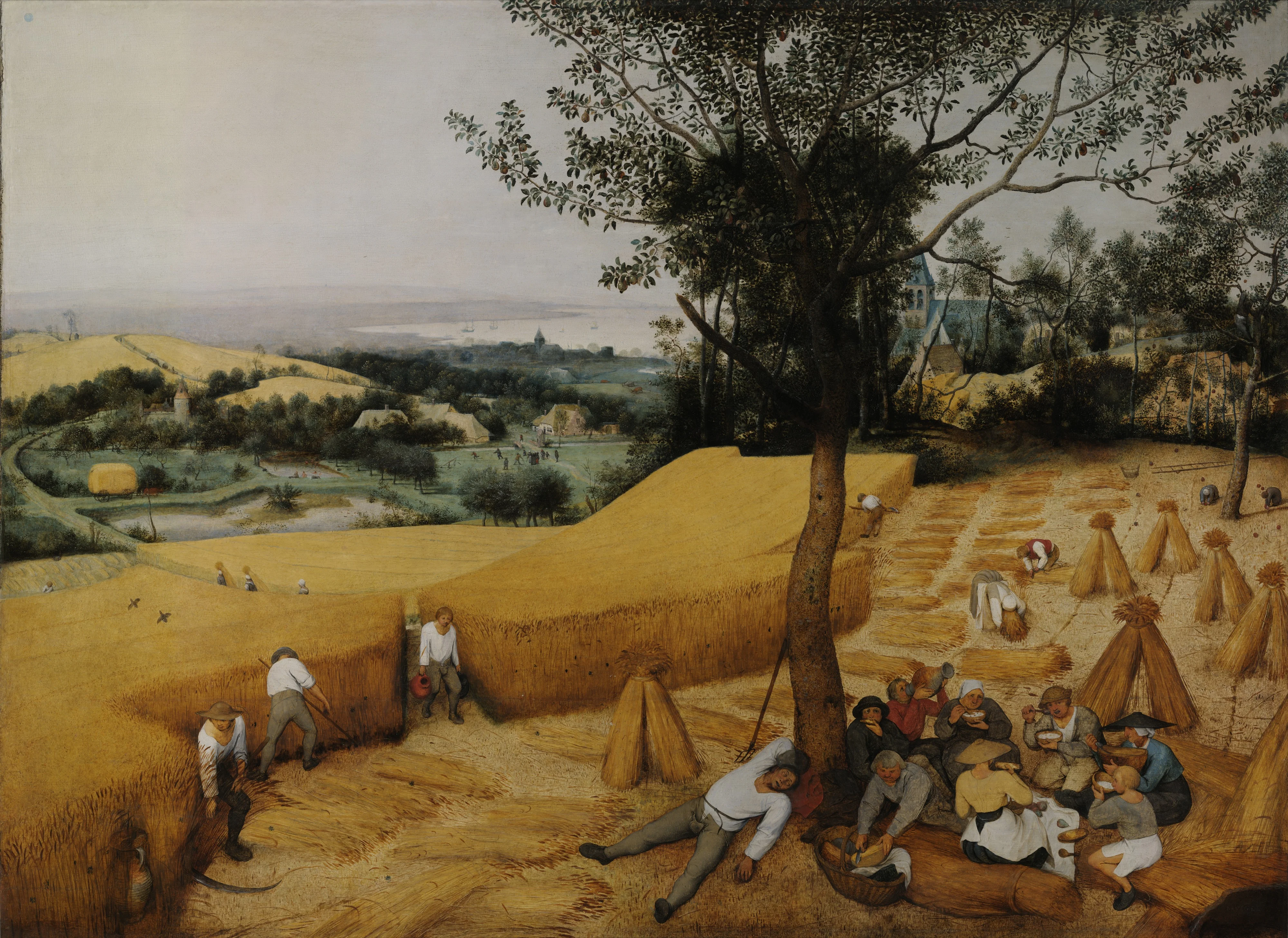
For a different kind of mastery, stand in front of Pieter Brueghel the Elder's The Harvesters of 1565, painted on oak as one of a cycle marking the turning year. The first thing the eye meets is the wheat. Brueghel sets a wall of ripe grain across the right foreground, brushed in warm ochres and dry yellows, and then cuts a narrow path straight through it, a pale wedge that pulls you into the field at the very moment the standing crop threatens to block the way. Workers reap along that edge while others rest under a single pear tree at the center, the one vertical that holds the whole horizontal painting together.
Then comes the close looking that rewards the trip. Beneath the tree a man lies flat on his back, mouth open, legs splayed, his shirt rucked up, asleep in the heat while his neighbors tear at bread and pears. Brueghel paints fatigue, not pastoral idyll. He withholds the usual deep golden distance and instead tips the horizon high, so the land climbs the panel and a hazy green bay with tiny ships sits near the top like a thing glimpsed, not entered. The composition refuses the tidy converging grid an Italian would have used. The recession is built from overlapping bands of color and from human scale shrinking by stages: foreground reapers, mid-ground sheaves, far-off figures the size of a thumbnail. It is perspective by atmosphere and by labor, a northern solution to the same problem of depth, and it is wholly convincing.
This is the lesson the corpus keeps teaching. The Renaissance was not one method but a family of methods, regionally adapted. Brueghel owes his deep space to oil paint and Flemish observation rather than to Florentine geometry, and the result holds its own against any ruled Italian floor.
Oil, glaze, and the slow light
The technical hinge of the period is the spread of oil paint. Egg tempera, the older medium, dries fast and lays down in short, hatched strokes; it gives crisp line and a slightly chalky finish, and it does not blend wet into wet for long. Oil dries slowly. That single property changed everything downstream. A painter could now model a cheek by softening one passage into the next over hours, build form in translucent layers, and lay a final glaze, a film of pigment-rich oil, over a lighter underpaint so the color seemed to be lit from within. The transition was gradual and overlapping. Many panels are mixed, tempera underpainting carried to finish in oil, and the dividing line scholars draw is cleaner than the studio ever was.
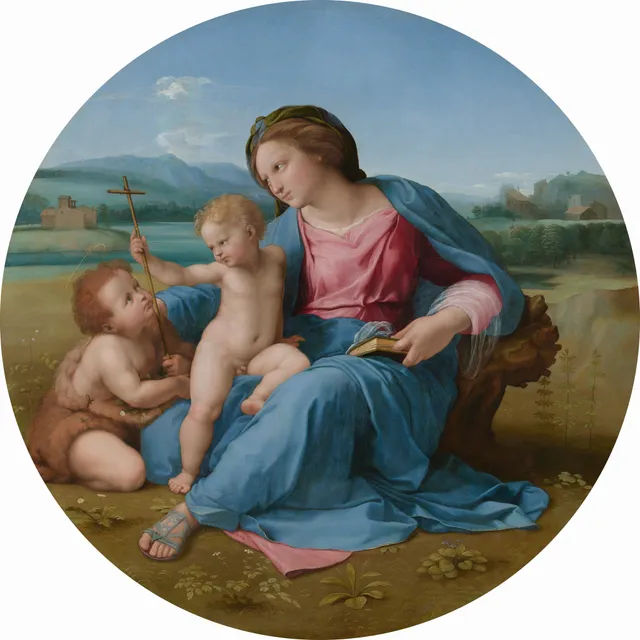
Raphael's The Alba Madonna, a tondo, shows what the slow medium buys. The Virgin's blue mantle is not a flat shape but a graded body of color, deepening into shadow where the cloth folds and lifting toward the knee where the light falls, the kind of continuous modeling oil makes possible and tempera resists. The round format forces every line into a controlled curve, and Raphael answers with a composition of linked arcs, the figures settling into the circle as if it were the only natural shape for them. The serenity people praise in this picture is, in part, a property of the binder.
Venice took oil furthest. There the panel gave way to canvas, a support better suited to the city's damp and to large commissions, and the weave of the cloth became part of the surface. Titian, whose work runs to more than a hundred and seventy pieces here, built late paintings out of loaded, broken brushwork that resolves only at a distance, paint handled as a substance with its own weather. Paolo Veronese used the same medium for the opposite end: vast, light-filled feasts where silver, rose and pale gold sit side by side without muddying. The Venetian preference for color built up in glazes, against the Florentine preference for drawn contour, is one of the real fault lines of the period, and it is at bottom a disagreement about materials.
What the medium permits, a temperament can stretch. El Greco, trained in Venice and Rome before he settled in Toledo, takes oil's capacity for glaze and elongation somewhere stranger. His Saint Martin and the Beggar stretches both figures and the white horse into a cold, silvered vertical, the paint thin and nervous, the light unnatural. He is using High Renaissance technique to leave the High Renaissance behind, which is how Mannerism begins.
The workshop as a system
The single most misleading word in popular accounts of the period is genius, because it hides the institution that produced the work: the bottega. A master ran a shop. Apprentices ground pigments, prepared panels, copied drawings and painted subordinate passages of drapery and background; the master reserved heads, hands and the design. Contracts specified how much of a picture the master's own hand would touch, and how much gold and ultramarine, the costly blue from lapis lazuli, the patron would pay for. Price was partly a function of material. A more expensive blue was a more expensive painting, written into the agreement before a brush was lifted.
We know the texture of these careers because the period produced its own historian. Giorgio Vasari, himself a working painter and architect, published his Lives of the Most Excellent Painters, Sculptors, and Architects in 1550 and again, enlarged, in 1568, and it remains the primary contemporaneous source for who trained whom and how. Vasari is also the man who gave the era its name, using the Italian rinascita, rebirth, to describe what he saw as art's recovery after the long medieval decline. His scheme is partisan, Florence-centered and not always reliable on dates, yet it encodes the workshop logic of lineage and influence that actually structured the trade.
That workshop discipline shows even in pictures we cannot attribute. The archive holds a panel by an unknown hand, Giacomo and Cardinal Marco investing Andrea, Abbot of San Zeno, a documentary record of a ceremony of office. No famous name attaches to it, and it is still built with the period's tools: ordered figures, legible space, the dignity of the human form treated as a given. Method, not celebrity, made the style portable. A Madonna and Child catalogued only as Italian 16th Century carries the same competence, which is exactly the point. The procedures were teachable, and they were taught.
What the corpus shows
Scholars argue about the period's boundaries, and the disagreement is instructive. The English word comes from the French for rebirth and, on the Tate's account, names the great revival of art in Italy from about 1400 under the influence of rediscovered classical culture. Wikipedia's survey notes the term is dated variously, from the fourteenth century to the seventeenth, or more narrowly to just the fifteenth and sixteenth. A tight scholarly window and a loose popular one have always coexisted.
Our own holdings make that elasticity measurable. Artifact World Gallery holds 20,458 works tagged Renaissance, drawn from 153 venues and produced by 2,232 named hands, with attached dates running from roughly 1100 all the way to 1995. The early and late edges are not errors so much as evidence: medieval precursors swept in at one end, and at the other, revivals, copies and works held in collections that catalogue by style as much as by strict chronology. The lesson is the one the materials already taught. Renaissance is at least as much a way of making, a set of inherited procedures, as it is a fixed span of years, which is why the label keeps reaching backward and forward past the textbook dates.
Works discussed in this article
The period's reach was never confined to painting, either. The Met's Heilbrunn essays treat Renaissance music as a parallel flowering, with its own theory of proportion and consonance, and the analogy is more than decorative. The same culture that calibrated harmonic ratios calibrated the intervals of a tiled floor receding into depth. Proportion was the shared instrument across the arts, applied with rulers in one workshop and with monochords in another.
Why the making still matters
The interpretation that fixed the period in the modern imagination, Jacob Burckhardt's study of 1860, treated the Renaissance as the birth of the individual and the modern mind, and it remains a foundational text. It is also a nineteenth-century book, and its emphasis on consciousness over craft helped produce the very mystification this essay resists. The corrective is not to deny the ideas. It is to put them back on the bench where they were realized. The dignity of the human figure is a real ambition, and it was achieved through the prepared ground, the pricked cartoon, the slow glaze and the divided labor of the shop.
Look once more at the smaller talents who never sat for Vasari. Lorenzo Lotto, with his fifty works here, painted portraits whose nervy psychological edge is inseparable from his cool, exact oil handling, and Fra Bartolomeo built monumental altarpieces from the same Florentine drawing discipline that produced Raphael. They were not lesser minds working from inferior ideas. They were working from the same materials and the same methods, which is why their pictures still cohere as a style five centuries on.
When the Venetian way of building a picture out of color rather than line passed into the seventeenth century, it became the engine of the Baroque, and El Greco's stretched figures point toward the deliberate strain of Mannerism. Neither successor invented its tools. Both inherited a shop, a binder and a way of preparing a surface, and changed what they asked the inheritance to say. That is the truest measure of the Renaissance achievement. It did not just leave masterpieces. It left a working method robust enough for the next two centuries to argue with.
So return to the field in The Harvesters and the path Brueghel cut through the standing grain. Someone reaped that wedge so the rest could be carried out. The painting is, among other things, a picture of labor making a way through abundance, and that is also a fair description of how the style itself was built: patiently, by hand, one prepared surface at a time, until the way through was clear enough for the next painter to follow.
Sources & further reading
- Renaissance, Art Term — Tate
- Renaissance Art — National Gallery of Art
- Historical Painting Techniques, Materials, and Studio Practice — Getty Conservation Institute
- Lives of the Most Excellent Painters, Sculptors, and Architects — Internet Archive (Giorgio Vasari)
- Renaissance — Wikipedia
- Music in the Renaissance — The Met, Heilbrunn Timeline of Art History
- The Civilization of the Renaissance in Italy — Wikipedia