Artist
Ernest Meissonier
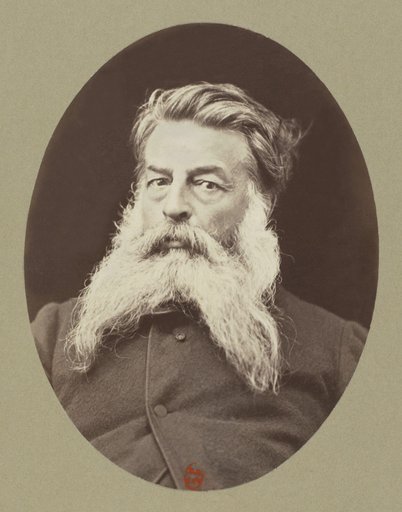
France
Ernest Meissonier is a France Academic Art artist. 38 works are cataloged here, principally at Cleveland Museum of Art.
Jean-Louis-Ernest Meissonier was a French academic painter and sculptor. He became famous for his depictions of Napoleon and his military sieges and manoeuvres in paintings acclaimed both for the artist's mastery of fine detail and his assiduous craftsmanship. The English art critic John Ruskin examined his work at length under a magnifying glass, "marvelling at Meissonier's manual dexterity and eye for fascinating minutiae." Meissonier enjoyed great success in his lifetime, becoming, with Gérôme and Cabanel, one of "the three most successful artists of the Second Empire."
Overview
Jean-Louis-Ernest Meissonier (21 February 1815-31 January 1891) was a French academic painter and sculptor who became one of the most celebrated and commercially successful artists of the Second Empire. Renowned for his microscopic precision in oil painting, he specialized in two distinct genres: intimate historical genre scenes depicting seventeenth- and eighteenth-century bourgeois life, and meticulously researched military subjects, particularly Napoleonic and contemporary campaigns. His works commanded enormous prices during his lifetime, and he was grouped with Jean-Léon Gérôme and Alexandre Cabanel as one of "the three most successful artists of the Second Empire. monument to academic art's emphasis on technical virtuosity and historical authenticity, though his reputation later suffered from modernist critiques of his conservative approach.
Biography & dates
Meissonier was born in Lyon on 21 February 1815, the son of Charles Meissonier, a prosperous dye-factory owner in Saint-Denis, north of Paris. The family relocated to Paris when Ernest was three. Despite paternal expectations that he enter the dye business, for which he was briefly apprenticed to a druggist on the Rue des Lombards, Meissonier's early sketches from 1823 demonstrated his artistic inclination. At age seventeen, around 1832, he obtained permission to pursue art, studying first under the drawing master Jules Potier, who arranged a brief stint of about five months in Léon Cogniet's studio. He also copied Dutch and Flemish masters in the Louvre, forming his style after their example. To support himself, Meissonier undertook extensive illustration work for publishers including Curmer, Hetzel, Dubocherhe, and Tony Johannot, producing images for editions of the Bible, works by Jacques-Bénigne Bossuet, Ludovico Ariosto's "Orlando Furioso," and Bernardin de Saint-Pierre's "Paul et Virginie" and "La Chaumière indienne." He married Emma Steinhel, sister of the painter Auguste Steinheil, in 1838; their children included Thérèse (born 1840) and Jean Charles (born 1848). In 1846 he purchased the Grande Maison in Poissy, which included winter and summer studios, and he later served as mayor of Poissy for one year. He was elected to the Académie des Beaux-Arts in 1861, succeeding Abel de Pujol, and subsequently served as president of the Institut de France and, in 1890, as the first president of the refounded Société Nationale des Beaux-Arts. He died on 31 January 1891 in his Paris mansion at 131 boulevard Malesherbes in the 17th arrondissement, built between 1874 and 1877 by architect Paul Boeswillwald, and was buried at the cemetery of La Tournelle in Poissy.
Style & movement
Meissonier operated firmly within the academic art movement, though he was not a product of the École des Beaux-Arts. His technique was distinguished by microscopic oil painting on small-scale canvases, a method that art critic John Ruskin examined under a magnifying glass, "marvelling at Meissonier's manual dexterity and eye for fascinating minutiae." His approach combined the detailed finish of seventeenth-century Dutch genre painters, particularly Gabriel Metsu, Gerard ter Borch, and Pieter de Hooch, with nineteenth-century documentary rigor in researching costumes, armor, and naturalistic observation. Théophile Gautier compared him to the Flemish masters for his evocation of period atmosphere. His subjects fell into two main categories: intimate genre scenes of bonshommes, or goodfellows, engaged in chess, card games, music-making, or smoking; and military-historical narratives. Critics such as Paul Mantz noted the apparent limitation of his repertoire, while others praised his elegant fabric painting and sharp, if cool, characterization. His working method involved extensive preparatory research, including the accumulation of a "work library" of costumes and accessories, anatomical studies at the Jardin des Plantes, and systematic analysis of horse movements. He also produced sculpture, largely in wax and plastic clay, as research tools for his paintings, describing his approach as that of "a sculptor, always seeking the relief."
Major works
Meissonier's Salon debut came in 1834 with Les Bourgeois Flamands (also known as The Visit to the Burgomaster), purchased by Sir Richard Wallace and now in the Wallace Collection, London, alongside fifteen other works by the artist. This inaugurated his series of miniature genre paintings in oils. Other significant early works include The Chess Player (1841), which earned a medal; The Smoker (1849); and The Quarrel (La Rixe, 1855), presented by Napoleon III to the English Court. His military commissions included The Emperor Napoleon III at Solferino (1864), which took more than three years to complete, and 1814 (1864). His most ambitious project was a series of Napoleonic battle scenes including Campaign of France, 1814 (1864), Friedland (1875, now in the Metropolitan Museum of Art), and 1805, the Cuirassiers before the Charge. He also depicted contemporary tragedy in Remembrance of Civil War (1848-49), based on his experience as a National Guard captain during the June Days, and Le Siège de Paris 1870-1871 (c. 1884). In 1874 he received a commission for a mural in the Panthéon, which he did not complete. His painting The Guard (La Garde, 1874) received favorable mention at the Salon. Works were acquired by major collectors including William Thompson Walters of Baltimore (now the Walters Art Museum) and William Vanderbilt of New York, through the Galerie Georges Petit, which represented him from the 1870s.
Influences & students
Meissonier's formative influences included the Dutch and Flemish masters he studied in the Louvre, particularly Gabriel Metsu, Gerard ter Borch, Pieter de Hooch, and Vermeer, as well as French artists such as Chardin, Gravelot, and Greuze. His early training under Jules Potier and brief association with Léon Cogniet provided institutional grounding, though he was largely self-taught through copying and book illustration. Among his artistic companions were Honoré Daumier and Charles-François Daubigny. He had relatively few pupils, but among them were his son Jean Charles Meissonier, Jean-Baptiste Édouard Detaille, who became known for his own military paintings, and the German painter Fritz Werner. Victor Geoffrey-Dechaume, a sculptor friend, reportedly directed Meissonier's work on small study figures in 1848. With historian Jules Michelet, he encouraged the landscape painter Paul Huet to seek admission to the Académie des Beaux-Arts, though unsuccessfully.
Legacy
Meissonier's posthumous reputation underwent significant fluctuation. During his lifetime, he enjoyed extraordinary success: Marcel Proust in adolescence, Guy de Maupassant, and Robert Louis Stevenson counted him among their favorite painters, and Eugène Delacroix and Vincent van Gogh admired his work. He received successive honors from the Legion of Honour: chevalier (1846), officier (1856), commandeur (1867), Grand officier (1880), and Grand Croix (1889). However, modernist critics later condemned his academic precision. Édouard Manet reportedly dismissed a battle painting with the remark that "everything is steel except the breastplates," and Edgar Degas coined the sobriquet "géant des nains" (giant of dwarfs), grouping him with painters later derided as "pompiers." The twentieth-century modernist critique relegated him to the margins of art history as a representative of outmoded academicism. His market remained strong during his lifetime, with works commanding enormous prices, though his extravagant spending on his Paris mansion and other properties left his heirs heavily in debt, leading to posthumous sales and the production of bronze casts from his wax sculptures to settle estates. The demolition inherited by his descendants. His three-dimensional work, largely unknown during his lifetime, has since been recognized for its contribution to nineteenth-century French historical genre and its demonstration of his empirical research methods.
Works by Ernest Meissonier
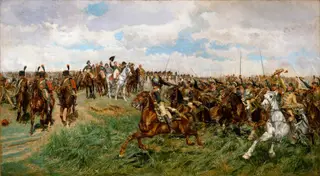 1807, Friedland
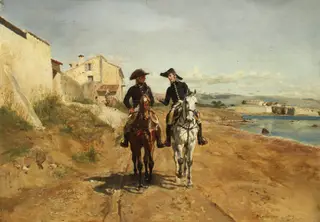 A General and His Aide-de-camp
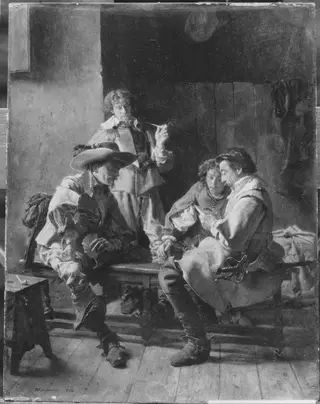 The Card Players
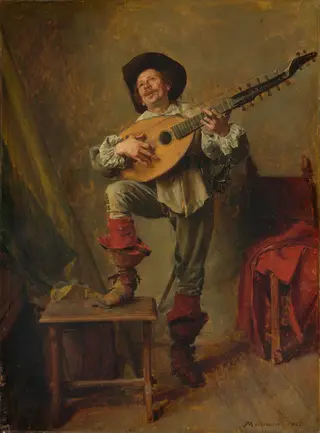 Soldier Playing the Theorbo
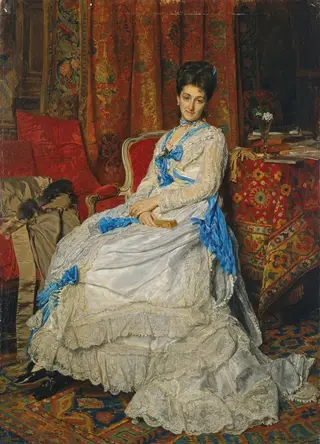 Josefa Manzanedo e Intentas de Mitjans, Second Marchioness of Manzanedo
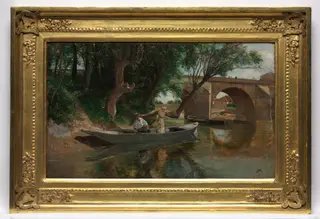 Bridge at Poissy (Pêcheurs à ligne)
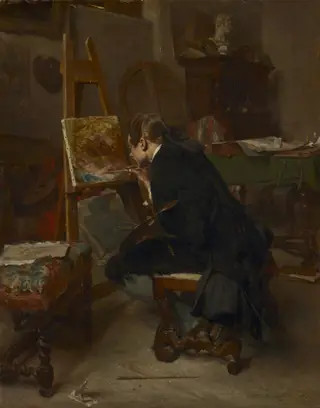 A Painter
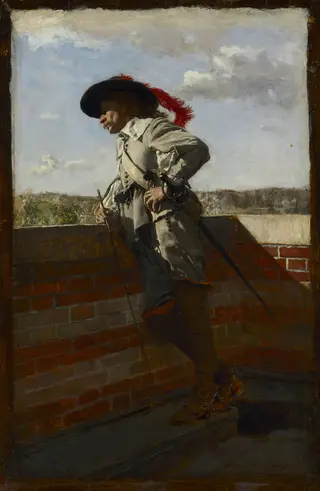 On a Terrace
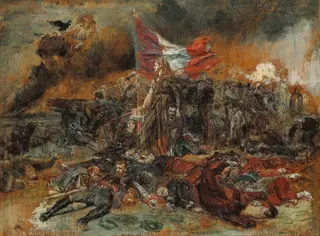 The Defense of Paris
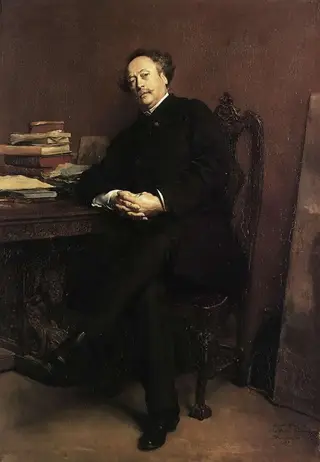 Alexandre Dumas son
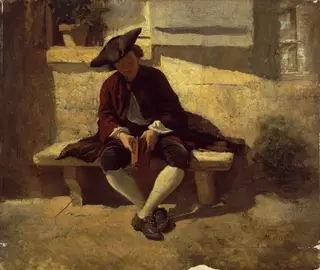 Young Man with a Book
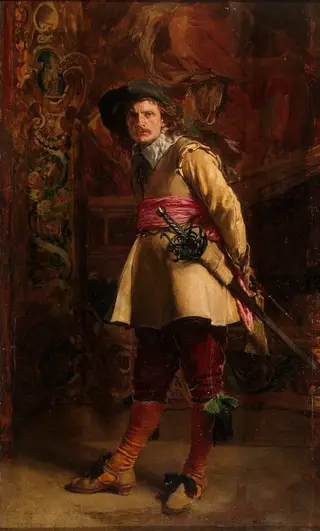 Musketeer
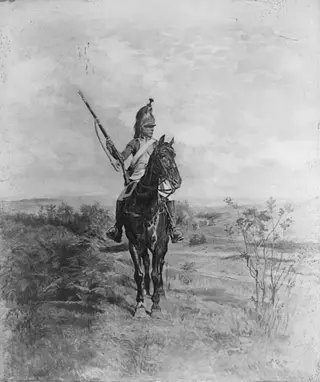 The Out-Post
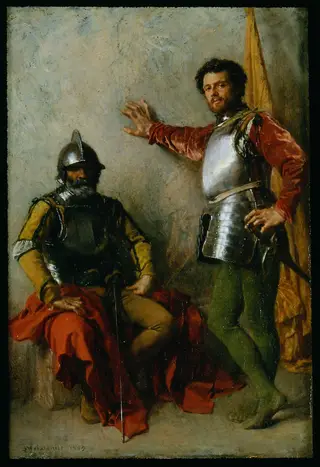 Two Soldiers
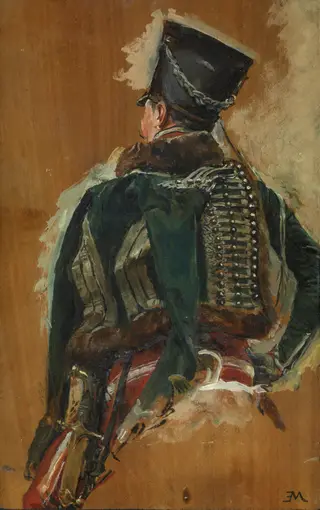 Cavalry Man
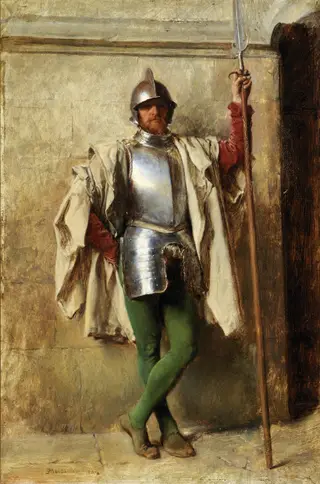 A Guard
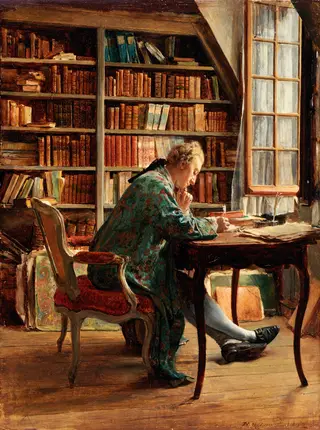 The Bibliophile
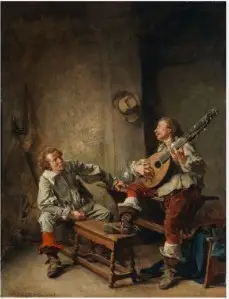 A Song
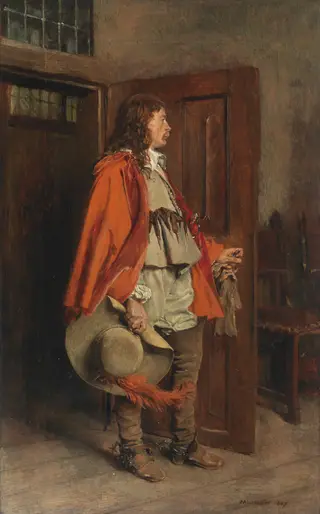 Man in a Red Cloak
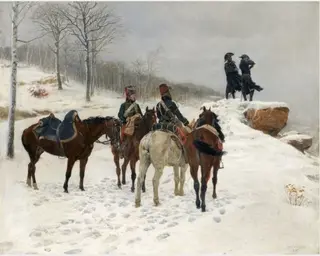 Group of Cavalry in the Snow: Moreau and Dessoles before Hohenlinden
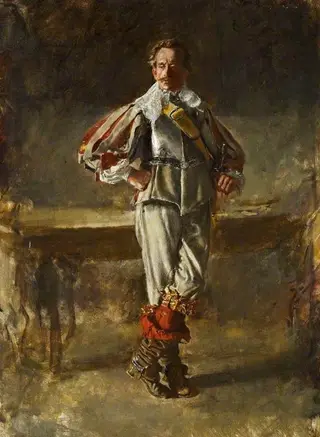 A Gentleman of the Reign of Louis XIII
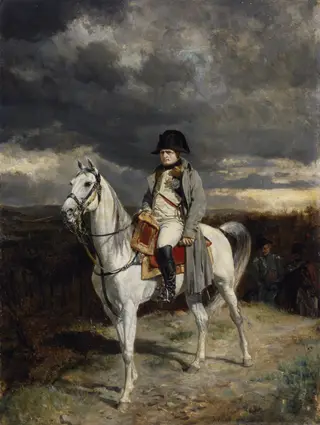 1814
1814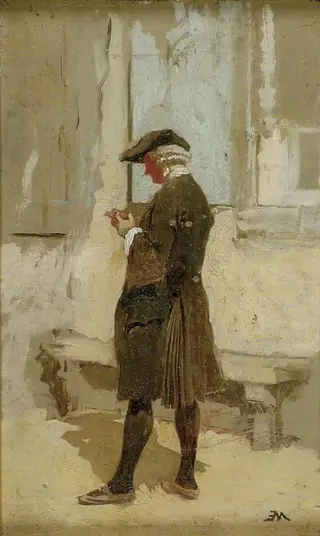 An Abbé
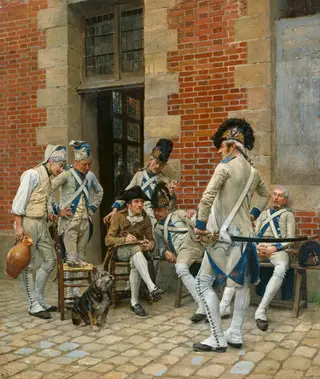 The Portrait of a Sergeant
38 works in the catalog · 24 shown
Collections represented


Artists in a similar vein