Artwork
The Bathers
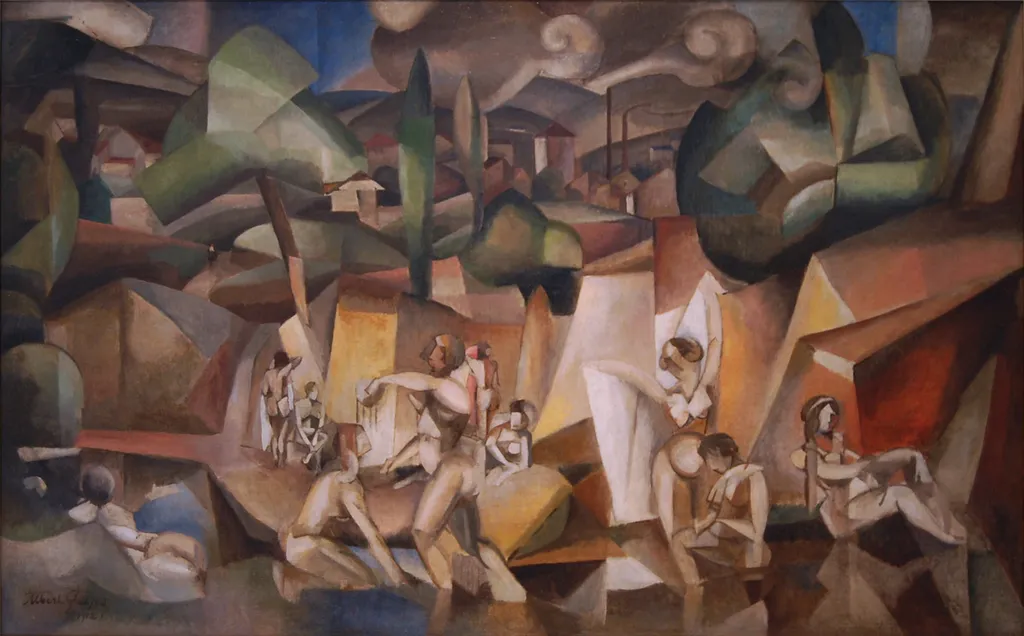
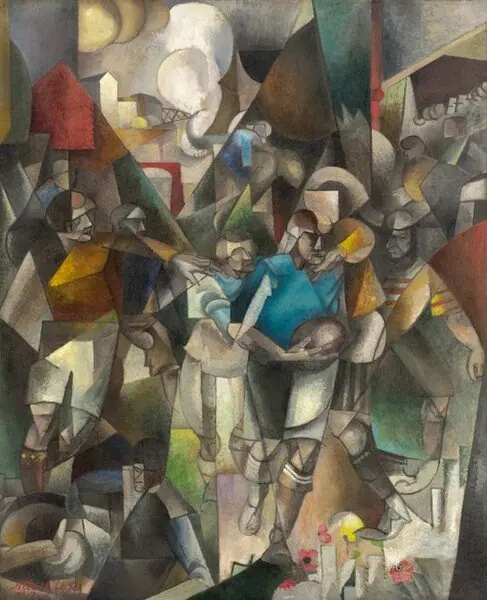
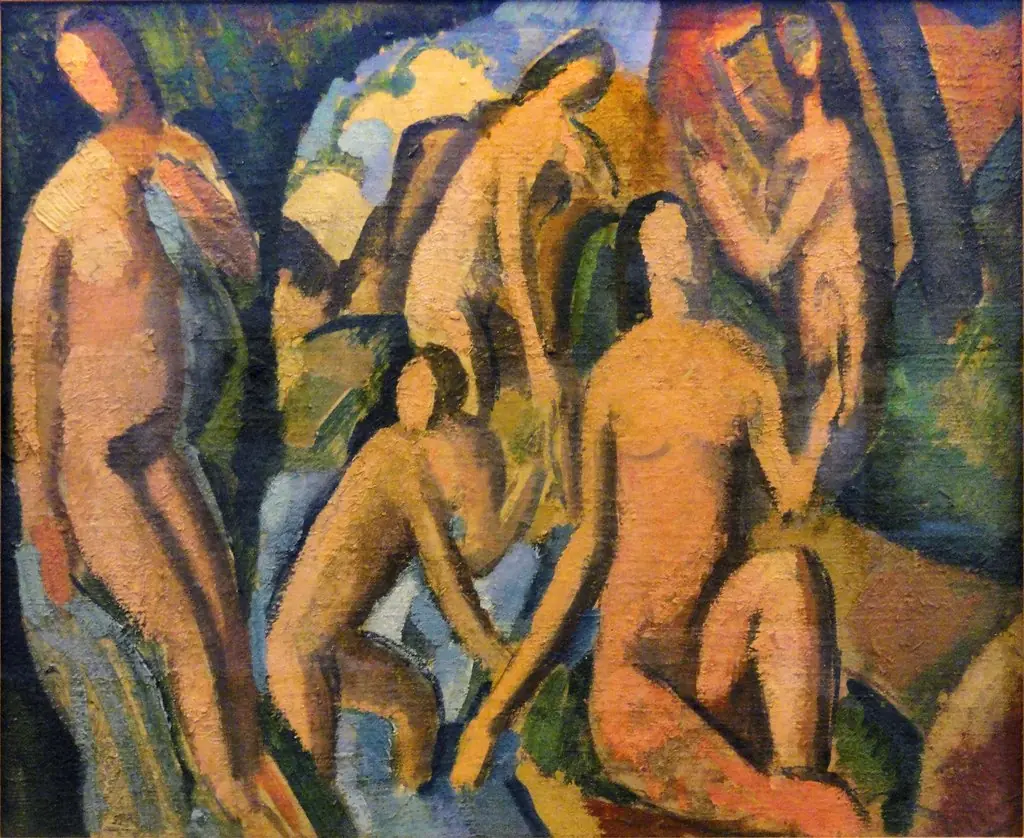
The Bathers is an oil painting by the Cubism Synthetic artist Albert Gleizes. It dates from 1912 and is held in the collection of the Musée d'art moderne de Paris.
About this work
The work was also reproduced in the book Du “Cubisme” that Gleizes co‑authored with Jean Metzinger, the first manifesto on Cubism.
The Bathers is a large oil painting by French artist Albert Gleizes, made in early 1912.
It was shown at the Salon des Indépendants in Paris in the spring of that year, then at the Salon de la Société Normande de Peinture Moderne in Rouen in the summer, and later at the Salon de la Section d'Or in the autumn. The work was also reproduced in the book Du “Cubisme” that Gleizes co‑authored with Jean Metzinger, the first manifesto on Cubism.
If you’re curious, check out Musée d'art moderne de Paris.
Overview
Albert Gleizes completed The Bathers, a large oil on canvas, in early 1912. The work presents a group of nude figures within a landscape, rendered through a fragmented, multi‑view approach that still allows the scene to be recognized. It exemplifies Gleizes’s early Cubist experiments, balancing abstraction with a lingering sense of the human form.
Technique & Style
The composition employs the Cubist strategy of simultaneous perspective, breaking the figures and surrounding space into interlocking planes that shift in orientation. Gleizes’s handling of color and brushwork reinforces a sense of motion, while the overall structure remains coherent, reflecting a personal adaptation of the theoretical principles outlined in the Section d’Or circle.
History & Provenance
After its completion, the painting was shown at three major Parisian venues in 1912: the Salon des Indépendants in spring, the Salon de la Société Normande de Peinture Moderne in Rouen during summer, and the Salon de la Section d’Or in autumn. It was reproduced in the 1912 publication Du « Cubisme », co‑written by Gleizes and Jean Metzinger, and entered the Musée d’Art Moderne de la Ville de Paris in 1937, where it remains on permanent display.
Context
The Bathers emerged at a moment when Cubism was coalescing into a more systematic doctrine, particularly within the Section d’Or group. Gleizes’s work illustrates the transition from the earlier, more literal Cubist experiments toward a language of form that could convey multiple viewpoints and temporal simultaneity, aligning with the theoretical discourse of the period.
Legacy
As an early example of the Section d’Or’s mature Cubist language, the painting has been cited in scholarly discussions of the movement’s evolution. Its inclusion in Du « Cubisme » helped disseminate the ideas of simultaneity and dynamic fragmentation, influencing subsequent artists who sought to integrate representational content within an abstracted visual framework.
Artist & collection

Artist
Albert Gleizes was a French artist, theoretician, philosopher, a self-proclaimed founder of Cubism and an influence on the School of Paris.