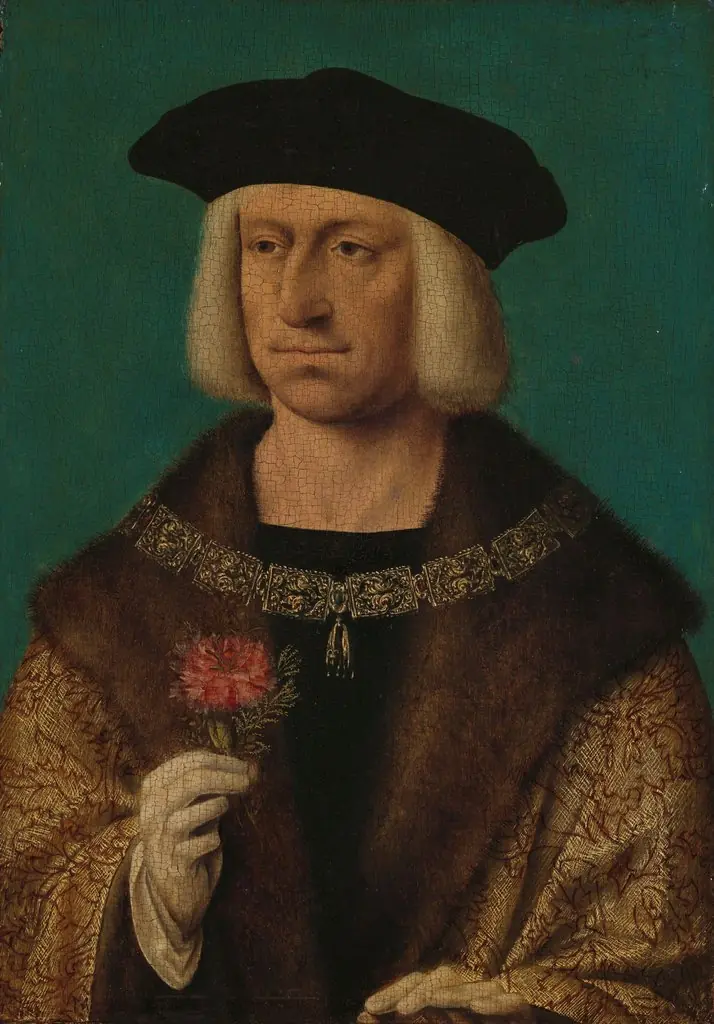
Artwork
Emperor Maximilian I
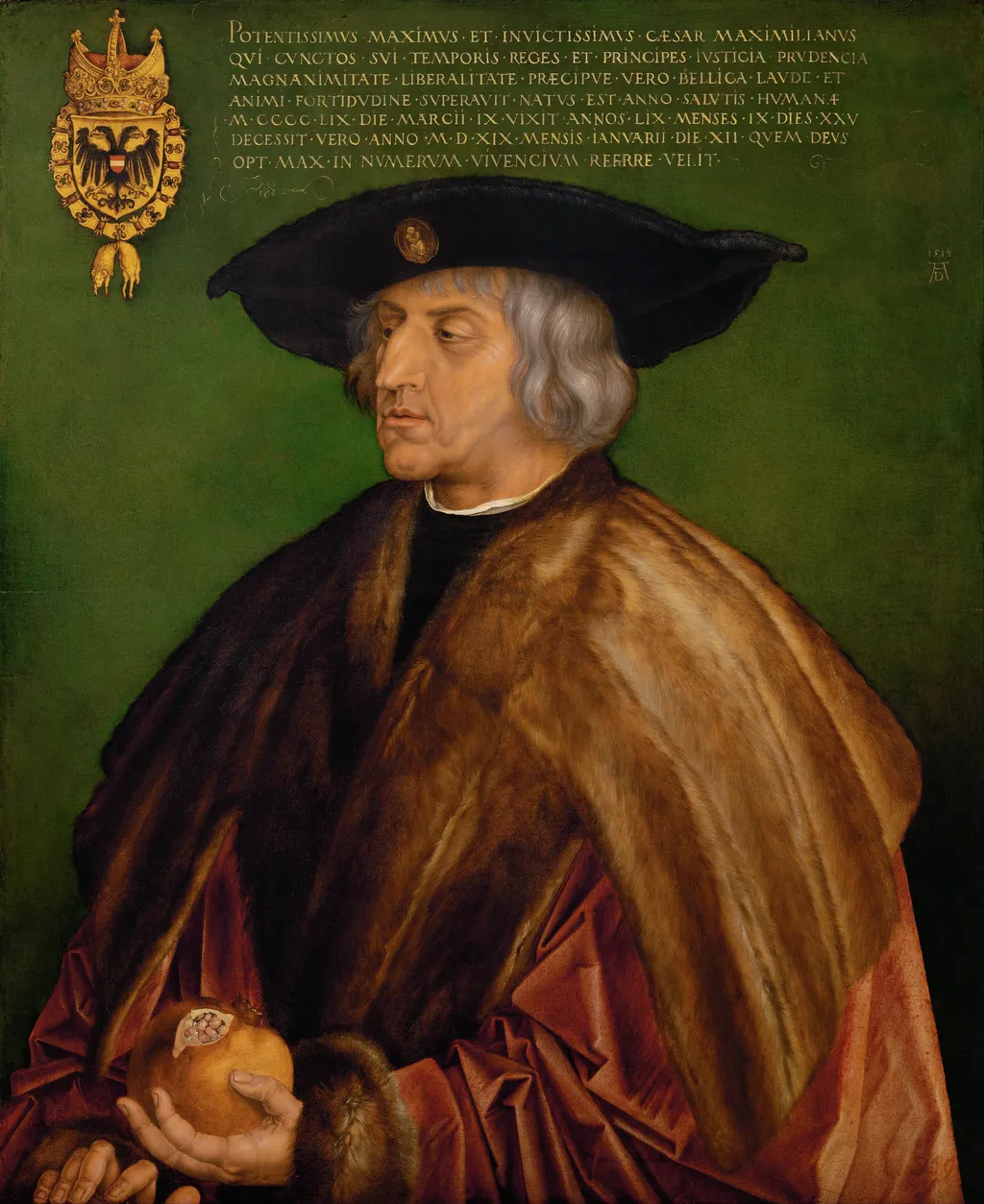
Emperor Maximilian I is an oil painting by the Northern Renaissance artist Albrecht Dürer. It dates from 1519 and is held in the collection of the Kunsthistorisches Museum.
About this work
Subject & Meaning
This posthumous portrait depicts Maximilian I, Holy Roman Emperor, based on a drawing Dürer made during a private sitting in Augsburg in June 1518.
This posthumous portrait depicts Maximilian I, Holy Roman Emperor, based on a drawing Dürer made during a private sitting in Augsburg in June 1518. The emperor is shown in a three-quarters view against a green background, wearing a fur-collared gown and a broad-brimmed hat. His left hand holds a large pomegranate, his personal emblem symbolizing the Holy Roman Empire; its many seeds represent diverse subjects united under one ruler, while its hidden sweetness reflects the emperor's concealed virtues.
In the upper left corner, the Habsburg coat of arms appears alongside the chain of the Order of the Golden Fleece. A lengthy Latin inscription enumerates Maximilian's titles and deeds, praising his justice, magnanimity, and military prowess while recording his birth and death dates. The work functions as both a realistic likeness and a piece of imperial propaganda, synthesizing political authority with anagogical meaning.
Technique & Style
Executed in 1519, this portrait is an oil painting on a lime wood panel measuring 74 by 61.5 cm. The work was created posthumously based on a preparatory pencil drawing Dürer made from life in June 1518, though the final painted version includes slight variations from the initial study.
Stylistically, the emperor is depicted in a three-quarters view against a green background, with his arms resting on an unseen parapet at the lower edge, a compositional device borrowed from Early Netherlandish portraiture. Maximilian wears a gown featuring a wide fur collar and a broad-brimmed dark hat adorned with a central brooch. His aging face, framed by grey hair, displays an aristocratic detachment while holding a large pomegranate, his personal symbol representing imperial cohesion. The upper left corner features the Habsburg coat of arms, the chain of the Golden Fleece, and a lengthy Latin inscription detailing the emperor's titles and life dates.
History & Provenance
Albrecht Dürer first encountered Emperor Maximilian I in Nuremberg in 1512, leading to a commission for the massive Triumphal Arch woodcut. The specific portrait painting originated from a life sitting during the Diet of Augsburg, where Dürer sketched the emperor in his private quarters on June 28, 1518. Although based on this preparatory drawing, the oil-on-lime-panel work was executed in 1519, after Maximilian's death in January of that year. Consequently, the finished image includes posthumous variations and an inscription detailing the ruler's titles and dates of birth and death. This version, distinct from a related painting in Nuremberg and a woodcut print, entered the collection of the Kunsthistorisches Museum in Vienna.
The oil painting *Emperor Maximilian I* by Albrecht Dürer is held in the Kunsthistorisches Museum in Vienna, Austria. The work, completed in 1519, is part of the museum's permanent collection. The sources do not provide a specific inventory or accession number for the painting. While the text details the creation of the work following a 1518 sittings and its subsequent display in the museum, it does not list any specific past or future exhibition history for this particular panel.
Context
Scholars characterize this work as a synthesis of representational, political, and anagogical elements within the German Renaissance. Katherine Crawford Luber argues that Dürer's genius is evident in his ability to produce multiple versions, drawing, woodcut, and paintings, that maintain an unchanging structural core while varying details to suit different contexts. The portrait exemplifies the complex task of imperial imagery, transforming a specific sitting in Augsburg into a lasting symbol of authority. The work's historical significance is rooted in Dürer's earlier collaboration with Maximilian on the massive Triumphal Arch woodcut project, which established the artist as a key figure in the emperor's propaganda machine. Unlike the Nuremberg version, which emphasizes symbols of office, the Vienna panel presents a more intimate, posthumous reflection. The inclusion of Early Netherlandish features, such as the parapet, demonstrates Dürer's integration of broader European artistic traditions into his distinct style.
Legacy
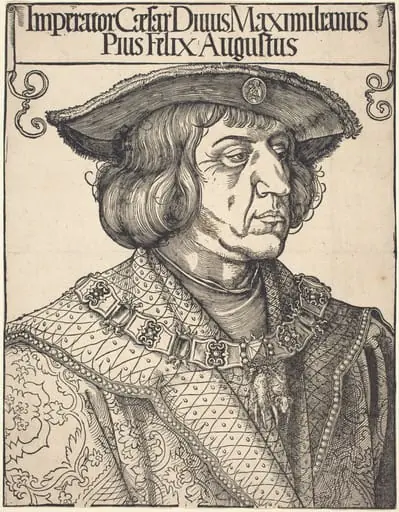
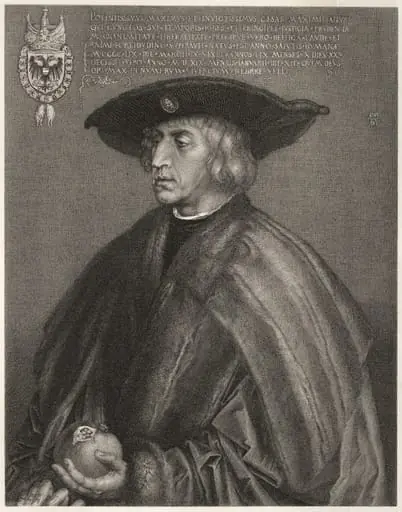
Dürer's portrait of Maximilian I is part of a unique group of imperial portraits, comprising a preparatory drawing, a woodcut, and two painted panels, in which Dürer synthesized the representational, political, and allegorical aspects of portraiture by repeating a single image while disguising the repetitions through subtle variations in costume and insignia. Katherine Crawford Luber has argued that this series bears testimony to Dürer's creative genius and his mastery of the complex task of imperial portraiture. The accompanying woodcut version of the portrait circulated widely during the early sixteenth century, both from the original block and from later copies, and a rare early impression preserved by the British Museum retains the name of its publisher, Johann Kramer. The painting itself remains in the Kunsthistorisches Museum in Vienna, where it continues to be exhibited as a key example of Dürer's late portraiture and of Habsburg visual propaganda.
Own this work as a print
Artist & collection
Artist
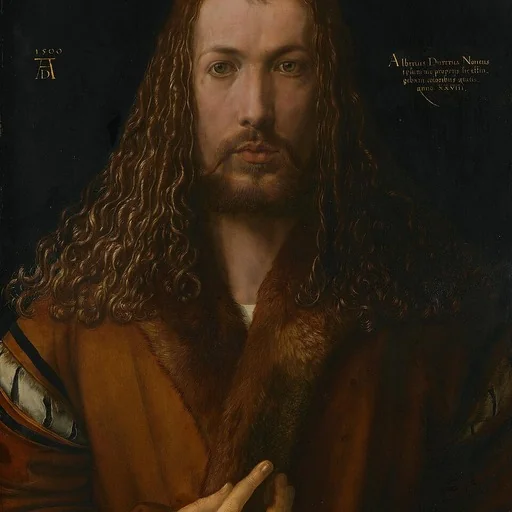
Albrecht Dürer spent his life in Nuremberg, a busy German city where artists traded prints like currency.

![Madonna and Child [obverse], by Albrecht Dürer](https://artifactworldgallery.com/img/albrecht-durer--madonna-and-child-obverse--d7b8ebf05d22ebe5-w320.webp)
![Lot and His Daughters [reverse], by Albrecht Dürer](https://artifactworldgallery.com/img/albrecht-durer--lot-and-his-daughters-reverse--b4ebf9b282faa17a-w320.webp)